AI optical module thermal management — 800G / 1.6T qualified
Ultra-soft TIF700UU pad and TIC800T-ST PCM-metal composite for next-gen 800G and 1.6T optical transceivers in AI data centers — 10 psi lower compression stress than the flagship competitor at 70% deflection, with stable thermal resistance after 1,000-hour aging.
Customer background
A global optical communication and AI interconnect solution provider specialising in high-speed optical modules for AI data centers, cloud computing infrastructure, and hyperscale networking equipment. Its products include 400G, 800G, and next-generation 1.6T optical transceivers used in GPU clusters, AI servers, and high-performance switches. As AI computing demand rapidly expanded, the customer experienced thermal limitations driven by higher power density, miniaturised packaging, and large-scale deployment in dense data-center racks.
Challenge 1
800G optical modules exceeded 50 W/cm² thermal density — traditional passive cooling could not maintain target DSP and laser temperatures.
Solution 1
TIF700UU's gel-like softness conforms to non-flat optical-module surfaces, filling micro air gaps even in QSFP-DD and OSFP envelopes where harder pads cannot deflect.
Challenge 2
QSFP-DD and OSFP compact packaging drastically reduced internal thermal dissipation space, leaving narrow assembly tolerances and minimal compression headroom for the TIM.
Solution 2
10 psi lower compression stress at 70% deflection means lasers and capacitors stay below their stress-crack threshold over the module's full service life.
Challenge 3
High-density rack deployment caused thermal-island effects — heat transfer between neighbouring modules pushed case temperatures above 60 °C.
Solution 3
TIC800T-ST PCM-metal composite at the cold-plate interface handles thousands of insertion / removal cycles without pump-out — purpose-built for hot-swappable optical-module bays.
Challenge 4
Excessive temperatures caused wavelength drift, increased bit error rates, and shortened laser lifespan — interface stress had to stay low to protect optical alignment.
Solution 4
Low-stress, low-modulus interface design keeps mechanical force off TOSA / ROSA laser packaging — protecting wavelength stability, lowering bit error rates, and extending laser service life.
Market context
AI data centers are rapidly transitioning from 400G to 800G and 1.6T optical interconnects. According to industry forecasts, the global AI optical transceiver market is expected to grow from USD 16.5 billion to USD 26 billion by 2026, driven by accelerated AI infrastructure deployment.
As optical module bandwidth increases, power consumption and heat generation rise significantly — making thermal management a critical factor in overall AI cluster performance.
Related industry overview: Thermal solutions for Data center & AI
The challenge
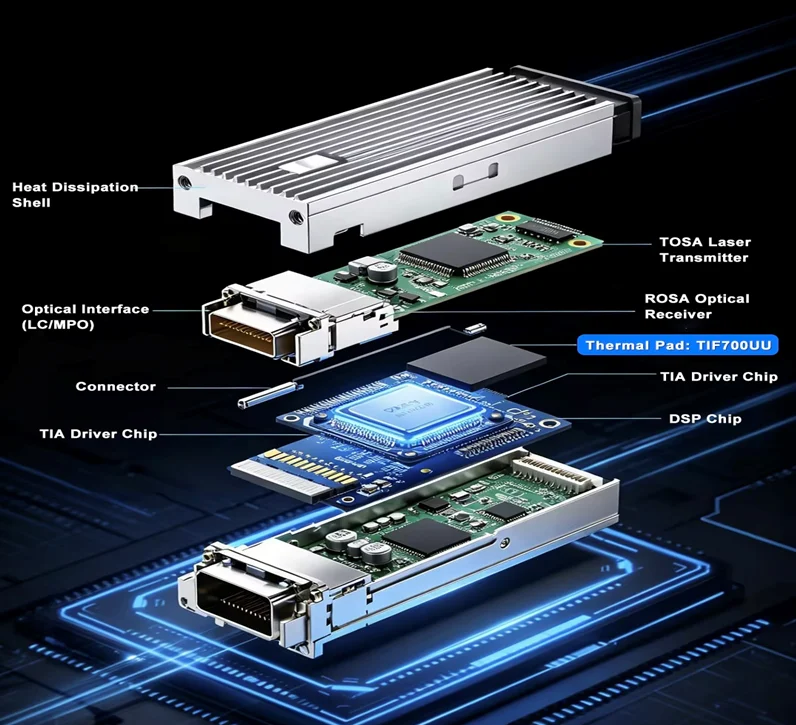
Exploded view of the 800G / 1.6T optical transceiver — the internal stack from optical cavity through DSP package to PCB defines where TIM has to fit and which components are most stress-sensitive.
The customer encountered three converging issues: rising thermal density, shrinking package dimensions, and severe thermal accumulation inside high-density racks. Traditional thermal pads could not maintain low thermal resistance under high compression conditions, while rigid materials introduced excessive mechanical stress on optical devices and capacitors.
Specifically:
- 800G optical modules exceeded 50 W/cm² thermal density, overwhelming traditional passive cooling.
- QSFP-DD and OSFP compact packaging drastically reduced internal thermal dissipation space.
- High-density rack deployment created severe thermal-island effects, with heat transferring between neighbouring modules and pushing case temperatures above 60 °C.
- Excessive temperatures caused wavelength drift, increased bit error rates, and shortened laser lifespan.
Thermal solution design
Ziitek recommended TIF700UU ultra-soft thermal interface material for internal optical-module cooling. Its gel-like softness allows excellent surface conformity and low contact thermal resistance even in narrow assembly spaces. For liquid-cooled external interfaces, TIC800T-ST PCM-metal composite components were introduced to improve durability during repeated insertion and removal cycles.
| Position | Ziitek product | Why |
|---|---|---|
| DSP / laser interface (inside module) | TIF700UU ultra-soft pad | Gel-like softness fills micro air gaps in QSFP-DD / OSFP envelopes; 10 psi lower stress at 70 % compression than competitor |
| Cold-plate interface (external) | TIC800T-ST PCM-metal composite | Carrier-supported PCM survives repeated insertion / removal in hot-swappable bays |
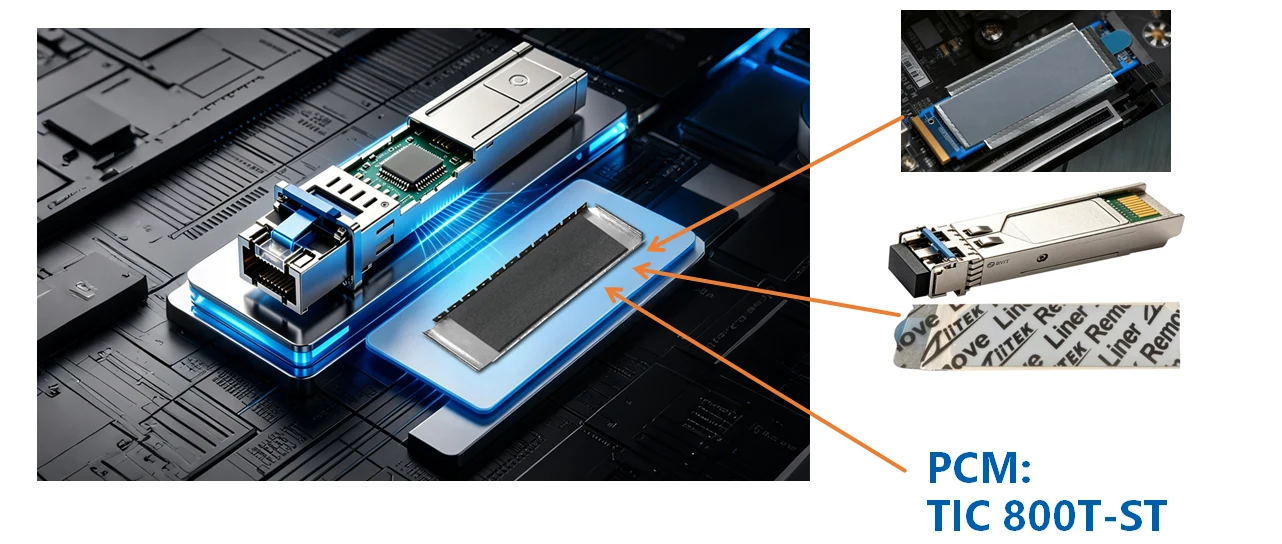
Close-up of cold-plate interface — TIC800T-ST PCM-metal composite engineered for hot-swappable optical-module bays.
Performance validation
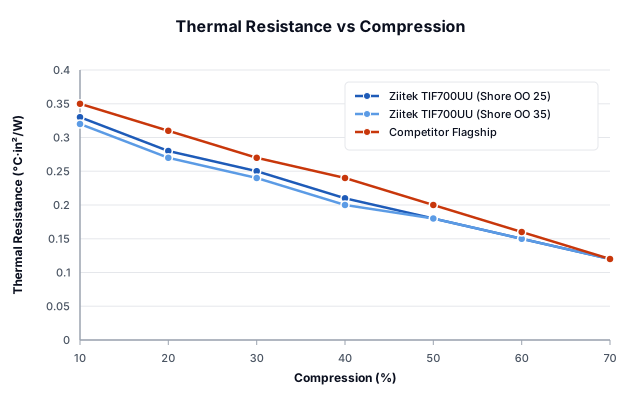
Testing demonstrated that the TIF700UU series delivered lower thermal resistance than the competitor's flagship product under all compression conditions. At 70 % compression, pressure values remained approximately 10 psi lower than the competitor's material, reducing stress on sensitive components. The material also maintained stable performance after 1,000-hour aging tests at 85 °C without thermal degradation.
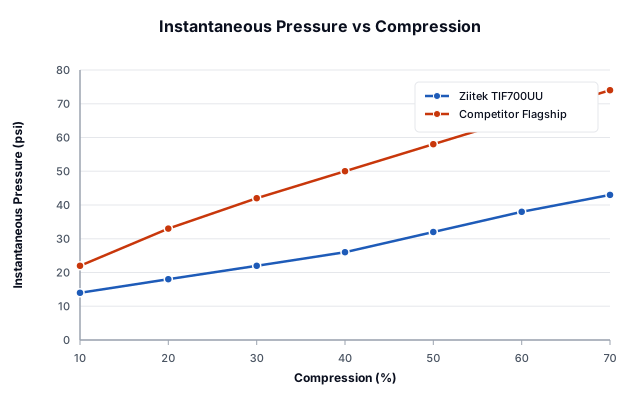
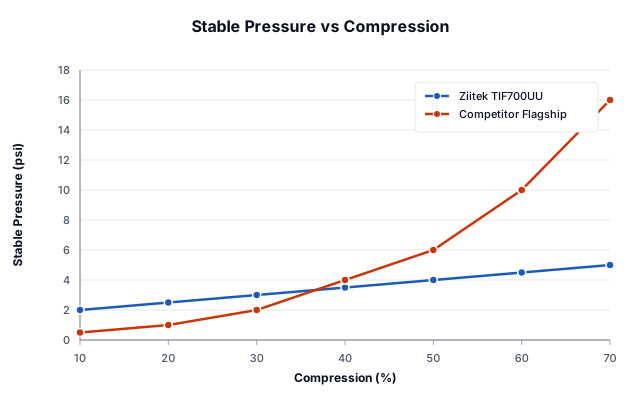
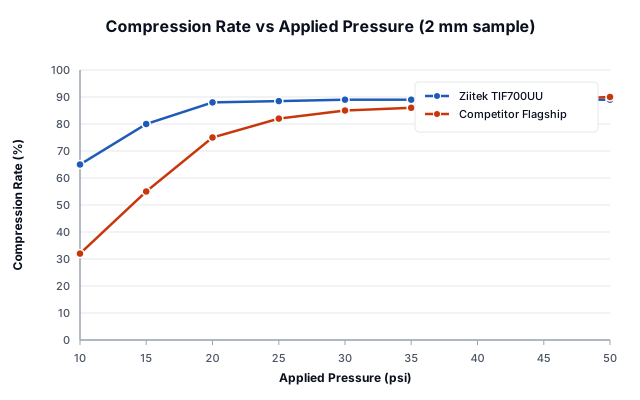
Using the stress testing equipment independently developed by ZIITEK, the pressure values during assembly and usage were simulated. The instantaneous and stable pressure of the TIF700UU gasket was overall superior to that of the flagship products of the competitor's. This indicates that the material can protect the device from stress to the greatest extent while filling within different height tolerances.
Reliability and manufacturing benefits
The adaptive deformation capability of the ultra-soft pad compensates for assembly tolerances and improves production yield consistency. Its low-stress structure minimises the risk of capacitor cracking, pump-out failure, and interface delamination during long-term thermal cycling.
Cooperation timeline
Collaboration began with small-batch thermal validation and mechanical stress testing. Ziitek engineering teams provided on-site support during prototype integration and reliability testing phases. After successful evaluation, the customer expanded the solution into mass production for high-speed AI optical modules — and the same material platform is positioned for 1.6T programs entering DVT.
Results
The customer achieved improved thermal stability, reduced optical signal degradation, enhanced system reliability, and higher production confidence for next-generation AI optical interconnect products.
Frequently asked questions
Why are ultra-soft thermal pads important for optical modules?
Ultra-soft pads conform better to uneven surfaces, reducing air gaps and contact thermal resistance while minimising mechanical stress on sensitive optical devices like lasers, photodiodes, and surface-mount capacitors.
What thermal conductivity is recommended for 800G and 1.6T optical modules?
High-performance AI optical modules typically require thermal interface materials with thermal conductivity above 10 W/m·K to support high heat flux density at the DSP and laser interfaces.
How does TIF700UU improve long-term reliability?
Its low-stress design reduces mechanical damage to lasers and capacitors, prevents interface aging issues, and maintains stable thermal performance over long operational cycles — validated by 1,000-hour aging at 85 °C with no thermal-resistance change.
Why is repeated insertion durability important for external thermal interfaces?
Optical modules are frequently inserted and removed during maintenance and upgrades, so materials at the cold-plate interface must resist wear and maintain stable thermal performance. TIC800T-ST's carrier-supported PCM construction is purpose-built for hot-swappable bays.
What role does thermal management play in AI data centers?
Efficient thermal management ensures stable optical transmission, prevents thermal throttling, and maximises overall AI computing utilisation. Thermal islands above 60 °C in dense racks degrade signal integrity and shorten laser lifespan — the right TIM stack is what blocks them.