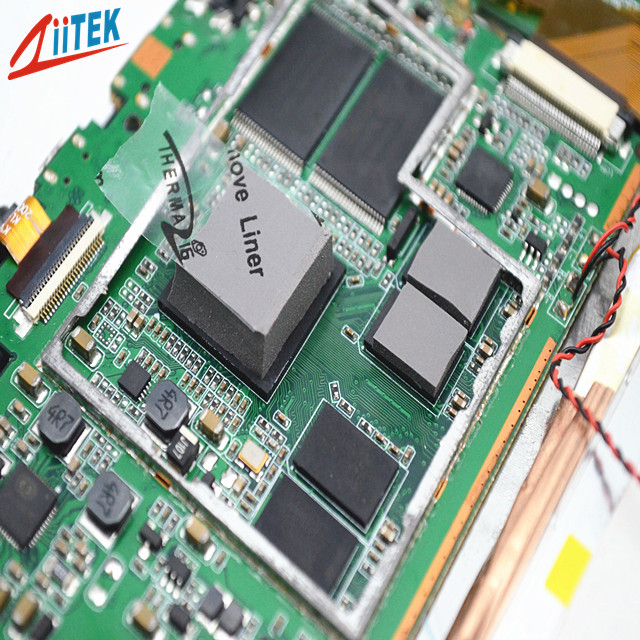
Z-PASTER 100-6060-11 Pad thermique sans silicone
- Thermal Conductivity (W/mK)
- 6.0
- Hardness (Shore oo)
- 60
- Density (g/cm³)
- 3.3
- Rigidité diélectrique (V/mm)
- ≥5500
- Thickness range (inch/mm)
- 0.040~0.200/1.00~5.00
- Recommended Operating Temperature (℃)
- -45~125
Z-PASTER 100-6060-11 6.0W/m·K Non-Silicone Thermal Pad
Z-PASTER 100 6060-11 series is a siloxane-free thermally conductive interface material applied to fill the air gaps between the heating elements and the heat dissipation fins or the metal base. Their flexibility and elasticity make them suited to coat very uneven surfaces. Heat can transmit to the metal housing or dissipation plate from the heating elements or even the entire PCB,which effectively enhances the efficiency and life-time of the heat-generating electronic components.
Z-PASTER 100-6060-11 — what to validate in production
Great thermal conductivity
Non-Silicone and oil-bleed
Available in different thickness options
High compliance adapts to various pressure application environments
Domaines d'application de cette qualité
Typical uses for this non-silicone thermal pad line include the following industries and applications.

GPU, ASIC, refroidissement liquide
Centres de données et serveurs d'IA
Métal liquide pour chipset GPU · Pads pour alimentation électrique verticale · Refroidissement de module DIMM · Solutions de refroidissement liquide pour GPU

Étanchéité, refroidissement et chauffage des batteries
Nouvelles énergies et batteries de VE
Étanchéité Z-foam 800 · Gels cellule-à-plaque froide · Films chauffants · Assemblage automatisé
Z-PASTER 100-6060-11 — spécifications de la fiche technique
Les valeurs ci-dessous sont transcrites de la fiche technique officielle. Utilisez le PDF lié pour la validation et le CoA spécifique au lot.
Demander un support d'ingénierie d'application| Paramètre | Valeur (typique / telle qu'indiquée) | Méthode / note |
|---|---|---|
| Couleur | Gris foncé | Aspect visuel |
| Construction | Non-silicone resin | — |
| Thickness range (inch/mm) | 0.040~0.200/1.00~5.00 | ASTM D374 |
| Hardness(Shore oo) | 60 | ASTM 2240 |
| Density(g/cm³) | 3.3 | ASTM D792 |
| Recommended Operating Temperature(℃) | -45~125 | — |
| Breakdown Strength(V/mm) | ≥5500 | ASTM D149 |
| Constante diélectrique @1MHz | 9.0 | ASTM D150 |
| Volume Resistivity(Ohm·meter) | >1.0x10¹² | ASTM D257 |
| Thermal Conductivity(W/m·K) | 6.0 | ASTM D5470 /ISO22007 |
| Classement d'inflammabilité | V-0 | UL94 (E331100) |
* Assurez-vous que les valeurs correspondent à la révision du PDF citée sur votre bon de commande.
Modèles Pad thermique sans silicone associés
Z-PASTER 100-6060-11 — questions fréquentes
Vous remplacez le TIM d'un autre fournisseur ou avez besoin d'une revue d'empilement ? Envoyez vos plans — notre service applications vous répond rapidement.
Parler à un ingénieurWhat is Thermal Conductivity?
Thermal conductivity indicates a material's ability to conduct heat and is typically measured in W/m·K. Under the same testing conditions, a higher thermal conductivity generally indicates better heat-conduction capability.
What is Thermal Resistance?
Thermal resistance indicates the resistance to heat flow through a material or interface and is typically expressed in K/W or °C/W. Lower thermal resistance generally means that heat can pass through the material more efficiently.
How do I choose the right thermal interface material?
The selection of a suitable TIM typically requires consideration of heat source power, gap thickness, target thermal resistance, operating temperature, assembly pressure, electrical insulation requirements, flame-retardant requirements, reliability, and cost.

Votre prochaine solution thermique commence ici.
Du prototypage rapide à la production à grande échelle, nos ingénieurs sont prêts à concevoir une solution thermique sur mesure pour votre application. Approuvé par plus de 7 000 clients dans les secteurs des véhicules électriques, de la 5G et de l'électronique grand public.