Integrated EV Battery Pack Sealing, Cooling & Heating
Addressing battery pack sealing and waterproofing, thermal management, and low-temperature heating with a full range of materials — Z-foam 800 silicone foam, TIF thermal gels and pads, and Kheat film heaters — to improve pack safety and efficiency.
With the rapid growth of the global new energy vehicle industry, battery pack energy density continues to increase, raising higher demands for sealing, thermal management, and low-temperature heating. In extreme climate regions such as India and Northern Europe, temperatures range from -40°C to over 45°C, and monsoon season water fording depth can exceed 300 mm — conventional sealing materials age and fail easily. Meanwhile, higher cell power density leads to increased thermal stress, and low winter temperatures reduce battery activity, raising starting power requirements by 40-70%. Ziitek provides integrated heat conduction, sealing, and heating solutions to help OEMs tackle challenging operating conditions and improve vehicle safety and reliability.
Scene challenges
Maintaining stable waterproof sealing over the new energy batteries' full lifecycle remains challenging, with a risk of leakage under water immersion conditions.
Power devices such as IGBTs and MOSFETs are highly pressure-sensitive; excessive assembly force may cause chip cracking or solder joint failure.
Lithium-ion batteries are highly temperature-sensitive, operating best at 15°C–40°C, with significant performance loss and safety risks at low temperatures.
As new energy vehicles move toward higher energy density, longer range, and faster charging, battery packs face increasingly complex environmental and operating challenges. Single-function materials or designs can no longer meet the combined demands of protection, thermal management, and heating.
Solution value
Z-FOAM800 is a closed-cell silicone foam with extremely low water absorption. It is UL157 certified and enables stable IP67/IP68 waterproofing. With compression set <5%, it ensures zero sealing failure over 10 years / 200,000 km in automotive applications.
TIF020-19 is a soft semi-solid gel material that operates under extremely low assembly pressure (<10 psi). It helps avoid stress damage caused by overly hard or over-compressed thermal pads, while ensuring full surface contact and efficient thermal conduction.
The PI heating film Kheat PI-RPLJ001 (35.2V-550W)-A1 (3M468) can be directly integrated inside battery packs. It delivers rapid heating with a simple structure and fast response, improving battery safety and extending service life.
The integrated design of battery pack sealing, heat conduction and heating reduces assembly time by 45% and improves heat dissipation efficiency by 63%, automated production effectively reduces and controls costs by 35%.
Industry status and trends
The penetration rate of new energy vehicles is rising rapidly, with global sales exceeding 20 million units in 2025. The battery pack — the core energy unit — directly determines overall vehicle safety. However, markets such as India and Southeast Asia face harsh environments of high temperature, heavy rain, and water logging; Northern Europe and Northern China need to cope with low temperatures below -30°C. The battery pack must prevent ingress of moisture, dust, and electrolyte, efficiently dissipate heat during charge/discharge, and quickly preheat cells in cold winters. A single material can no longer meet these combined requirements — integrated sealing, thermal conduction and heating solutions are becoming indispensable.
Three technical pain points
Pain point 1 — Insufficient long-term sealing and waterproof reliability. Conventional EPDM or ordinary foam exhibit high compression set (typically >15%) after long-term compression, leading to reduced sealing interface pressure and difficulty maintaining IP67 rating. During India's monsoon season with severe road waterlogging, any sealing failure sharply increases the risk of short circuits.
Pain point 2 — Wide-temperature-range thermal management failure under extreme temperature swings. Battery systems must switch between rapid preheating at -40°C and efficient heat dissipation at 45°C, but conventional thermal management solutions struggle to balance both. This leads to delayed temperature control, performance degradation, and increased risks to safety and service life.
Pain point 3 — Coupling challenge of vibration/shock and thermal management. Continuous vibration during driving can cause cell displacement, loosening of connectors, and even internal short circuits. Meanwhile, high-rate fast charging makes the microscopic gaps between cell bottom and cold plate a thermal bottleneck; traditional thermal pads struggle to simultaneously provide compressive compliance and long-term reliability.
Ziitek's integrated solution
1. Battery box main sealing: Z-FOAM800 silicone foam
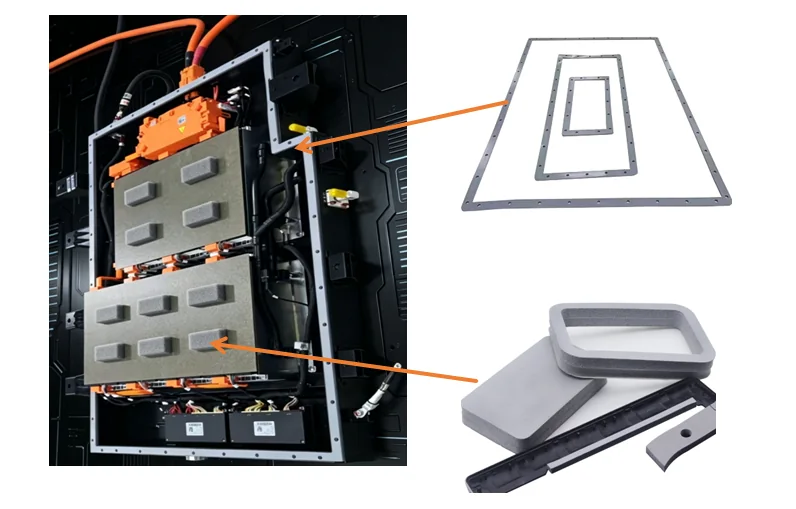
Z-FOAM800 features a closed-cell silicone foam structure with ultra-low water absorption (<0.1%), UL157 gasket certification, and UL94 V-0 flame rating. It maintains elasticity from -40°C to 200°C, with compression set as low as 1.8% (after 1000h at 85°C/85% RH). Die-cut to precisely fit the battery case sealing groove, and combined with a rivet nut limit design (compression 50-60%), it ensures long-term IP67/IP68 waterproofing.
Z-FOAM800 silicone foam applied to the battery-box sealing groove
2. Thermal interface between cell bottom and liquid cooling plate: TIF series thermal gel / silicone sheet
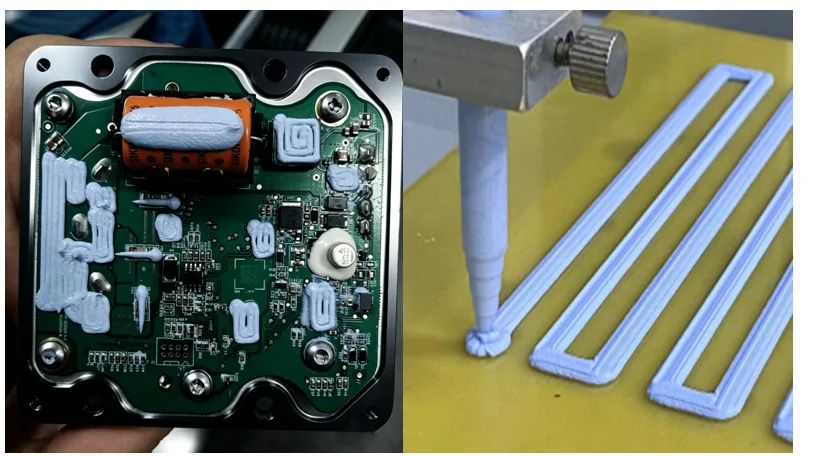
When the cell bottom is uneven or the gap exceeds 1.5 mm, traditional thermal pads fail to fill effectively. Ziitek's TIF020-19S (2.0 W/m·K) and TIF035-05AB (3.5 W/m·K) two-part thermal gels can be automatically dispensed, filling steps, gaps or irregular surfaces. The gel exerts almost no pressure on components (<10 psi), avoiding damage to pressure-sensitive cells or IGBT modules. Thermal impedance is as low as 0.080°C·in²/W @10 psi, significantly improving heat dissipation. For sheet applications, the TIF100 series (1-5 W/m·K, Shore 00 27-65) also provides low-stress conformability.
Automated dispensing of TIF thermal gel onto the cold-plate line
3. Low-temperature heating: Kheat SP / PI series heaters
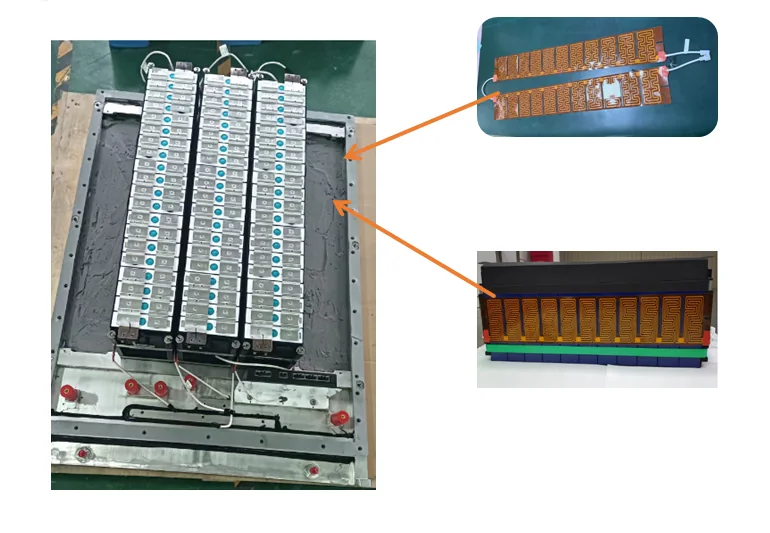
In cold climates, battery internal resistance increases and starting power demand is 40-70% higher than in summer. Kheat silicone rubber heaters (-40°C to 150°C) and polyimide (PI) heaters (-60°C to 250°C) can be designed with segmented heating zones, power density 1-2 W/cm², thickness 0.2-5 mm. The heaters can be supplied with PSA on one side, attached to cell bottoms or side surfaces, and used with temperature sensors for precise control. When combined with TIF thermal materials, they provide uniform heating at low temperatures and unobstructed heat conduction at high temperatures, creating a closed-loop thermal management system.
Kheat segmented film heater mounted against the cell group inside the battery pack
Recommended products
Application
Recommended P/N
Main specs
Main sealing of the battery box body
Z-FOAM800 series
Compression set ≤5%, UL94 V-0, -40 to 200°C, IP68
Bottom of the battery cell and the liquid cooling plate
Power density 1-2 W/cm², thickness 0.2-5 mm, -60 to 250°C
Sealing assistance (threaded holes, etc.)
Zpaster 917T01 flame-retardant tape
UL94 V-0, highly compatible with Z-FOAM800
Your next thermal solution starts here.
From rapid prototyping to full-scale production — our engineers are ready to design a custom thermal solution for your application. Trusted by 5,000+ clients across EV, 5G, and consumer electronics.