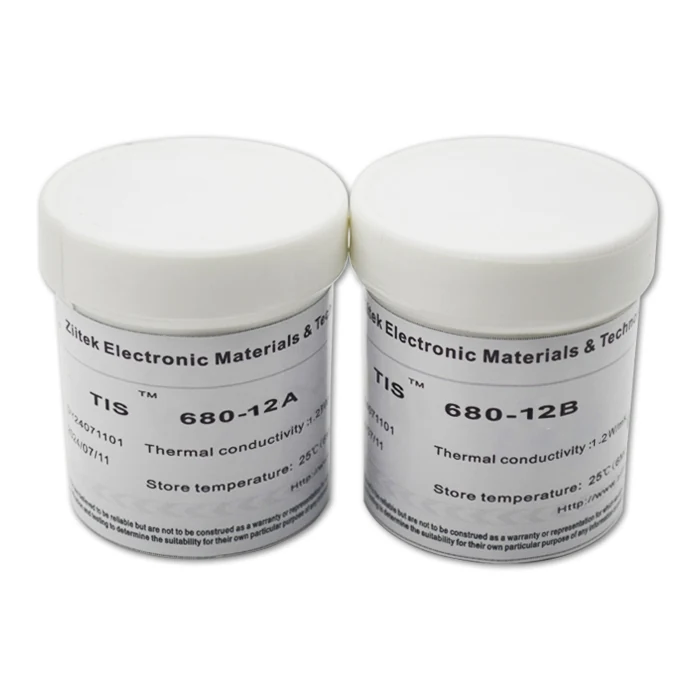
TIS680-12AB Silicone Potting Compound
- Density (g/cm³)
- 2.4
- Dielectric Breakdown Volt…
- 6,000
- Dielectric Constant @1MHz
- 4.2
- Hardness (Shore OO)
- 65
- Operating temperature
- −45 to 200 °C
- Thermal Conductivity (W/m·K)
- 1.2
TIS680-12AB — Product overview
TIS™ 680-12AB Series is a two-part silicone potting adhesive with high thermal conductivity, room temperature curable, long working time and fire resistance. It is especially suitable for capacitor, small electronic equipment sealing. Its flexible, elastic characteristics enable it to provide cushioning for the materials it is coated with. The lower viscosity allows the thermal potting adhesive to cover the surface more fully, greatly increasing the efficiency of heat transfer from the heating device or the entire PCB to the metal case or diffusion plate, thus improving the efficiency and service life of the electronic
TIS680-12AB — Features
Good thermal conductive
Good insulation performance
Good elasticity
Lower shrinkage
Low viscosity, easy gas emissions
Good solvent resistance and waterproof performance
Application engineering
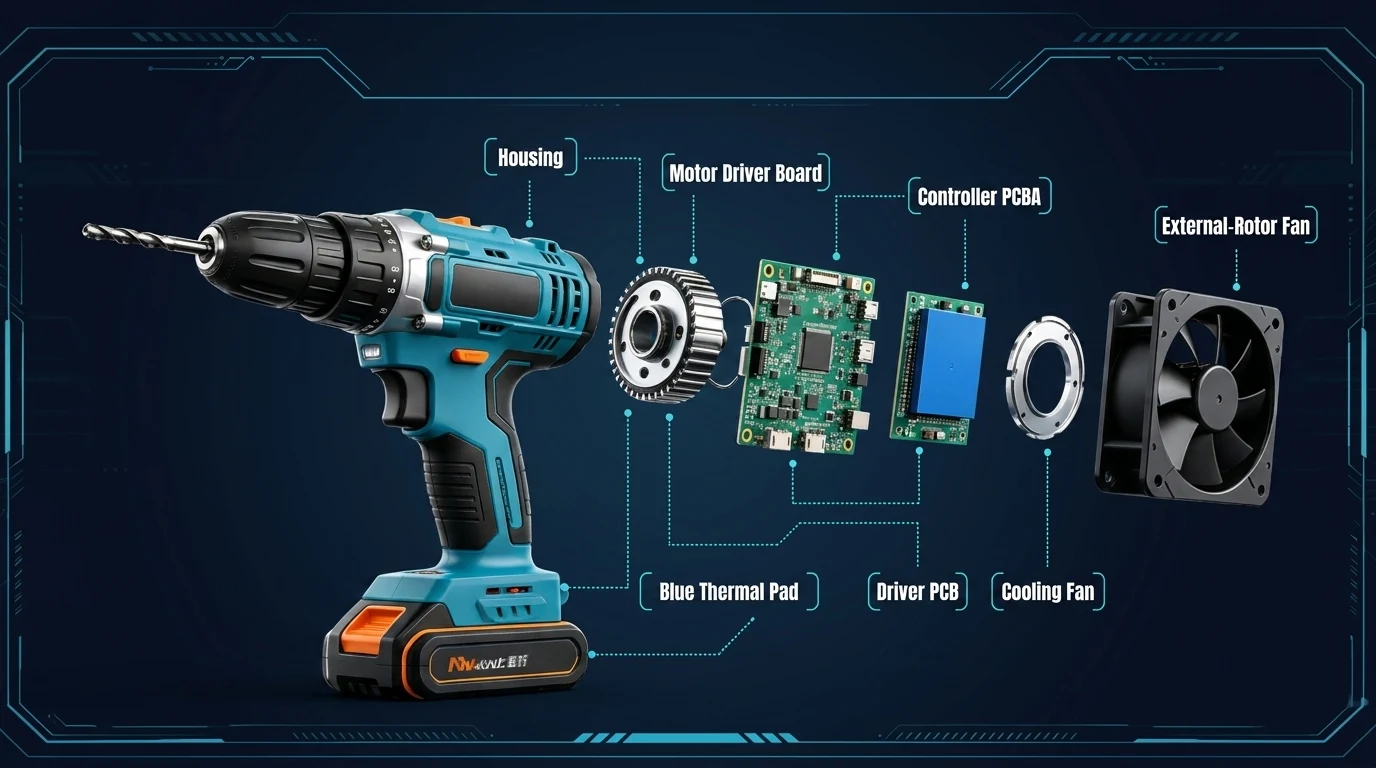
Planning the potting process for a drone ESC
An ESC potting design must connect the power components to the housing while accounting for component stress, cavity filling and access for repair. Evaluate TIS680-12AB against the assembly's electrical, thermal and production requirements.
- Power components
- Potting compound
- ESC housing
- Cooling environment
Map the cavity and heat path
Provide the component heights, potting depth and housing contact surfaces. Review trapped-air locations and the added mass before selecting a fill level; a conductivity value alone does not predict MOSFET temperature.
Control mixing and curing
The linked TIS680-12AB datasheet specifies A:B = 100:100 by weight. Define mixing, degassing and dispensing steps, then qualify the stated cure schedule in the actual assembly. Do not substitute a volume ratio or another grade's cure conditions.
Validate the assembly
Compare the same load, airflow, ambient temperature and measurement location before and after potting. Surface temperature and junction temperature are different measurements. Include thermal cycling, vibration and electrical checks appropriate to the ESC.
Bring these inputs to the design review
- PCB/cavity drawing, component heights and fill depth
- Continuous and peak electrical load, airflow and ambient range
- Required isolation, moisture protection and repair access
- Mixing equipment, batch size and permitted cure window
Customer-confirmed application-brief specifications: 65 Shore OO, density 2.4 g/cm³ and operating range −45 to 200 °C. The linked legacy PDF has earlier values; request the current qualification revision. Potting alone does not establish an IP rating, flight qualification or guaranteed temperature reduction.
Where this grade is used
Typical application targets for this grade include Industrial control, transformer, coil, amplifier, high voltage package, relay, high current junction box, etc.;, Heat sink assembly, thermal sensor potting, thermal conductive product potting;, Heat conduction between the battery cell and the cold tube;, LED and power drive potting;.

TIS680-12AB — datasheet specifications
Values below are transcribed from the official datasheet (Customer-confirmed application brief, 2026-10-30; legacy PDF retained for reference). Use the linked PDF for sign-off and lot-specific CoA.
Request application engineering support| Parameter | Value (typical / as stated) |
|---|---|
| Material Properties (Before Curing) | |
| Product Name | TIS680-12A / TIS680-12B |
| Color | White |
| Viscosity @25°C (mPa·s) | 3,000 |
| Shelf life | 6 months @25°C in sealed container |
| Mix Ratio (By weight) | A : B = 100 : 100 |
| Mix Color | Gray |
| Operational Time | 30 mins |
| Conditions for Complete Curing | 24 H |
| Conditions for Complete Curing | 2 H |
| Conditions for Complete Curing | 1 H |
| Material Properties (After Curing) | |
| Hardness (Shore OO) | 65 |
| Density (g/cm³) | 2.4 |
| Operating temperature | −45 to 200 °C |
| Elongation | 120 % |
| CLTE | 3.0×10⁻⁵ 1/°C |
| Fire resistance UL94 | V-0 |
| Water Absorption Rate | < 0.1 wt% |
| Thermal Conductivity (W/m·K) | 1.2 |
| Thermal Impedance @1mm | 0.48 °C-in²/W |
| Dielectric Breakdown Voltage (V/mm) | ≥6000 |
| Dielectric Constant @1MHz | 4.2 |
| Volume resistivity @25°C (Ω·cm) | 3.0×10¹³ |
Selected specifications updated from the customer-confirmed application brief: 65 Shore OO, 2.4 g/cm³, −45 to 200 °C and dielectric strength ≥6000 V/mm. The linked legacy PDF has earlier values for these properties; request the current revision for qualification. Other listed properties remain from the legacy datasheet.
Related silicone potting compounds models
| Model | λ (W/m·K) | Hardness | View |
|---|---|---|---|
| TIS680-10AB | 1 W/m·K | 65 Shore A | Details |
| TIG680-15AB | 1.5 W/m·K | 45±5 Shore A | Details |
| TIS680-15AB | 1.5 W/m·K | 85 Shore D | Details |
| TIG680-20AB | 2 W/m·K | 35±5 Shore A | Details |
| TIG680-28AB | 2.8 W/m·K | 25 Shore A | Details |
| TIS680-28AB | 2.8 W/m·K | 65 Shore A | Details |
| TIG680-30AB | 3 W/m·K | 25±5 Shore A | Details |
| TIS680-35AB | 3.5 W/m·K | 55 Shore 00 | Details |
TIS680-12AB — common questions
Replacing another vendor's TIM or need a stack review? Send drawings — applications responds quickly.
Talk to an engineerHow should TIS680-12AB be mixed?
The linked TIS680-12AB datasheet specifies Part A:Part B = 100:100 by weight. Measure each component by weight and follow the grade-specific mixing and degassing instructions; a 1:1 weight ratio is not permission to meter equal volumes.
Which cure schedule applies to TIS680-12AB?
The linked datasheet lists 24 hours at 25 °C, 2 hours at 70 °C, or 1 hour at 100 °C. Confirm the applicable revision and qualify the selected schedule for the actual potting depth, component temperature tolerance and production process.
What must be checked before potting a drone ESC?
Review cavity geometry, component height, potting mass, wetting and air escape, electrical load, housing contact and repair access. Verify thermal cycling, vibration and electrical performance on the assembled ESC; potting alone does not establish an IP rating.
Can the expected ESC temperature reduction be calculated from conductivity alone?
No. Compare the same electrical load, ambient conditions, airflow and sensor location with a defined baseline. A housing or MOSFET surface reading is not a junction-temperature measurement, and a prior project's reduction is not a guaranteed result for a new design.

Your next thermal solution starts here.
From rapid prototyping to full-scale production — our engineers are ready to design a custom thermal solution for your application. Trusted by 7,000+ clients across EV, 5G, and consumer electronics.