Thermal epoxy adhesive
Single-part heat-cure thermal epoxy for permanent structural bonding plus thermal management in one compound. Through-plane conductivity 2.5–4.5 W/m·K across 2 TIE380 grades — the entry 2.5 W/m·K 380-25 for general electronics adhesion and the high-λ 4.5 W/m·K 380-45 for power-semiconductor and EV battery thermal joints.
2
Qualités TIE380
2.5–4.5 W/m·K
Conductivité thermique (λ)
Mono-composant
Aucun mélange — durcissement à chaud
≥ 130 °C / 30 min
Cycle de polymérisation
−40 – 150 °C
Plage de fonctionnement
Préparation à la sélection
Commencez par l’empilage, pas par le nom du produit.
Une présélection utile commence par le chemin thermique et les contraintes d’assemblage. Ces informations permettent à Ziitek de cibler les grades et documents pertinents.
Interface et géométrie
Indiquez la surface de contact, l’entrefer ou l’épaisseur de liaison visée, ainsi que l’état des surfaces.
Objectif thermique
Ajoutez la puissance ou le flux thermique, l’élévation de température admissible et les contraintes de refroidissement.
Électrique et production
Précisez l’isolation, la conformité, l’assemblage, la reprise et les volumes prévus.
Toutes les qualités de Thermal epoxy adhesives dans un seul tableau
Les 2 références de thermal epoxy adhesives avec conductivité thermique (W/m·K), notes de couleur et fiches techniques PDF. Cliquez sur le nom d'un modèle avec un lien pour obtenir les spécifications complètes, les photos et les conseils d'application.
| Photo | Modèle | λ (W/m·K) | Dureté | PDF et étape suivante |
|---|---|---|---|---|
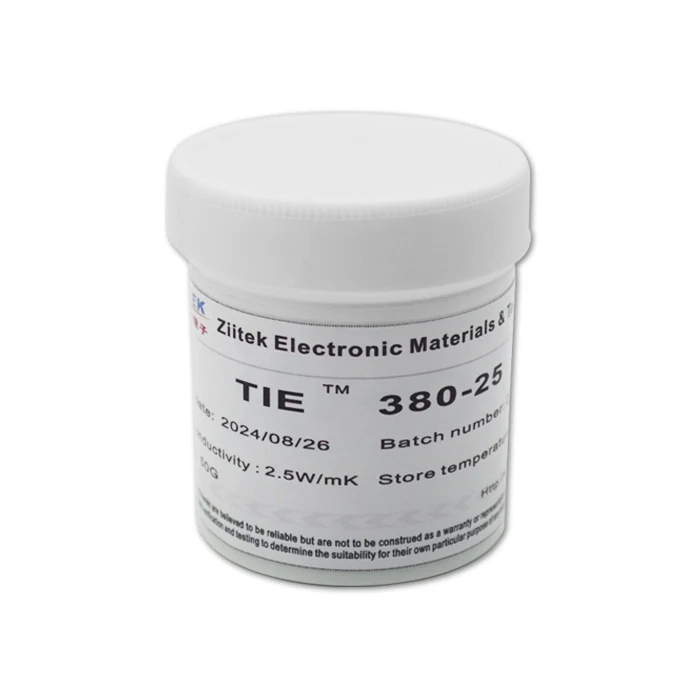 | TIE380-25 | 2.5 W/m·K | 92 Shore A | |
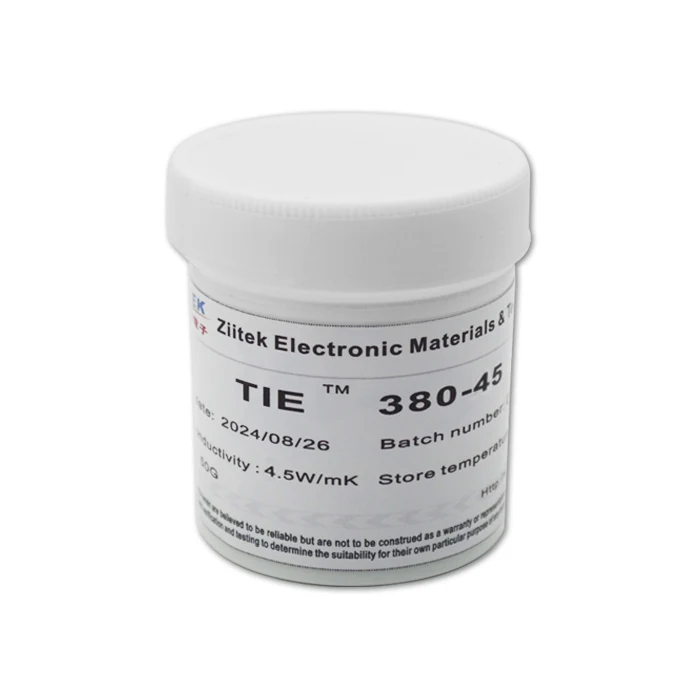 | TIE380-45 | 4.5 W/m·K | 92 Shore A |
Cas d'utilisation de l'époxy thermique
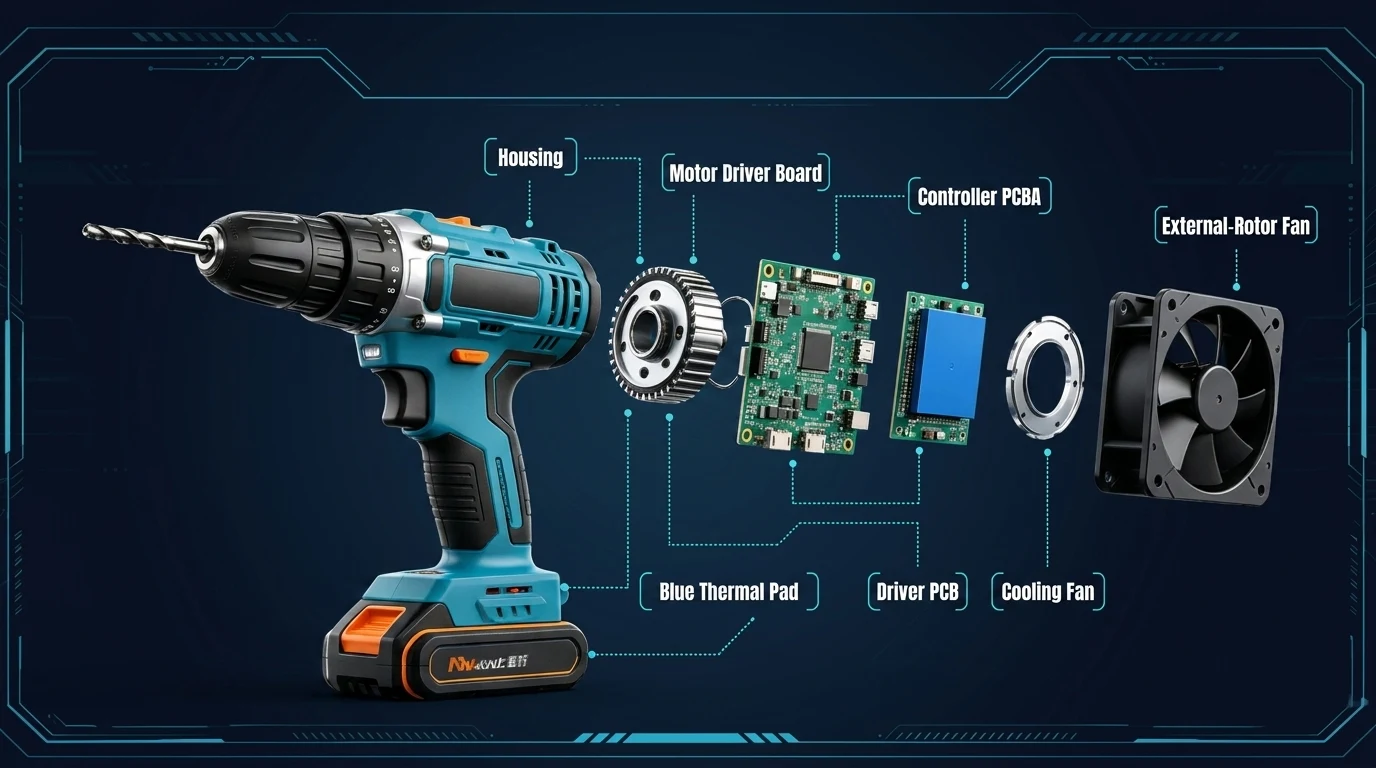
Fenêtre de spécifications typiques (adhésif époxy thermique)
| Paramètre | Plage typique / note | Méthode |
|---|---|---|
| Conductivité thermique | λ de qualité adhésive — voir la fiche technique | ASTM D5470 |
| Résistance au cisaillement par recouvrement | Substrats métalliques / céramiques | ASTM D1002 |
| Rapport de mélange et durée de vie en pot | Bi-composant — par série | — |
| Polymérisation | Options de polymérisation à température ambiante + à chaud | TDS |
| Transition vitreuse | Ligne de collage rigide | DMA |
| Résistivité volumique | Comportement électrique selon le grade | ASTM D257 |
| Température de fonctionnement | Qualité électronique | UL746B |
| Durée de conservation | Stockage au froid parfois requis | — |
| Application | Manuel, distribution automatique | — |
Thermal epoxy adhesives — questions fréquentes
Besoin d'aide pour présélectionner ou trouver une équivalence ? Contactez un ingénieur thermicien Ziitek — SLA de réponse en 2 heures.
Parler à un ingénieurWhat is thermal epoxy adhesive and how does it differ from RTV silicone adhesive?
Single-part heat cure vs two-part epoxy — which TIE grade do I want?
Is the bond conductive — can it short out a metal-can SMD?
How thick should the bondline be?
Can I rework or remove a TIE380 joint after cure?
What's the operating temperature range?
Autres gammes de gestion thermique
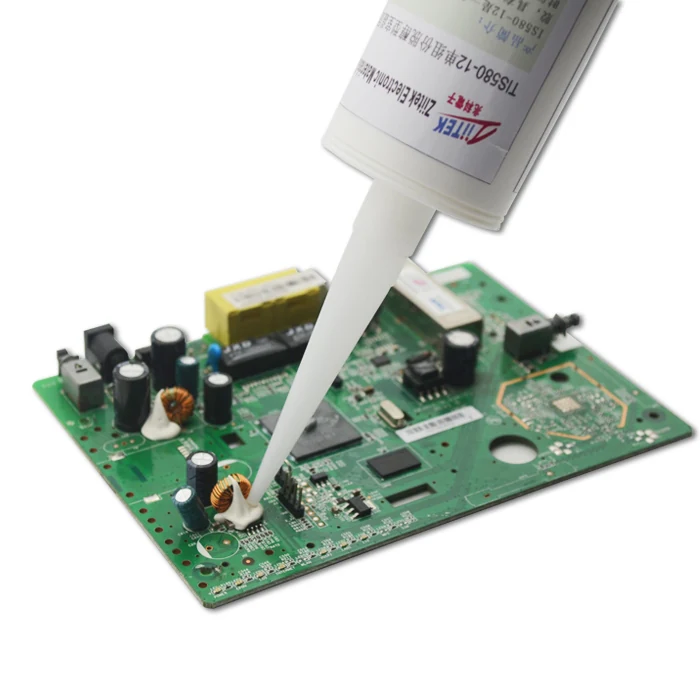
TIS580
Adhésif silicone thermique (RTV)
RTV mono-composant durcissant à température ambiante — joint plus souple, température de service plus élevée, meilleure résistance à la fatigue thermique. À choisir en l'absence de four.
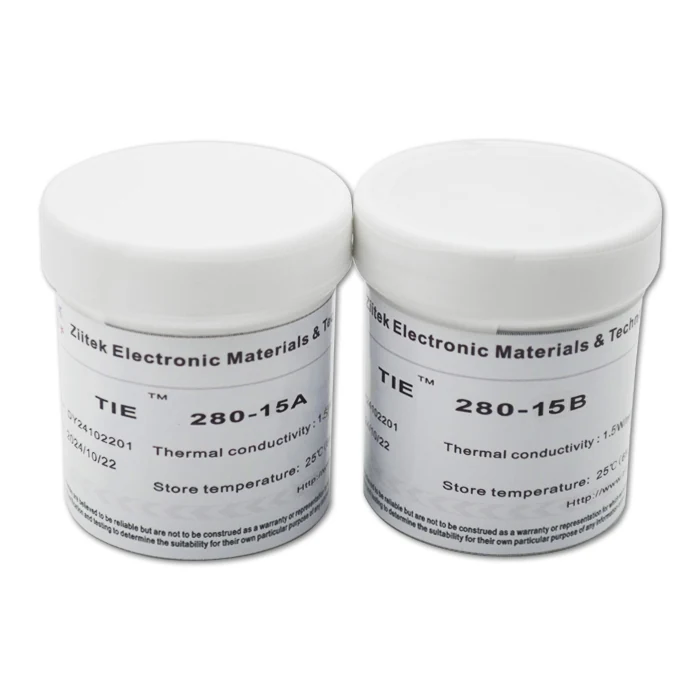
TIE280-AB
Résine d'enrobage époxy
Époxy thermoconducteur bi-composant durcissant à température ambiante pour l'encapsulation complète des circuits imprimés, capteurs et modules.
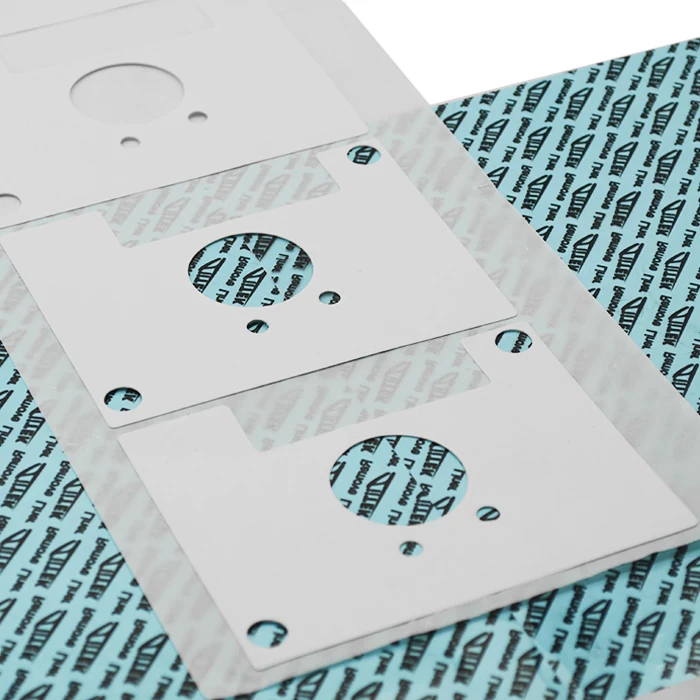
TIA
Ruban adhésif thermique
Adhésif double-face sensible à la pression (PSA) à sec — peler et remplacer, sans étape de durcissement. À choisir lorsque la reprise ou le positionnement instantané sont importants.
Échantillon
Contactez notre service d'ingénierie
Besoin d'aide sur les compromis de programme de durcissement, le conditionnement en seringue ou en cartouche, ou la préparation du substrat ? Réponse en 2 heures.
Your next thermal solution starts here.
From rapid prototyping to full-scale production — our engineers are ready to design a custom thermal solution for your application. Trusted by 7,000+ clients across EV, 5G, and consumer electronics.