Thermal epoxy adhesive
Single-part heat-cure thermal epoxy for permanent structural bonding plus thermal management in one compound. Through-plane conductivity 2.5–4.5 W/m·K across 2 TIE380 grades — the entry 2.5 W/m·K 380-25 for general electronics adhesion and the high-λ 4.5 W/m·K 380-45 for power-semiconductor and EV battery thermal joints.
2
TIE380 grades
2.5–4.5 W/m·K
Thermal conductivity (λ)
Single-part
No mixing — heat cure
≥ 130 °C / 30 min
Cure schedule
−40 – 150 °C
Operating range
Every Thermal epoxy adhesives grade, one table
All 2 thermal epoxy adhesives part numbers with thermal conductivity (W/m·K), colour notes, and PDF datasheets. Click a model name with a link for full specs, photos, and application guidance.
| Photo | Model | λ (W/m·K) | Hardness | PDF & next step |
|---|---|---|---|---|
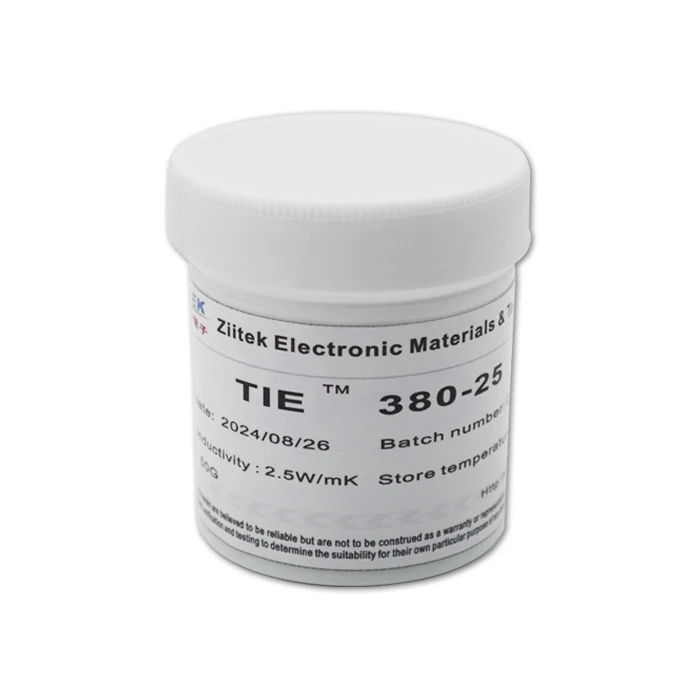 | TIE380-25 | 2.5 W/m·K | 92 Shore A | |
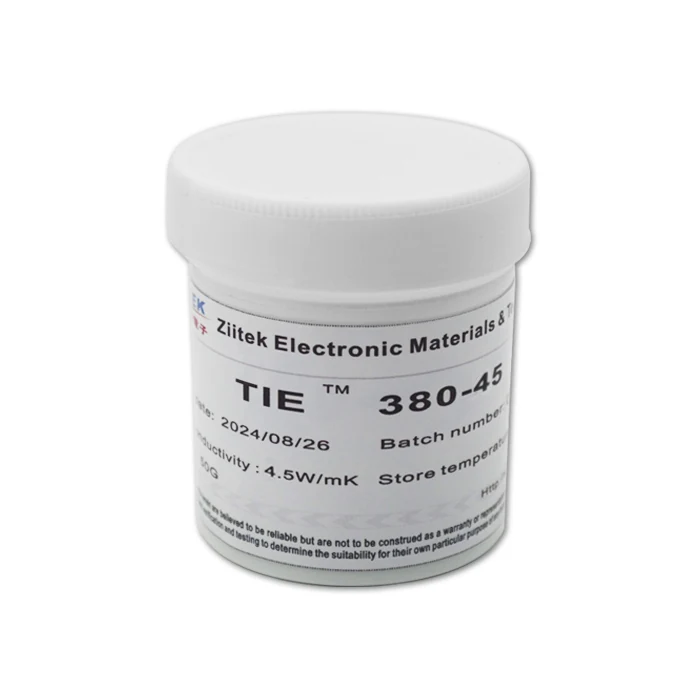 | TIE380-45 | 4.5 W/m·K | 92 |
Where thermal epoxy fits
Two-part bonding epoxies attach heat sinks and housings with structural strength — distinct from full potting, but overlapping chemistries.
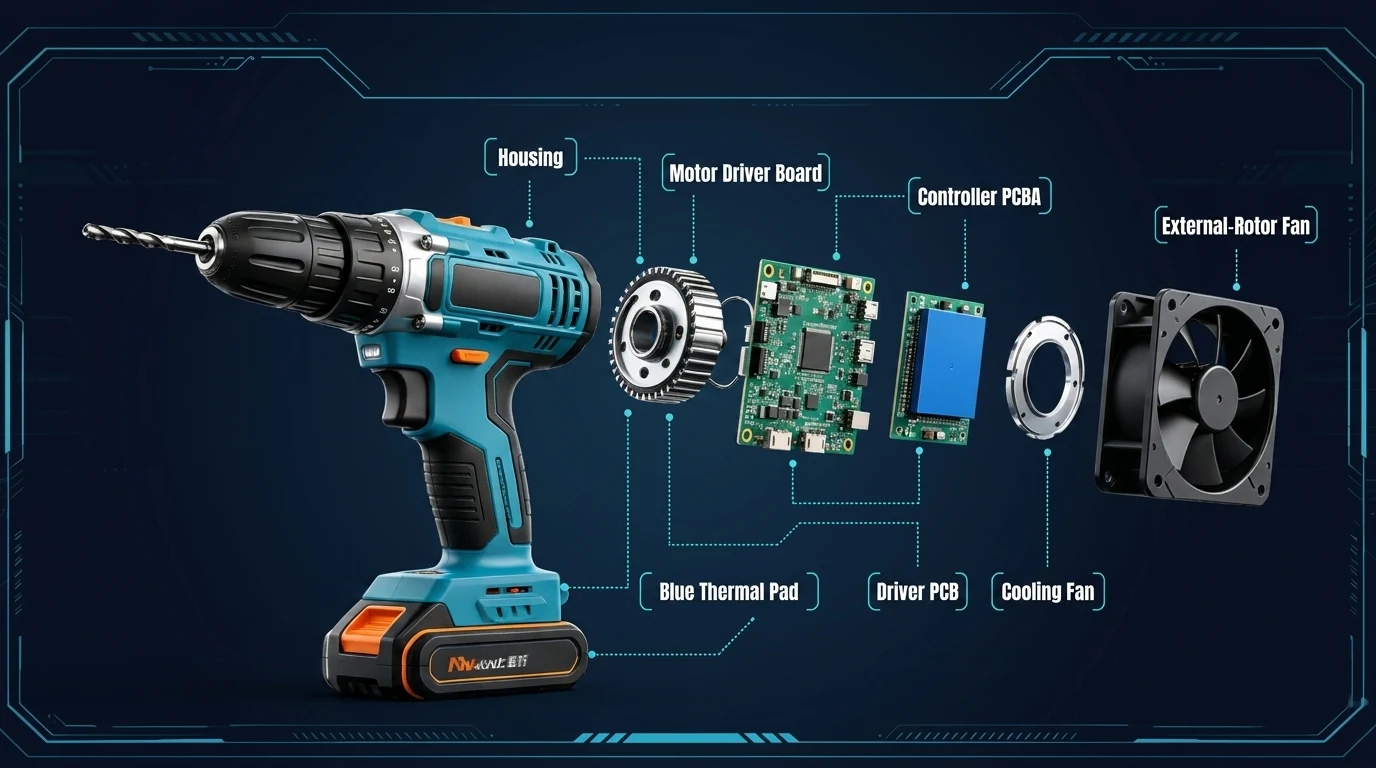
Typical specification window (thermal epoxy adhesive)
| Parameter | Typical range / note | Method |
|---|---|---|
| Thermal conductivity | Adhesive-grade λ — see TDS | ASTM D5470 |
| Lap shear strength | Metal / ceramic substrates | ASTM D1002 |
| Mix ratio & work life | Two-part — per series | — |
| Cure | Room-temp + heat-cure options | TDS |
| Glass transition | Rigid bondline | DMA |
| Volume resistivity | Electrical behaviour per grade | ASTM D257 |
| Operating temperature | Electronics-class | UL746B |
| Shelf life | Cold storage sometimes required | — |
| Application | Manual, auto-dispense | — |
* Representative grades. Request a lot-specific datasheet or CoA for your exact part number.
Thermal epoxy adhesives — common questions
Need help shortlisting or cross-referencing? Talk to a Ziitek thermal engineer — 2-hour response SLA.
Talk to an engineerWhat is thermal epoxy adhesive and how does it differ from RTV silicone adhesive?
Thermal epoxy is a thermosetting polymer loaded with metal-oxide or ceramic filler that, once cured, becomes a rigid, high-modulus structural bond with dual function — mechanical fastening plus a thermal conduction path. Compared to RTV silicone adhesive (TIS580), epoxy gives higher lap-shear strength (typical 8 – 20 MPa vs 1 – 3 MPa for RTV silicone), stiffer post-cure modulus, and better moisture resistance, at the cost of brittleness under thermal cycling and the need for a heat cure step. Pick epoxy when the joint must replace a screw or rivet; pick silicone when the joint must absorb mechanical or thermal-cycle stress.
Single-part heat cure vs two-part epoxy — which TIE grade do I want?
Both TIE380-25 and TIE380-45 are single-part (1K) heat-cure formulations — pre-mixed, ready to dispense from cartridge or syringe, no Part-A/Part-B mixing required. They cure on a heated platen or in a reflow oven (typical 130 °C / 30 min). For two-component room-temp-cure structural bonding our two-part TIE280-AB potting epoxy line gives a longer pot-life with no oven needed; see the epoxy-potting-compound family for that workflow.
Is the bond conductive — can it short out a metal-can SMD?
TIE380 series is electrically insulating (volume resistivity ≥ 10¹³ Ω·cm typical) — the ceramic filler provides thermal conduction without forming a continuous metal path, so a thin bondline between an LED can and a copper heatsink will not short. Verify the dielectric strength on the datasheet for the specific grade if your bondline is operating above 100 V; some grades will derate at very thin bondlines under high-voltage conditions.
How thick should the bondline be?
For maximum thermal performance, target the thinnest bondline that still gives full coverage and tolerates the part-to-substrate flatness — typically 50 – 200 µm. Thinner bondlines reduce thermal resistance linearly with thickness, so 50 µm at 2.5 W/m·K gives lower interface resistance than 200 µm at 4.5 W/m·K. Use a controlled clamp pressure or shim during cure to lock the bondline; once cured, the joint is permanent and cannot be reworked without breaking the substrates.
Can I rework or remove a TIE380 joint after cure?
Cured TIE380 epoxy is a permanent structural bond — by design, it cannot be peeled or melted off. Removal requires either mechanical fracture (chisel, ultrasonic) or solvent attack (chlorinated or strong polar solvents) which usually damages the substrate. If reworkability is on the spec, switch to TIA800 thermal adhesive tape (peel-and-replace) or TIS580 RTV silicone adhesive (can be cut and re-bonded).
What's the operating temperature range?
TIE380-25 and TIE380-45 are rated −40 °C to +150 °C continuous service. Above 150 °C the epoxy backbone will gradually oxidise (Tg around 110 – 120 °C means modulus softens before chemical degradation begins). For silicone-class continuous-service ranges (−50 to +200 °C and beyond) use TIS580 RTV silicone adhesive or one of the silicone potting compounds.
Adjacent thermal management lines
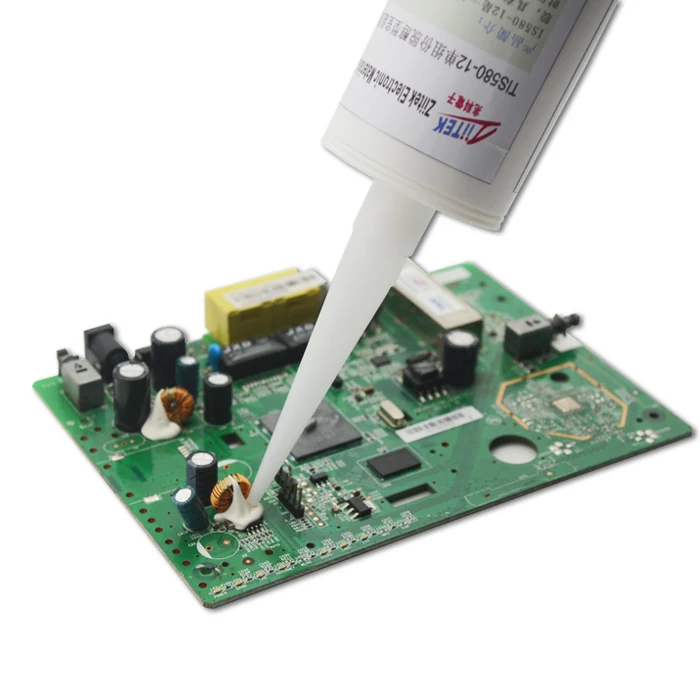
TIS580
Thermal silicone adhesive (RTV)
Single-component ambient-cure RTV — softer joint, higher service temp, better thermal-cycle fatigue. Pick when no oven is available.
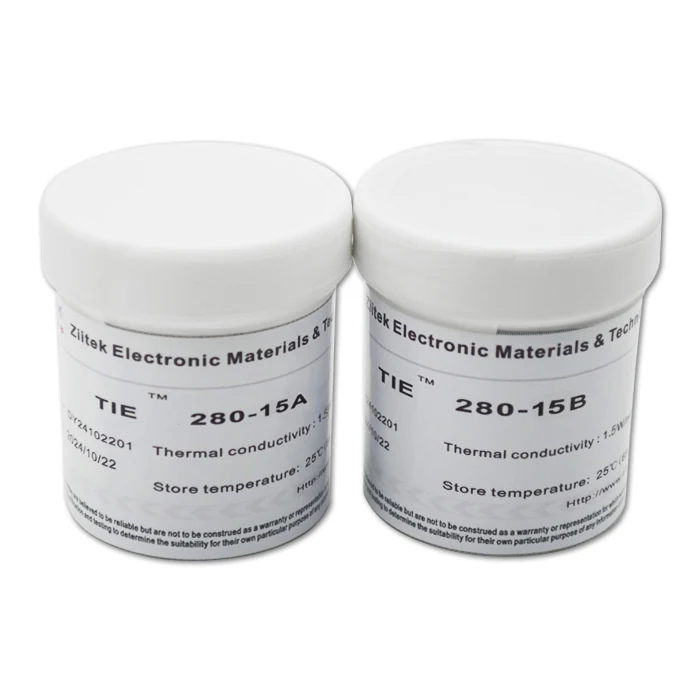
TIE280-AB
Epoxy potting compound
Two-part room-temperature-cure thermally conductive epoxy for fully encapsulating PCBs, sensors, and modules.
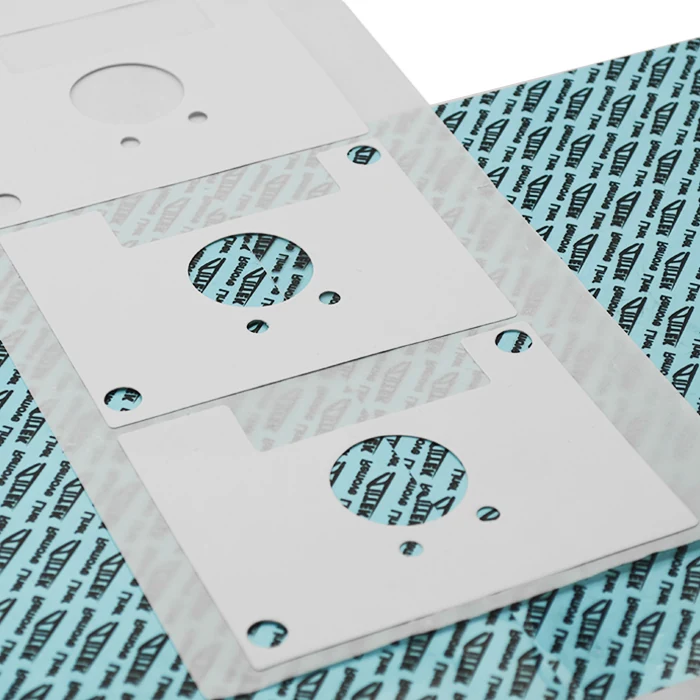
TIA
Thermal adhesive tape
Dry double-sided PSA — peel-and-replace, no cure step. Pick when reworkability or instant placement matters.
Sample
Talk to engineering
Need help with cure-schedule trade-offs, syringe vs cartridge packaging, or substrate prep? 2-hour response.
Your next thermal solution
starts here.
From rapid prototyping to full-scale production — our engineers are ready to design a custom thermal solution for your application. Trusted by 5,000+ clients across EV, 5G, and consumer electronics.