Breaking Thermal Barriers in Ultra-Light Smart Glasses
A global consumer electronics brand faced thermal challenges in smart glasses due to higher processor power, limited space, and strict skin-temperature limits. Using ultra-thin graphite heat spreaders and advanced thermal interface materials, ZIITEK reduced processor temperatures by 8.7°C and improved comfort and reliability.
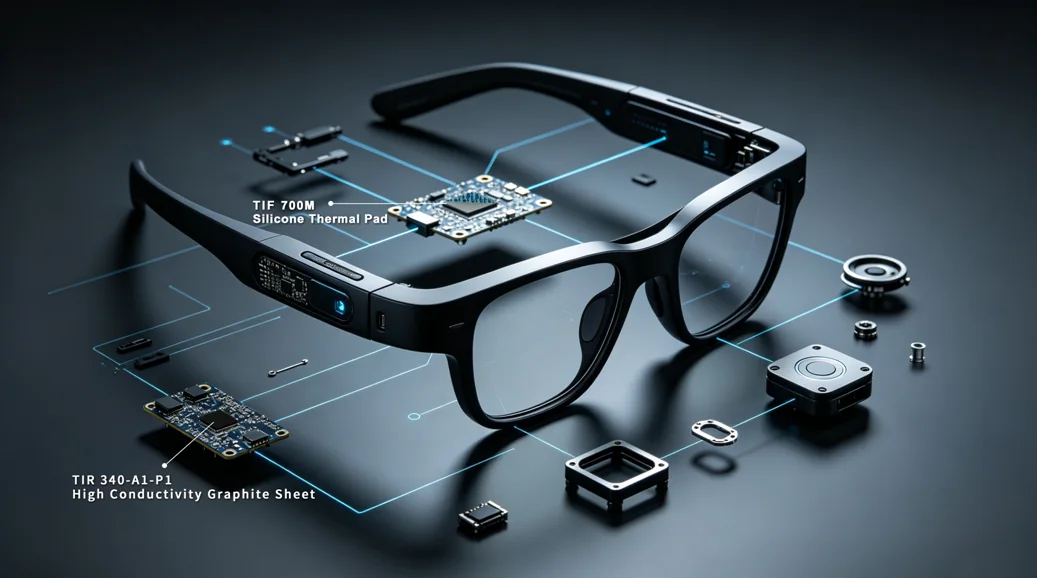
As AI models, real-time translation, voice interaction, and AR technologies continue to evolve, smart glasses are becoming the next-generation personal computing platform. However, integrating high-performance processors, batteries, and optical modules into a lightweight structure weighing less than 50 grams creates significant thermal management challenges that directly impact user experience and product success.
Customer Profile
The customer is a leading global consumer electronics company specializing in smartphones, AIoT ecosystems, wearable devices, and smart consumer products.
By 2025:
- Over 1 billion connected AIoT devices
- Annual IoT revenue exceeded RMB 120 billion
- Ranked among the world's top three wearable device suppliers
- Strong presence across China, India, Southeast Asia, and Europe
- Smart glasses shipment target exceeds 5 million units within three years
Thermal management performance became a key qualification criterion during product commercialization.
Challenge 1: Localized SoC Hotspot Generation
Customer Pain Point
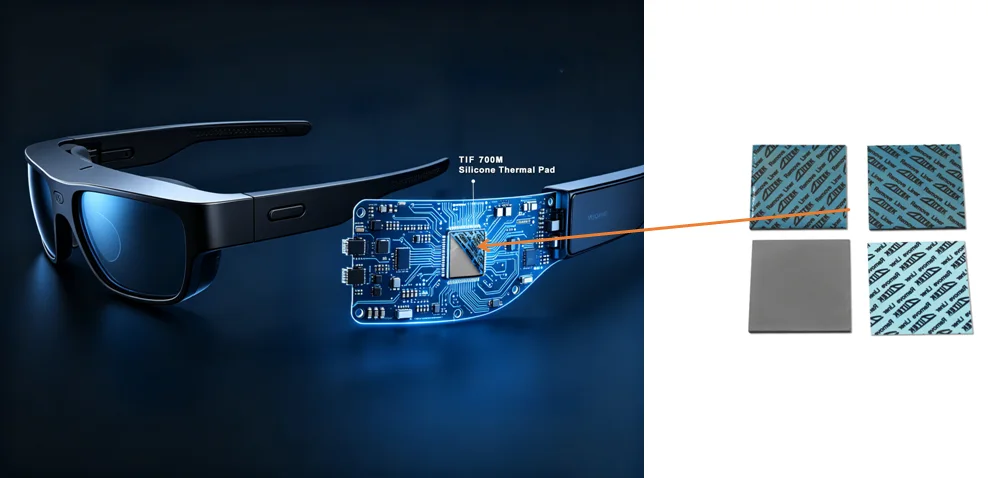
The main processor inside smart glasses operates continuously for AI voice interaction, image recognition, translation, and AR rendering. Due to the extremely limited internal space of the temple structure, conventional cooling solutions such as heat pipes or vapor chambers cannot be integrated, resulting in localized heat accumulation and thermal throttling.
ZIITEK Solution — TIF700M High-Performance Thermal Pad
- Thermal conductivity: 6.0 W/m·K
- High compressibility
- Excellent conformability
- Stable thermal performance under long-term operation
Results
- Processor temperature reduced by 8.7°C
- Eliminated thermal throttling
- Improved computing stability
- Enhanced system reliability
Challenge 2: Optical Module Thermal Drift
Customer Pain Point
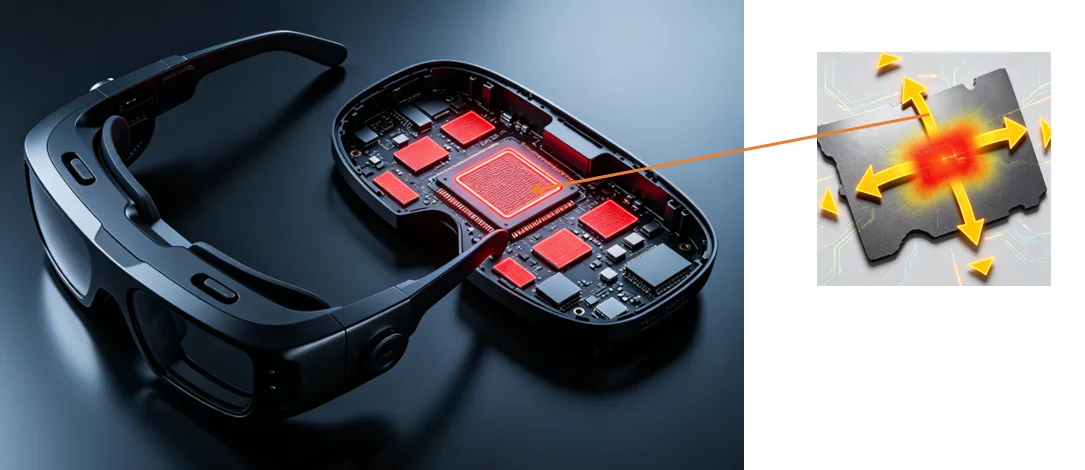
Micro-LED displays and waveguide optical modules are highly sensitive to temperature fluctuations. Excessive heat may lead to optical distortion, display instability, and lens fogging, negatively affecting user experience.
ZIITEK Solution — TIR340A1-P1 Ultra-Thin Graphite Sheet
- In-plane thermal conductivity up to 1200 W/m·K
- Thickness as low as 0.04 mm
- Excellent heat spreading capability
- Optional insulation coating
Results
- Optical module temperature reduced by 6.1°C
- Improved display stability
- Prevented lens fogging
- Enhanced image quality consistency
Challenge 3: Skin-Contact Temperature Control
Customer Pain Point
The distance between the heat source and the user's skin is often less than 0.3 mm. Continuous operation may cause uncomfortable surface temperatures and negatively impact wearing comfort.
ZIITEK Solution — Combined Thermal Architecture
- TIF700M Thermal Pad
- TIR340A1-P1 Graphite Sheet
This dual-layer design transfers heat away from hotspots and distributes heat uniformly throughout the frame.
Results
- Surface temperature reduced by 6.2°C
- Surface temperature maintained below 40°C
- Improved long-term wearing comfort
Project Background
According to industry forecasts, global smart glasses shipments are expected to exceed 20 million units annually within the next few years. As processing capabilities continue to increase, thermal management has become one of the most critical design considerations.
ZIITEK Three-Level Thermal Management Architecture
Level 1 – Processor Cooling
Material: TIF700M Thermal Pad — Function: Efficiently transfers heat from the processor to the structural frame.
Level 2 – Optical Module Heat Spreading
Material: TIR340A1-P1 Graphite Sheet — Function: Rapidly spreads localized heat across a larger area.
Level 3 – Battery & Structural Thermal Management
Material: Customized TIF700M Series — Function: Balances battery temperature and improves overall thermal uniformity.
Project Results
Item | Before | After |
|---|---|---|
SoC Temperature | 51.8°C | 43.1°C |
Optical Module Temperature | 42.3°C | 36.2°C |
Surface Temperature | 41.5°C | 35.3°C |
Material Cost | Baseline | -12%~18% |
Recommended Products
TIF700M Thermal Pad
Applications: AI Processor · Battery Module · Main PCB
- Thermal Conductivity: 6.0 W/m·K
- Ultra-soft design
- High compression ratio
- UL94 V-0 compliant
TIR340A1-P1 Graphite Sheet
Applications: Optical Modules · Smart Glasses Temple · Frame Structures
- In-plane thermal conductivity up to 1200 W/m·K
- Thickness as low as 0.04 mm
- Flexible and bendable
- Optional insulation coating
Conclusion
As smart glasses evolve into the next-generation personal computing platform, thermal management has become a critical enabler of performance, reliability, and user comfort.
Through the combination of TIF700M Thermal Pads and TIR340A1-P1 Ultra-Thin Graphite Heat Spreaders, ZIITEK delivers a complete thermal management solution that addresses processor cooling, optical stability, skin-contact temperature control, and manufacturing consistency, supporting the mass commercialization of smart glasses.
Frequently asked questions
Is the 1200 W/m·K thermal conductivity measured data?
Yes. The value represents the in-plane thermal conductivity of the graphite sheet. Test reports are available upon request.
Will graphite sheets cause electrical short circuits?
Insulated versions with single-sided or double-sided dielectric coatings are available, ensuring electrical safety.
Are the materials compliant with RoHS and REACH requirements?
Yes. All products comply with RoHS, REACH, and Halogen-Free requirements.
What are the advantages compared with imported materials?
15–20% lower material cost, faster lead time, flexible customization, and proven replacement experience in mass-production projects.