UL 94 V-0 vs VTM-0 Flame Ratings: TIM Selection
V-0 and VTM-0 are two different UL 94 burn tests, not two safety tiers. Learn how each is run and which flame rating your thermal pad or gap filler needs.
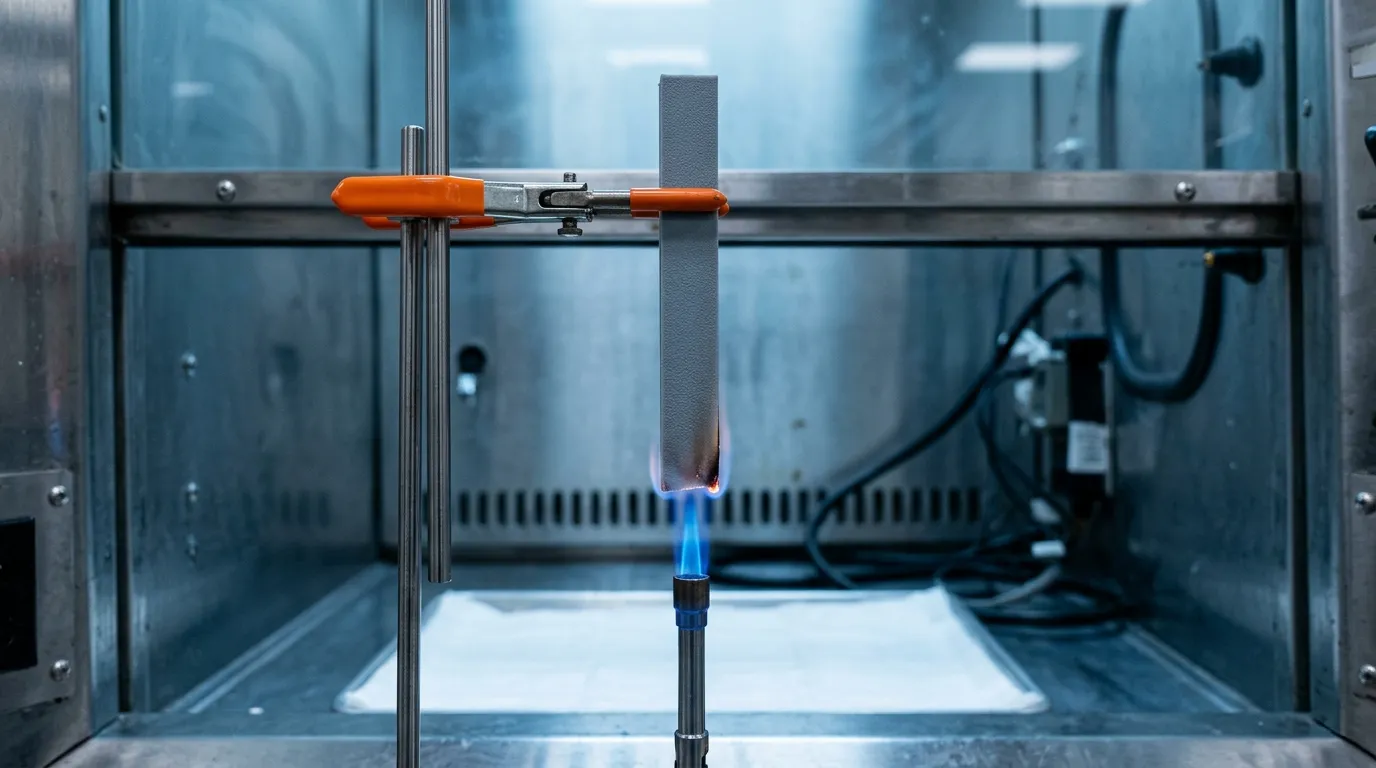
UL 94 V-0 and VTM-0 are two different burn tests, not two tiers of the same rating. V-0 and VTM-0 use closely corresponding classification criteria for afterflame, total flaming time, afterglow, and flaming drips, but they are achieved through different test methods and specimen configurations. — the specimen must stop burning within 10 seconds after each flame application, total burn time stays under 50 seconds, and no flaming drips ignite the cotton below. A thin, flexible TIM that is not suitable for the standard V test may instead be evaluated using the VTM method. A thick, self-supporting pad can be tested to V-0. The two ratings are not interchangeable on a datasheet, and neither is "better" than the other. This guide explains how each test works, what the ratings mean for thermal interface materials (TIMs), and how to pick the right one — plus the questions to ask your supplier before you accept a rating. We make thermal interface materials at ZIITEK and certify them under UL 94, so this is written from the supplier side of the table. For the wider picture, see our certifications and compliance guide for thermal materials.
What Are UL 94 V-0 and VTM-0?
UL 94, the Standard for Safety of Flammability of Plastic Materials for Parts in Devices and Appliances, is a set of small-scale burn tests published by Underwriters Laboratories (UL). It classifies materials into 12 ratings across three groups: six for rigid parts used in enclosures and structural components (HB, V-2, V-1, V-0, 5VB, 5VA), three for thin films that cannot support themselves (VTM-2, VTM-1, VTM-0), and three for low-density foams (HBF, HF-2, HF-1).
V-0 is the most common flame rating printed on electronics materials. A V-0 specimen is a vertical bar, 125 × 13 mm and up to 13 mm thick, held from the top clamp. A 20 mm blue flame is applied to its bottom edge twice for 10 seconds each time. To earn V-0, each specimen must stop flaming within 10 seconds after each application, the ten applications across the set must total no more than 50 seconds of flaming, and the specimen must not drip flaming particles that ignite a cotton layer placed 300 mm below.
VTM-0 is the top rating of the VTM (vertical thin material) method, used for films and thin sheets that are generally not capable of supporting themselves. The specimen is a 200 × 50 mm sheet, no more than 3 mm thick, rolled lengthwise around a 12.7 mm (½ in) mandrel and taped on one side to form a cone. The flame is applied to the cone's bottom for 3 seconds, twice. The pass criteria are identical to V-0: afterflame under 10 seconds per application, 50 seconds total, and no flaming drips that ignite the cotton.
| UL 94 V-0 | UL 94 VTM-0 | |
|---|---|---|
| What it tests | Self-supporting bar | Thin, flexible sheet or film |
| Specimen | 125 × 13 mm bar, ≤13 mm thick | 200 × 50 mm sheet, ≤3 mm thick, rolled into a cone |
| Mounting | Suspended vertically from a clamp | Cone held vertically, tape-side down |
| Flame | 20 mm blue flame, 10 s × 2 | 20 mm blue flame, 3 s × 2 |
| Burn limit | Must not reach the holding clamp | Must not reach a mark 125 mm from the bottom |
| Dripping | No flaming drips that ignite cotton | No flaming drips that ignite cotton |
| Afterflame | ≤10 s per application, ≤50 s total | ≤10 s per application, ≤50 s total |
The standard is also harmonized with international equivalents: IEC 60695-11-10 covers the vertical and horizontal burn methods, with ISO counterparts for foams and films. When you see "UL 94 V-0" or "UL 94 VTM-0" on a thermal pad datasheet, this is the family of tests behind the claim — and if you are new to TIMs, what a thermal pad is and where it sits in the stack is the place to start.
How the Two Burn Tests Actually Differ
The pass thresholds are the same, so the practical difference between V-0 and VTM-0 lives entirely in the test setup. Four differences matter when you are reading a datasheet:
Sample geometry and thickness. The V method needs a self-supporting bar at least 125 × 13 mm. The VTM method exists because a thin sheet cannot hold that shape — it rolls into a cone instead.
VTM testing is intended for thin materials that are not suitable for the standard V test because they may distort, shrink, curl, or otherwise fail to remain self-supporting during testing. Thickness is an important factor, but there is no universal 3 mm cutoff that determines whether a material receives a V-0 or VTM-0 rating.
Flame application. The V test applies the flame for 10 seconds twice; the VTM test applies it for 3 seconds twice. The shorter application matters: a thin film that survives 10 seconds of flame contact is not the same challenge as a film that survives 3 seconds, and UL does not let you report them as one rating.
Where the burn must stop. In the V test, the flame front must not reach the holding clamp. In the VTM test, specimens carry a mark 125 mm from the bottom edge, and the burn must stop before it. This is the VTM equivalent of the clamp rule — a fixed, measurable endpoint instead of a hardware one.
What a rating means in the UL system. UL states two things explicitly: a VTM-0 rating cannot be considered equivalent to a V-0 rating because the test methods are quite different, and failure to pass the UL 94 V test is a precondition of all VTM ratings — VTM exists for materials that cannot be meaningfully evaluated as a self-supporting bar. UL's own description of the combustion tests for plastics makes both points in one page, and detailed method parameters are tabulated in a widely cited V vs VTM comparison.
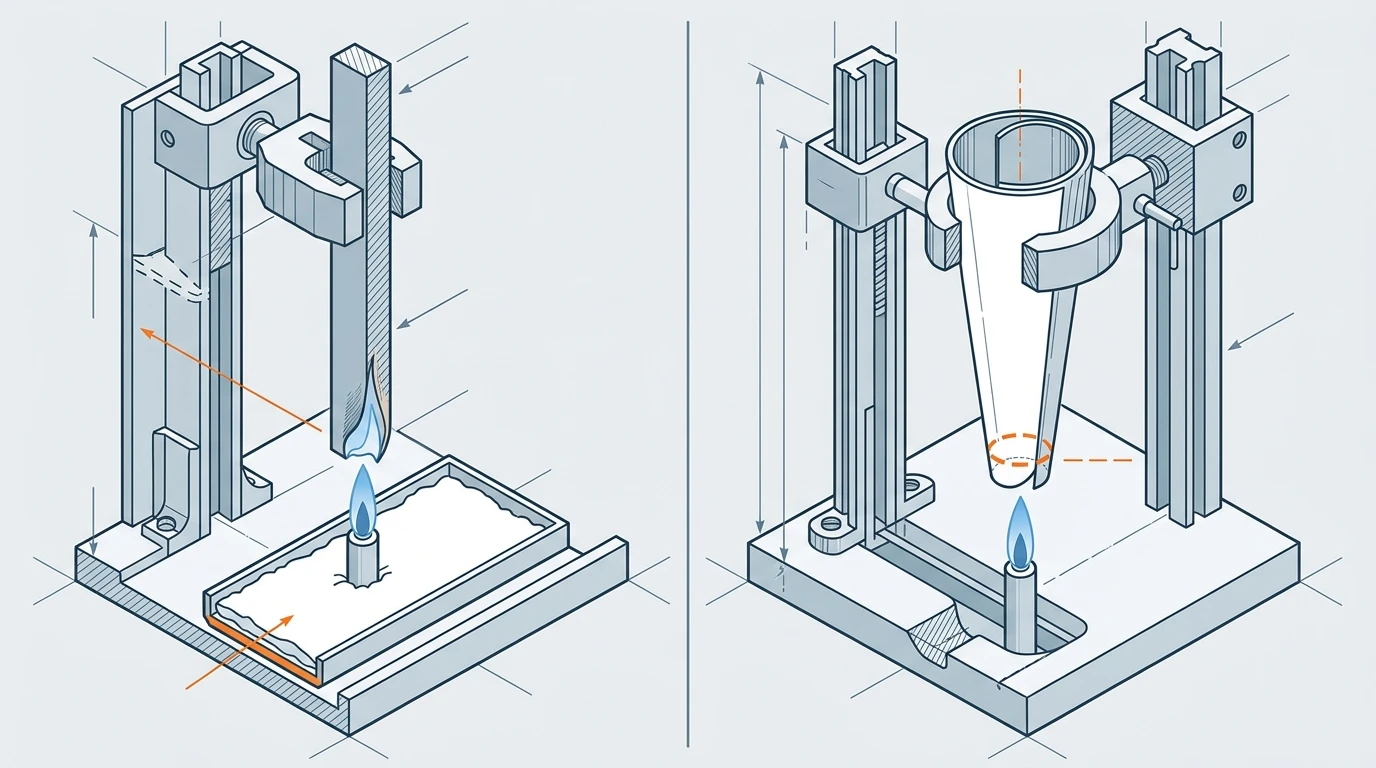
The V test burns a self-supporting bar held from a top clamp; the VTM test burns a cone rolled from a thin sheet. Same pass criteria, different geometry.
There is also a horizontal test you will see on datasheets: HB (horizontal burn), where the specimen lies flat and the flame is applied once. HB is the least demanding of the common ratings — slow burning at under 76 mm/min for thin specimens — and is usually printed when a material simply is not flame-retardant enough for a V rating. For TIM selection, HB-rated materials are the ones to treat with suspicion in an application that demands self-extinguishing behavior.
Why Thin Thermal Pads and Films Are Tested to VTM
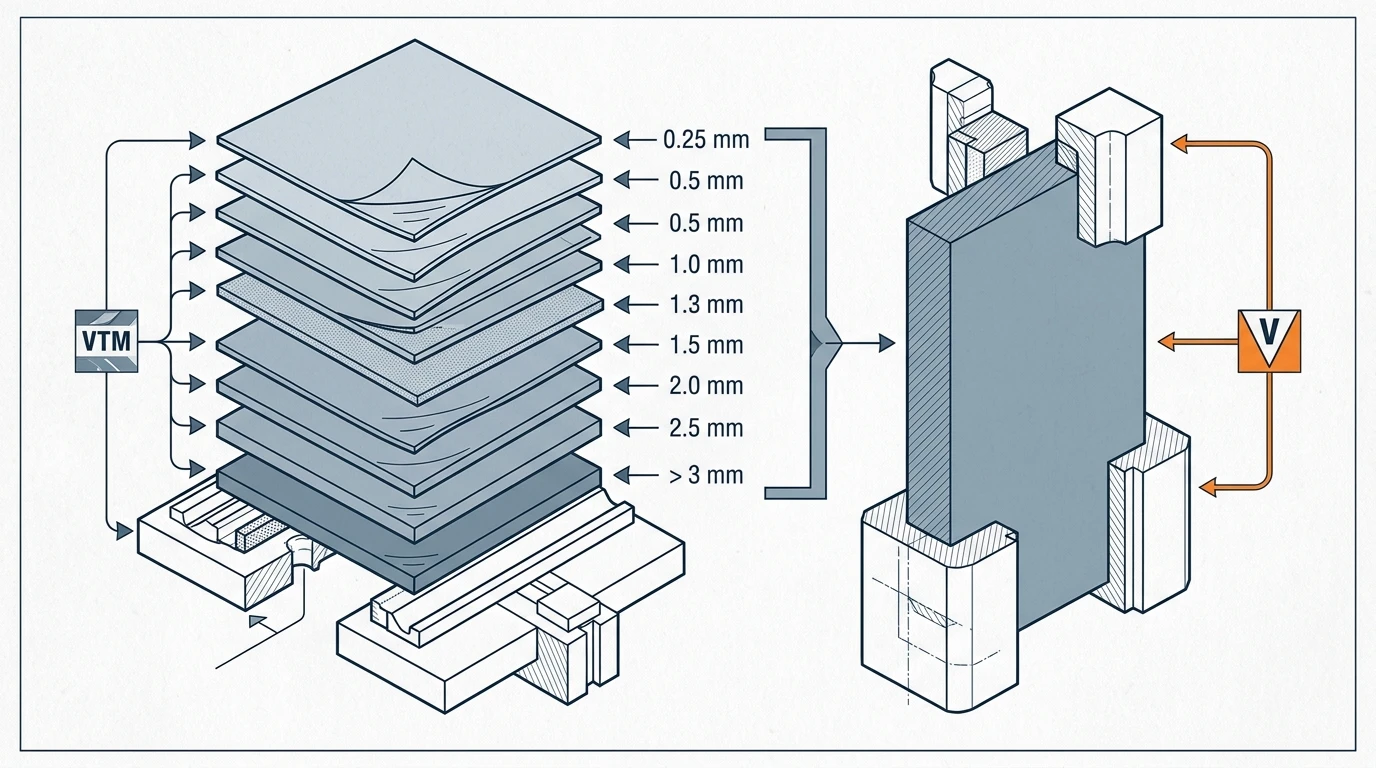
Here is where the standard meets thermal interface materials. A silicone thermal pad's job is to be soft and conformable, and the thinner it is, the more it behaves like a film. Hold a 1 mm pad upright and apply a flame: it softens, shrinks, and curls away from the heat before you can evaluate whether it self-extinguishes. That is exactly the failure mode the VTM method was designed for. This is why you will see VTM-0 on thin pads, thermal tapes, and films, and V-0 on thicker, self-supporting pads.
The thickness story is not absolute — the V method allows bars up to 13 mm, and a 5 mm rigid pad can absolutely be tested as a V-0 bar. But in practice, most thermally conductive pads in the 0.25–3 mm range (the bulk of what goes under CPUs, GPUs, and power modules) are soft enough that suppliers evaluate them with the VTM method. A good rule of thumb: below about 3 mm, expect VTM; above it, V-0 becomes possible and is common for stiff pads. Either way, the rating must come from a test on the actual material thickness you are buying, because flame ratings are thickness-dependent — a V-0 result at 3 mm does not automatically hold at 1 mm. Our thermal pad thickness and compression guide covers how thickness drives the thermal side of the same decision.
Gap fillers and greases complicate the picture further. A liquid gap filler cannot be burned as a bar or a cone at all; suppliers cure a slab of the material and test the cured sample. The same applies to phase-change materials. So when a datasheet for a gap filler prints "UL 94 V-0," what was actually burned was a cured slab at a stated thickness — and the method used (V or VTM) should be visible in the supporting test report. If it is not, that is a question for the supplier, not an assumption to make.
For the differences between pads, gels, and phase-change materials, our gap pad vs gap filler vs phase-change comparison walks through when each makes sense.
Is VTM-0 "Worse" Than V-0?
This is the question that generates most of the confusion, and the honest answer is: no, but it is not the same rating either. The pass criteria are identical — 10 seconds afterflame, 50 seconds total, no flaming drip ignition. A material that earns VTM-0 extinguishes just as fast as one that earns V-0. What you cannot do is treat the labels as interchangeable, because they certify different specimens under different procedures. UL is explicit that a VTM-0 rating is not equivalent to a V-0 rating.
The practical consequence for buyers:
- A V-0 claim on a very thin film is the suspicious direction. If a 0.5 mm tape datasheet prints "UL 94 V-0" with no test report, ask how a film that thin was evaluated as a self-supporting bar. It may be a real V-0 result on a thick slab of the same compound, which does not prove the film behaves the same way — or it may be a loose datasheet claim.
- A VTM-0 claim on a thin pad is the normal direction. For thin, flexible TIMs, VTM-0 is the appropriate method and a legitimate, equally strict rating. End-product standards commonly accept "94VTM-0" for thin-film and flexible parts.
- The decision rarely pits them against each other. For a given part thickness, usually only one method is physically applicable. The rating to specify is the one your end-product standard requires, verified at your thickness.
| Dimension | V-0 | VTM-0 |
|---|---|---|
| Pass strictness | ≤10 s afterflame, ≤50 s total, no flaming drips | Identical thresholds |
| Typical TIM thickness | Self-supporting pads, roughly ≥3 mm | Thin pads, tapes, films, roughly ≤3 mm |
| Spec recognition | The default ask in most OEM specs | Accepted for thin/flexible parts, less universally quoted |
| Test report needed | Yes, at your thickness | Yes, at your thickness — method matters |
| Interchangeable? | No — different method from VTM-0 | No — different method from V-0 |
The rating you choose is not a quality scoreboard — it is a match between the part's geometry and the method UL provides for testing that geometry. When the geometry and the requirement line up, the rating is doing its job. If you are still weighing material families against each other, our how to choose a thermal interface material guide covers the full decision beyond flammability.
How to Choose: Which Flame Rating Should Your TIM Carry?
Work through these five steps, in order, and the answer stops feeling like a judgment call.
1. Read the actual requirement. What does your end-product standard or customer spec say? Many OEM specs write "UL 94 V-0" as a blanket line, but the applicable standard (IEC 62368-1, UL 746C, or an industry-specific requirement) may accept VTM-0 for thin parts. If the spec is a blanket "V-0," that is a legitimate thing to push back on with the certifier — for a 1 mm pad, VTM-0 may be the only method that physically applies.
2. Check the thickness and the self-support question. Below ~3 mm or for materials that flex, curl, or soften under heat, the applicable method is VTM. Thick, rigid pads can be tested to V. Match the method to the part, not to the letter of the spec.
3. Verify the UL yellow card. The authoritative source is the manufacturer's UL yellow card (or equivalent certificate), which lists the rating by material grade and thickness. A datasheet line is a claim; the yellow card is the record. The rating must cover the exact thickness you are buying.
4. Ask for the test report. A one-page summary of the test — method used, specimen dimensions, conditioning (48 h at 23 °C and 50% RH for the first set, 168 h at 70 °C for the second), and the afterflame/drip results — tells you everything the datasheet line does not. Conditioning matters: the aged set is the one that shows whether the flame retardant survives heat exposure.
5. Document the decision. Record the method, the rating, the yellow card number, and the tested thickness in your design file. When your compliance reviewer asks why a thin pad carries VTM-0 instead of V-0, the answer is then one sentence with a report attached — not an argument.

The selection is a sequence: requirement first, then geometry, then documentation — not a guess about which rating sounds better.
While you are comparing candidates, remember that flame rating is one line of the spec sheet. Thermal conductivity (W/mK) and the thickness–compression relationship usually decide whether the material works thermally at all; the flame rating decides whether it is allowed in the product.
What to Ask Your Thermal Material Supplier
You do not need to become a UL 94 expert to buy a compliant TIM — you need the supplier to hand over four things:
- The yellow card number (a UL file number such as E331100) and the grades it covers.
- The tested thickness for the rating on the part you are buying — not the range, the exact thickness.
- The test method (V or VTM) and specimen details, from the test report.
- Any downgrade notes — ratings often drop with thickness or with added fillers, and a supplier that cannot explain the drop is a supplier to double-check.
A supplier that has done the work will answer without hesitation. As a manufacturer, we document ratings the same way we expect buyers to read them: ZIITEK's UL yellow card (file E331100) covers the TIF, TIS, TIG-780, TIC800K, TCP, and Z-FOAM series families with flame retardancy rated up to UL 94 V-0, and our TIF silicone thermal pads carry UL 94 V-0 across the series. Thin tapes and films follow the applicable VTM route with their own supporting documentation. If your compliance reviewer is pushing back on a rating, send us the requirement and the material thickness — our engineering team will point you to the right grade and the test documentation to back it up. And if you are starting a fresh selection, our thermal interface materials selection guide is the full walkthrough.
The bottom line: UL 94 V-0 and VTM-0 are methods, not ranks. Thin pads get tested to VTM-0, thick self-supporting pads can get tested to V-0, the pass criteria are the same, and the two labels are not interchangeable. Read the requirement, match the method to the thickness, and verify the rating on the yellow card at your exact thickness — do that, and the flame rating stops being a source of friction and becomes a box you tick with confidence.