Silicone Foam Gaskets for Electronics Sealing: IP68 Guide
Silicone foam gaskets for electronics sealing reach IP68 when you control compression set, squeeze and groove design. Specs, tests and sourcing steps here.
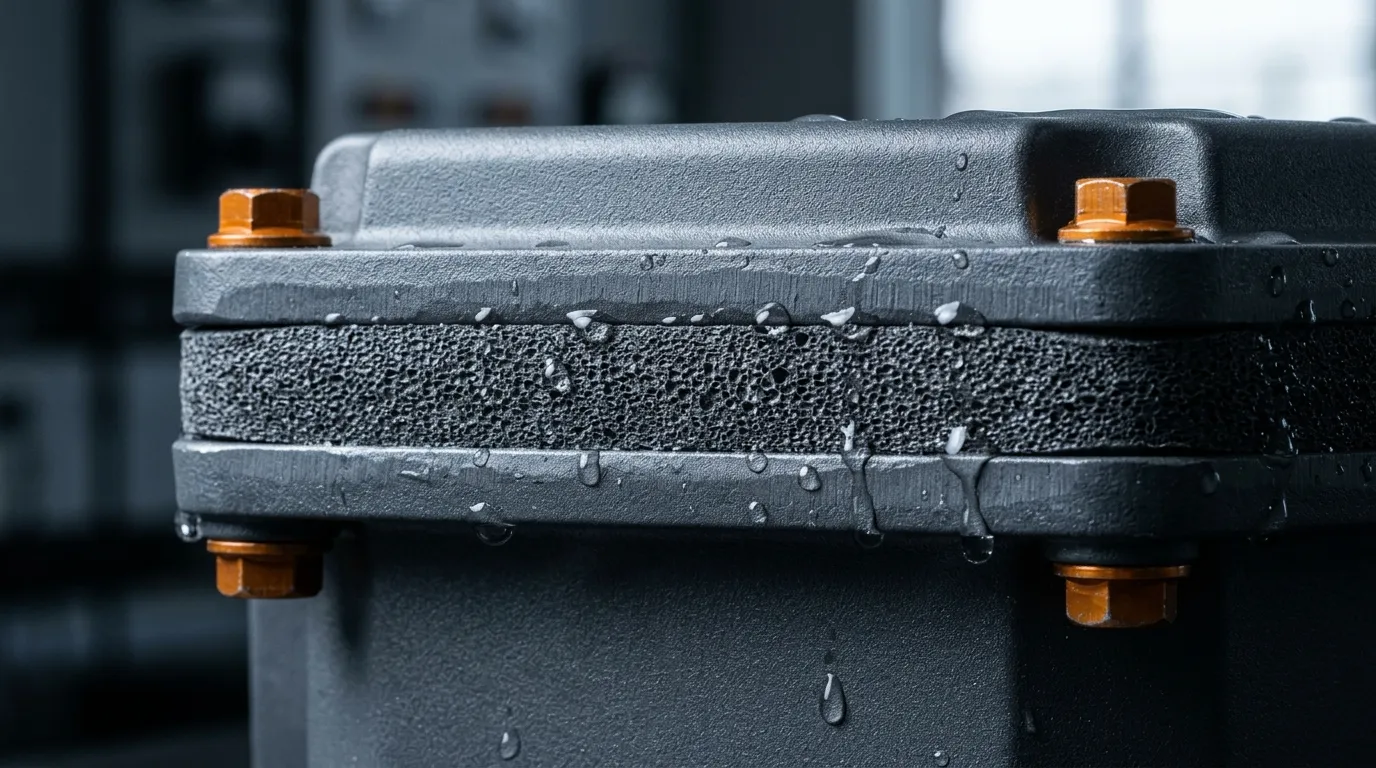
Your enclosure passed IP68 in the lab. Eighteen months later, a customer's unit comes back with water inside the connector bay. The gasket didn't fail dramatically — it just stopped pushing back. That slow loss of sealing force is compression set, and it is the single most common reason silicone foam gaskets for electronics sealing stop earning their IP rating.
This guide covers what IP68 actually demands from a gasket, why closed-cell silicone foam is usually the right answer, the five specs that predict long-term sealing, how to design the groove and squeeze, and how to specify a custom gasket without guessing. It draws on IEC 60529 test conditions, material standards, and first-party manufacturer specifications for IP68-rated closed-cell silicone foam gaskets. For the wider material family — densities, hardness grades, and where silicone foam fits alongside sponge and solid rubber — see our silicone foam sealing materials guide.
What "IP68" Actually Requires From a Gasket
IP ratings come from IEC 60529, the international standard for degrees of protection against solid particles and water. The code is two digits: the first covers solids, the second covers water. IP68 means IP6X — dust-tight, no ingress of dust under the standard's test — plus IPX8 — continuous immersion in water under conditions agreed between manufacturer and user, commonly interpreted as 1.5 m for 30 minutes for portable electronics. By contrast, IPX7 only promises temporary immersion at 1 m for 30 minutes, per the IP code definition.
| Rating | Solids | Water | Typical enclosure use |
|---|---|---|---|
| IP54 | Dust-protected | Splashing water | Indoor controls, HVAC electronics |
| IP65 | Dust-tight | Water jets | Outdoor telecom, industrial panels |
| IP66 | Dust-tight | Powerful water jets | Outdoor cameras, EV charging |
| IP67 | Dust-tight | 1 m immersion, 30 min | Portable instruments, connectors |
| IP68 | Dust-tight | Continuous immersion | Submersible sensors, outdoor electronics |
Two implications follow. First, an IP68 gasket is doing two jobs at once: staying dust-tight per IEC 60529 (IP6X) while holding back water under hydrostatic pressure — not just splash. Second, the rating belongs to the system, not the material. The enclosure stiffness, fastener spacing, venting, and the gasket all participate. A perfect gasket in a flexing plastic housing will leak at the corners; that is why the design guidance in this guide matters as much as the material choice.
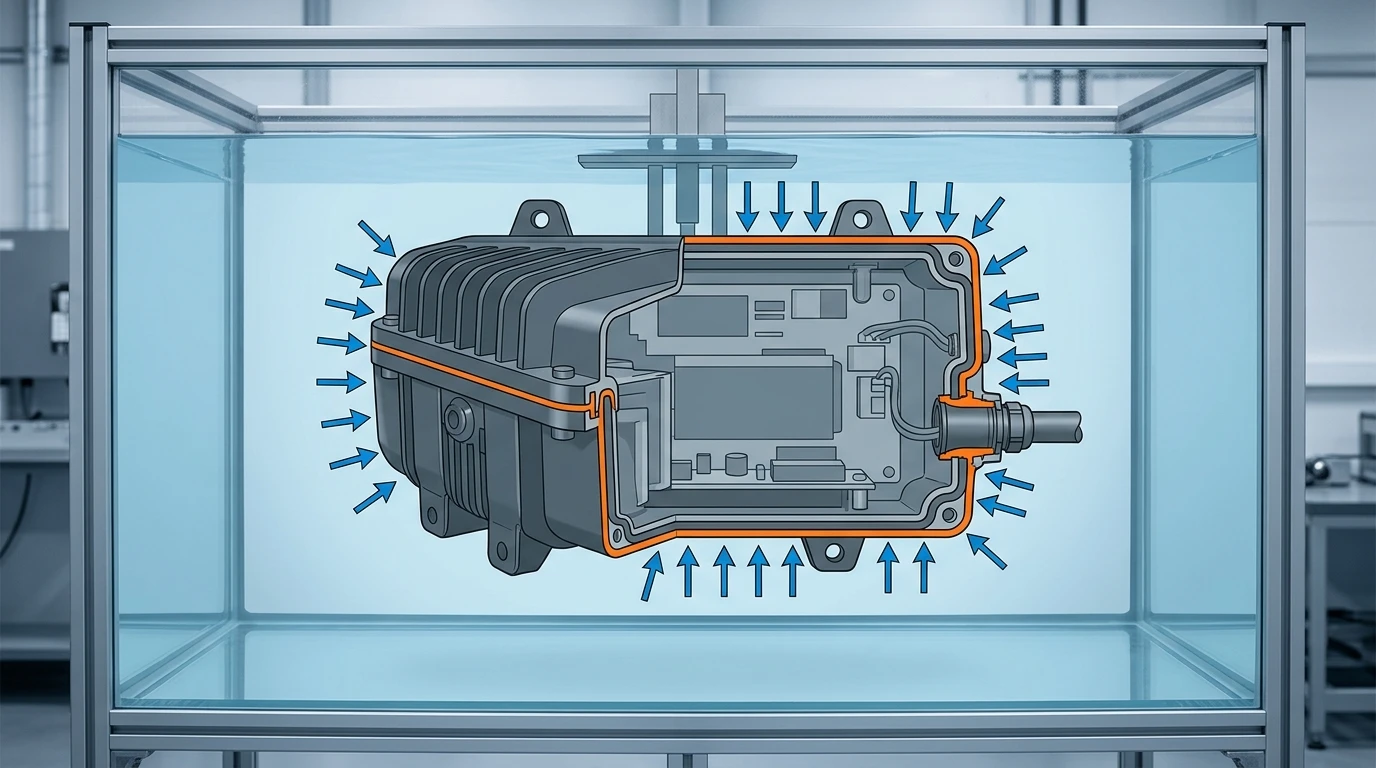
IEC 60529 defines IP68 as dust-tight plus continuous immersion — the harshest combination an electronics seal routinely faces.
Why Silicone Foam (Not Solid Rubber or EPDM)
Engineers often reach for EPDM or solid silicone rubber first because those materials are familiar. Both are the wrong default for modern electronics enclosures.
EPDM foam has poor long-term rebound: compression set above 15% is common, which means the seal force decays and the IP rating quietly expires. It also stiffens badly at low temperatures. Solid silicone rubber seals well but needs heavy compression — often several hundred kilopascals of force per metre of seal — which demands thick-walled housings, many screws, and high closure force. That is expensive and mechanically awkward for plastic enclosures with large perimeters.
Closed-cell silicone foam sits between the two: it compresses at low force (typically a few psi at 25% deflection for soft-to-medium grades, versus tens of psi for solid rubber), rebounds over years, and keeps its properties from about -55 °C to 200 °C. Industry references such as Rogers BISCO® silicone foams publish the same profile: wide temperature range, low compression set, UL 94 flame ratings, UV and ozone resistance. Those are exactly the properties an outdoor electronics seal needs.
One vocabulary note before the next section: "silicone foam vs silicone sponge" is a recurring question, and the distinction matters. Silicone sponge is a denser, fully closed-cell material with higher toughness; silicone foam is lighter and softer, and can be open- or closed-cell. Both have sealing roles — the IP-critical choice is the cell structure, which is next.
| Property | EPDM sponge | Solid silicone rubber | Silicone foam (closed cell) |
|---|---|---|---|
| Typical compression set | >15% | Low | Low (≤5–10%) |
| Seal force at 25% deflection | Moderate | High | Low |
| Temperature range | -40 to 120 °C | -55 to 200 °C | -55 to 200 °C |
| UV / ozone resistance | Moderate | Excellent | Excellent |
| Flame rating options | Limited | UL 94 | UL 94 V-0 |
Open Cell vs. Closed Cell: The Choice That Decides the Rating
Cell structure determines whether a foam gasket can hold water back at all. ASTM D1056, the standard specification for flexible cellular rubber, classifies these materials by cell type for exactly this reason.
Open-cell foam has interconnected voids. Air moves through it, so it is excellent for cushioning, acoustic damping, and light dust exclusion — and useless for water sealing. Water wicks through the interconnected cells under hydrostatic pressure.
Closed-cell foam has non-interconnecting cells. Each gas bubble is sealed inside its own wall, so water has no continuous path through the material. This is the structure required for IP65 and above. A closed-cell gasket under 15–30% compression forms a continuous barrier around the enclosure seam; the cell walls do the sealing work, not surface contact alone.
The practical metric is water absorption. A genuine closed-cell silicone foam absorbs almost nothing — the Z-FOAM®800 series, for example, specifies water absorption below 0.1% by weight, which is why it carries an IP68 rating. An open-cell or partially open material will show measurable absorption, and that number is a reliable canary: if the datasheet does not state water absorption, ask for it before you trust the IP claim.
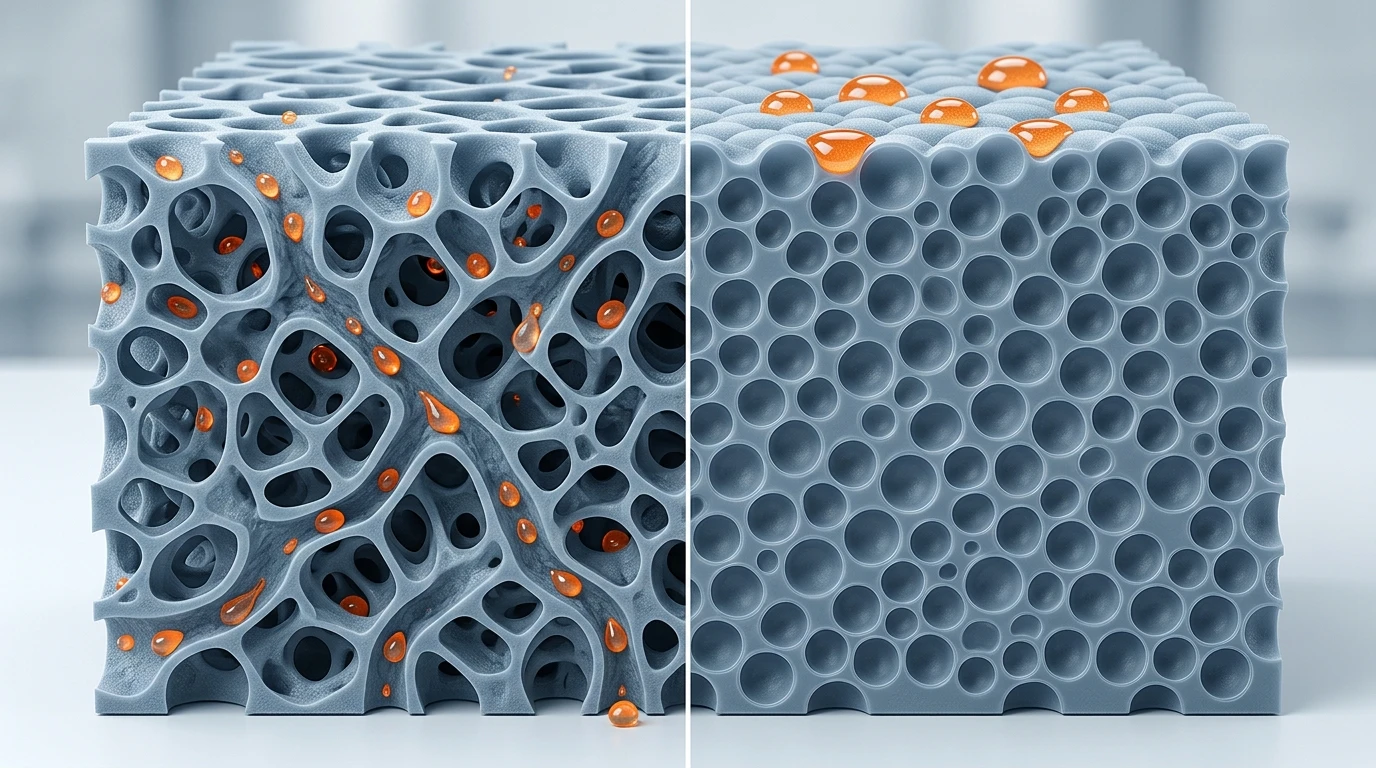
In open-cell foam water finds a continuous path; in closed-cell foam the sealed cells stop wicking — the difference between an IP68 gasket and a cushioning pad.
Five Specs That Predict Whether a Gasket Holds IP68
Datasheets list many numbers; five predict long-term sealing. Use them as your checklist when comparing silicone foam gaskets for electronics sealing.
1. Compression set. This is the predictor. Compression set measures how much of its original thickness a foam loses after being held compressed at temperature. Low is good: 5% or below at the service temperature means the gasket keeps pushing against the housing for years. Materials with 15%+ set lose seal force quickly — the failure mode that opened this guide.
2. Density and hardness. Soft grades seal with very low closure force, which suits thin-walled plastic housings; firmer grades resist extrusion under deep compression and hold shape during die cutting. Match density to the force your enclosure can actually deliver.
3. Operating temperature range. Outdoor electronics see thermal cycling every day. A gasket rated -40 °C to 200 °C covers automotive, telecom, and LED applications with margin.
4. Flame rating. Enclosures that carry electronics often require UL 94 V-0 flammability — the strictest common rating — for fire safety compliance. It is a pass/fail gate, not a preference.
5. Water absorption. Below 0.1% confirms closed-cell integrity. Higher numbers mean open cells, which means the "IP68" claim is doing the work the material is not.
| Spec | Why it matters | What to ask for |
|---|---|---|
| Compression set | Predicts long-term seal force | ≤5% at service temperature |
| Density / hardness | Sets closure force vs extrusion resistance | Shore 00 value + psi at 25% deflection |
| Temperature range | Survival through thermal cycling | -40 °C to 200 °C or wider |
| Flame rating | Fire safety compliance | UL 94 V-0 |
| Water absorption | Confirms closed-cell integrity | <0.1% by weight |
The Z-FOAM®800 series is a concrete example of a closed-cell silicone foam gasket built to this checklist: UL 94 V-0, IP68-rated, compression set ≤5%, water absorption <0.1%, and a -40 °C to 200 °C range, with UL Yellow Card coverage under file E331100. Any supplier you shortlist should be able to put equivalent numbers in writing.
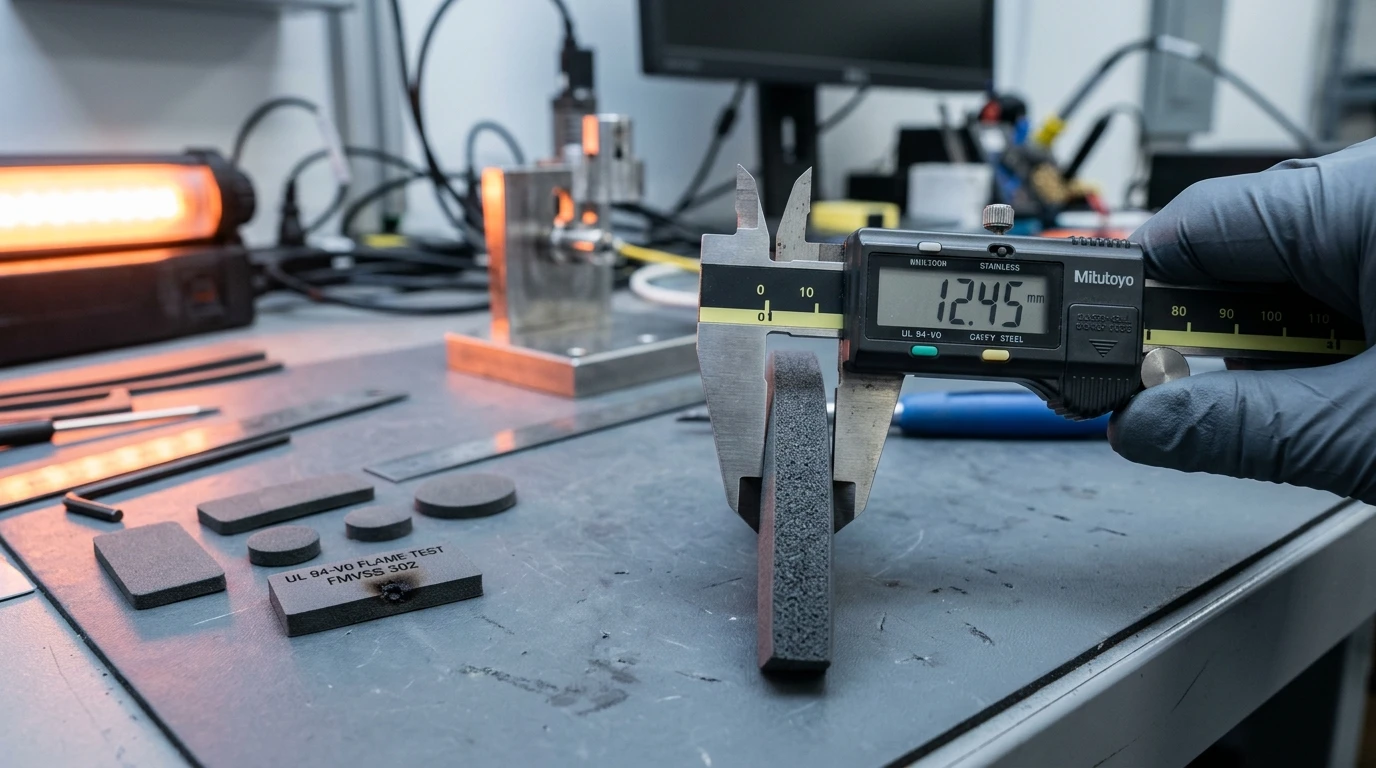
Five datasheet values separate an IP68-grade gasket from a cushioning pad: compression set, density, temperature range, flame rating, and water absorption.
Designing the Seal: Groove, Squeeze and Compression Force
Material selection is half the job; the other half is how the gasket is constrained. Three design parameters decide whether the seal works in production.
Squeeze (deflection). A closed-cell silicone foam gasket should be compressed roughly 15–30% of its free thickness, with very soft grades tolerating more. Below that range the seal is not continuous; far above it, the foam can extrude into gaps, the closure force climbs, and compression set accelerates. This is the same deflection logic used for other soft interface materials, and the trade-offs are covered in our thermal pad thickness and compression guide — different material, same physics.
Groove design. Machine the gasket seat so the foam is confined on three sides. The groove depth should be 70–85% of the gasket's free thickness (that is what produces the 15–30% squeeze), and the groove should not be overfilled — if the foam fills the groove completely with no room for lateral expansion, assembly force spikes and the gasket may walk out of the seat. A shallow, well-proportioned groove with the gasket held by silicone foam gasket tape or a pressure-sensitive adhesive backing also keeps the gasket in place during assembly, which prevents the classic displaced-gasket leak.
Compression force budget. Foam gaskets exist precisely because enclosure walls cannot take high forces. A soft closed-cell silicone foam delivers a working seal at a few psi of line pressure; a medium grade is still only in the 6–14 psi range at 25% deflection. Compare that with molded solid rubber, which can need an order of magnitude more, and you see why foam is the default for large-perimeter plastic enclosures.
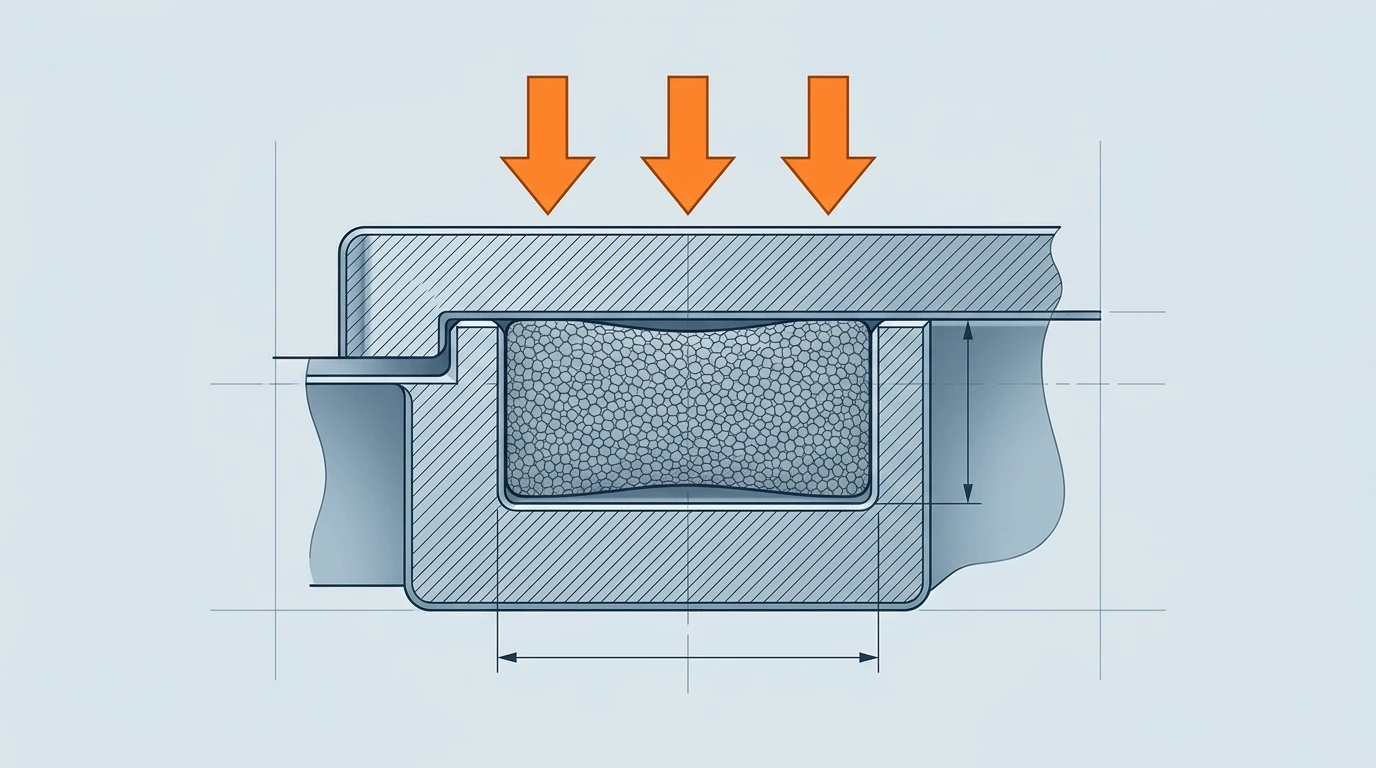
Constrain the foam on three sides, target 15–30% squeeze, and keep closure force within what the housing can deliver.
Where Electronics Sealing Fails — and What Holds
Field failures cluster into four patterns, and all four are preventable at the specification stage.
Compression set over time is the quiet killer: the seal holds the test, then loses force across thermal cycles and the first heavy rain finds the gap. Spec low-set foam. Gasket displacement during assembly happens when the gasket is not located — no groove, no adhesive — and gets pinched or shifted under the lid. Thermal cycling loosens fasteners and changes the gap, which is why the seal needs deflection margin, not just contact. Material degradation (UV on EPDM, ozone on many organics) is why silicone's inorganic backbone wins outdoors.
The applications that stress these mechanisms hardest are the ones silicone foam gaskets serve most: outdoor telecom and networking enclosures, LED drivers and luminaires, instrumentation, security cameras, and EV battery packs. Battery enclosures are a demanding case — vibration, thermal swing, and immersion risk all at once. Z-FOAM®800 has been used in this role, including an Indian EV manufacturer that adopted it for IP67/IP68 battery pack sealing with a claimed service life of 10 years or 200,000 km with no seal failure. Our EV battery pack sealing case study walks through that application in detail, and the Z-FOAM silicone foam gasket product range lists the available grades and formats. Where the same seam also needs shielding, EMI gaskets can share the joint — but that is a separate material decision, not a foam property.
Testing and Certifications to Ask For
An IP rating printed on a datasheet is a claim; the test report is the evidence. When you qualify a silicone foam gasket for an IP68 enclosure, ask for documents, not adjectives.
- IEC 60529 test reports — dust chamber and water immersion results from a test laboratory, with the test conditions (depth, duration) stated. For IPX8, the conditions are agreed between manufacturer and user, so the report must state yours.
- Flammability — UL 94 V-0 status, ideally backed by a UL Yellow Card (UL's flammability testing services describe the program). UL Yellow Card file numbers are publicly verifiable.
- Enclosure standards — UL 50 / UL 50E and the parallel NEMA enclosure ratings matter when the gasket is qualified as part of a rated enclosure, not just as a material.
- Chemical compliance — RoHS, REACH, and increasingly TSCA, Prop 65, and PFAS declarations, because electronics OEMs export into regulated markets.
- Quality systems — IATF 16949 for automotive supply chains, ISO 9001 for general manufacturing. These govern whether the production gasket matches the qualified sample.
Our materials certification and compliance hub lists the certification packages available on ZIITEK's product lines, including the UL Yellow Card file and third-party chemical test reports, so you can see what a complete compliance file looks like before you ask another supplier for theirs.
How to Specify and Source Custom Silicone Foam Gaskets
By this point the specification almost writes itself. A complete RFQ for an IP68 silicone foam gasket should state: enclosure material and wall thickness; groove dimensions; target squeeze (15–30%); density/hardness grade; operating temperature range; flame rating required (UL 94 V-0); water absorption limit (<0.1%); adhesive backing if needed; part format (die-cut part, sheet, or tape roll); and the IP rating target with test conditions. Volume and lead time close the loop.
Then qualify the supplier on three things beyond price. Die cutting and converting capability — a gasket is only as good as its cut edge and dimensional tolerance, so confirm the supplier runs its own die cutting or converting (the die cutting and custom converting capability outlined on ZIITEK's blog is an example of what to look for, including multi-layer composites and adhesive laminating). Certifications in force — UL Yellow Card, IATF 16949, ISO 9001, and current RoHS/REACH declarations, all verifiable. Prototype discipline — the supplier should cut samples, agree the test plan, and iterate on squeeze before production tooling.
When you are ready to compare candidates, ZIITEK manufactures Z-FOAM®800 closed-cell silicone foam gaskets with die cutting, adhesive application, and full compliance documentation, and will quote custom shapes from drawings. Request a sample kit and specification sheet through the contact page — sample testing is the fastest way to validate squeeze and closure force on your own enclosure.
An IP68 rating is earned at the drawing board, not in the test chamber: closed-cell structure for the water path, low compression set for the years after the test, and a groove that holds the gasket where it belongs. Specify those three things and the seal will still be working when the warranty runs out.