Low-Outgassing Thermal Pads: How to Read ASTM E595 Data
TML and CVCM answer different questions, and non-silicone is not automatically low outgassing. How to read ASTM E595 data before you qualify a thermal pad.
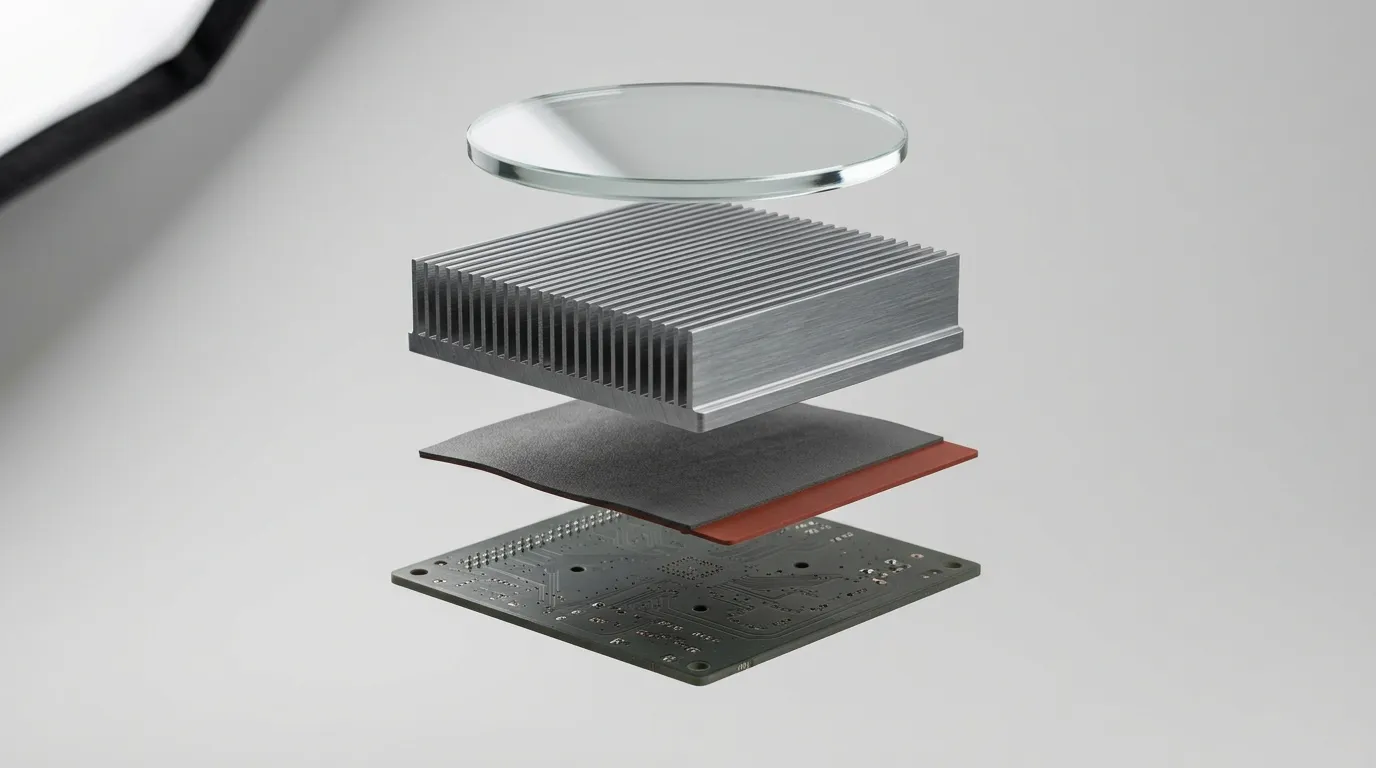
ASTM E595 reports three numbers for a material: total mass loss (TML), collected volatile condensable materials (CVCM) and water vapor regain (WVR). Read them as one scoreboard and you will make two expensive mistakes — treating a low TML as proof that a camera lens stays clear, and treating "non-silicone" as a synonym for low outgassing. Neither follows from the test. E595 weighs what leaves a small specimen in a vacuum oven and what condenses on a plate held at 25 °C; whether that condensate reaches your lens is a separate question the standard declines to answer.
This guide is about reading the numbers: what each measurement records, which conditions make results comparable, a worked example on a real datasheet line, the fields to demand in a report, and when ASTM E595 data is enough. For the wider document set a thermal material carries, see the certifications and compliance hub for thermal materials.
TML, CVCM and Optical Contamination Are Three Different Measurements
Two measured quantities and one outcome the test does not measure. Keeping them apart is the skill.
| Measurement | What it records | What it cannot tell you |
|---|---|---|
| TML (total mass loss) | Share of the specimen's initial mass that left during 24 hours at 125 °C in vacuum. Everything volatile at that temperature counts, water included. | Which species left, or how much would cross the enclosure to a surface. |
| CVCM | Share of the initial specimen mass that condensed on a collector at 25 °C — the fraction able to form a deposit on a cooler surface. | Whether anything condenses below 25 °C, where cold optics often sit. |
| Optical contamination | A system outcome: transmission loss, haze or fogging on the real optics after the real thermal and vacuum history. | Nothing about the material alone. Not an E595 quantity; no material test certifies it. |
Mass leaves the material, travels, and lands. E595 covers the leaving properly and the traveling only at one fixed temperature. The landing depends on geometry: pad-to-lens distance, view factor, optical surface temperature, run time. A pad losing 0.3% in a sealed box with nothing sensitive in line of sight is a different risk from the same pad 8 mm below a lens at −10 °C.
TML and CVCM also move independently. A hygroscopic material can lose several percent of its mass and deposit almost nothing, because most of what left was water; a heavily plasticized one can lose little and deposit most of it. The TML/CVCM pair is not a scoreboard: CVCM is the number that speaks to deposition, which is why it deserves more attention than the bigger, more quotable TML figure.
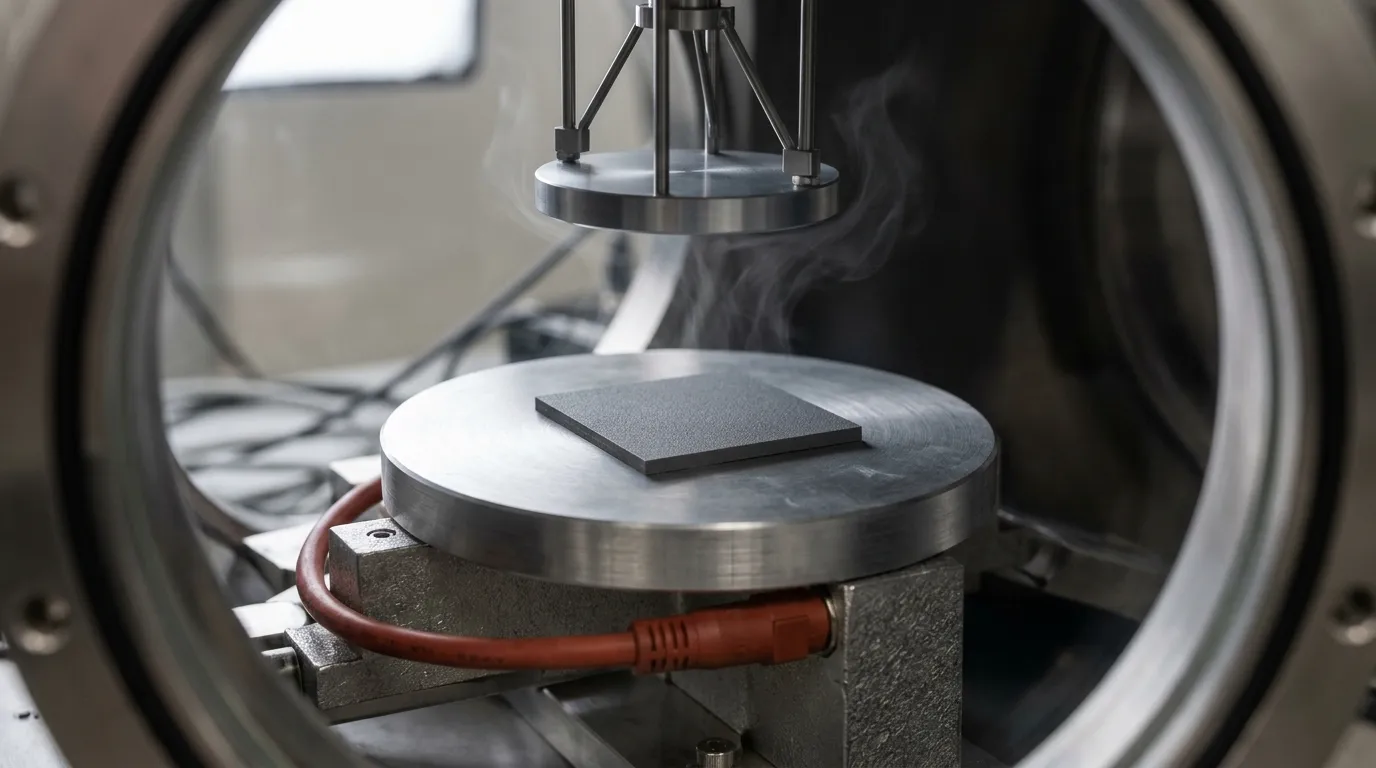
Illustrative render, not a ZIITEK equipment photo: a heated stage, a cooled collector, and 24 hours standing in for years.
What ASTM E595 Measures, and Which Conditions Make Results Comparable
ASTM E595-15(2021) fixes the apparatus and the arithmetic. A specimen is held at 125 °C for 24 hours below 7 × 10⁻³ Pa (5 × 10⁻⁵ torr); what condenses on a collector at 25 °C is weighed, and the specimen is re-weighed after conditioning at 23 °C and 50% relative humidity to give WVR. All three figures are expressed against the initial specimen mass.
Three sentences do most of a buyer's work.
- §1.4 calls the method "primarily a screening technique" that is "not necessarily valid for computing actual contamination on a system or component because of differences in configuration, temperatures, and material processing."
- §5.6 states that "materials that condense only below 25 °C are not detected."
- §1.5 records that 1.00% TML and 0.10% CVCM "have been used as screening levels for rejection of spacecraft materials" — and that acceptance criteria "shall be determined by the user."
That last clause is the one buyers skip. The pass mark is not in the standard; it is in your requirement document or the one your customer handed you. E595 ranks low outgassing materials against each other, not against your assembly. A program worried about a cold optical surface may set CVCM an order of magnitude tighter than 0.10%; a sealed housing with no optics may legitimately accept far more. "Meets ASTM E595" without the number and the limit it is compared against is not a specification.
Comparability is narrower than datasheets admit. §5.3 and §5.4 limit valid comparison to results from 125 °C specimen and 25 °C collector temperatures with similar collector geometry. §5.2 adds that 24 hours is not years of service, and that if expected operating temperatures exceed 65 to 70 °C the test temperature should be raised — at least 30 °C above the maximum service temperature.
Why Non-Silicone Does Not Automatically Mean Low Outgassing
Silicone pads volatilize mainly as low-molecular-weight cyclic siloxanes: the fraction that makes them soft is the fraction that migrates. A non-silicone binder removes that pathway, a real advantage in optics, where siloxane films are hard to remove. It does not remove the mechanism: outgassing is what any polymer does when warm and under vacuum, and a non-silicone pad is still a filled polymer compound.
What can leave: plasticizers and processing oils, coupling agents on the filler, antioxidants, residual resin or solvent from curing, and the adhesive on a liner or carrier film. None contains silicon, and all can condense. The condensate behaves differently, but a hydrocarbon film on a lens is still a film: what matters optically is thickness and refractive index, not which element it came from.
"Non-silicone" answers one question only: is the volatile fraction likely to be siloxane? It does not answer whether a grade is a low outgassing thermal pad. The defensible statement about a non-silicone thermal pad is the one backed by a test value for that grade, at a stated construction.

Illustrative render. A few hundredths of a percent of condensate is invisible on a datasheet and very visible on a lens.
Worked Example: Reading One Datasheet Line
Here is a real line from the Z-PASTER-100-15-02F datasheet: outgassing (TML) 0.30%, ASTM E595, alongside 1.5 W/m·K, 65 Shore 00, 0.25–5.0 mm and a −20 to 125 °C continuous-use range. Four readings matter; only the first is obvious.
The value is a TML, at E595 conditions, for this grade. 0.30% clears the historical 1.00% screening level. A screen, not a certificate: §1.4 and §1.6 say an acceptable result does not guarantee an uncontaminated system.
There is no CVCM on that row. TML says mass left; it does not say mass landed. For optics the missing number is the more decision-relevant one, and "not listed" is a request to make, not a value to assume.
The value belongs to that model. The 6.0 W/m·K grade in the same family publishes a different property table (density 3.3 g/cm³, 60 Shore 00, −45 to 125 °C) and no outgassing row at all. Different filler loading and binder ratio mean a different volatile budget; nothing about 0.30% transfers, and a series-level claim built by copying one number across seven part numbers is wrong.
Thickness changes the arithmetic. TML and CVCM are percentages of the specimen's own mass, and mass scales with volume: a 5 mm pad under the same footprint presents roughly ten times the material of a 0.5 mm pad, so the absolute mass available to migrate differs even when the percentage does not. Ask what specimen was tested and whether it matches the drawing.
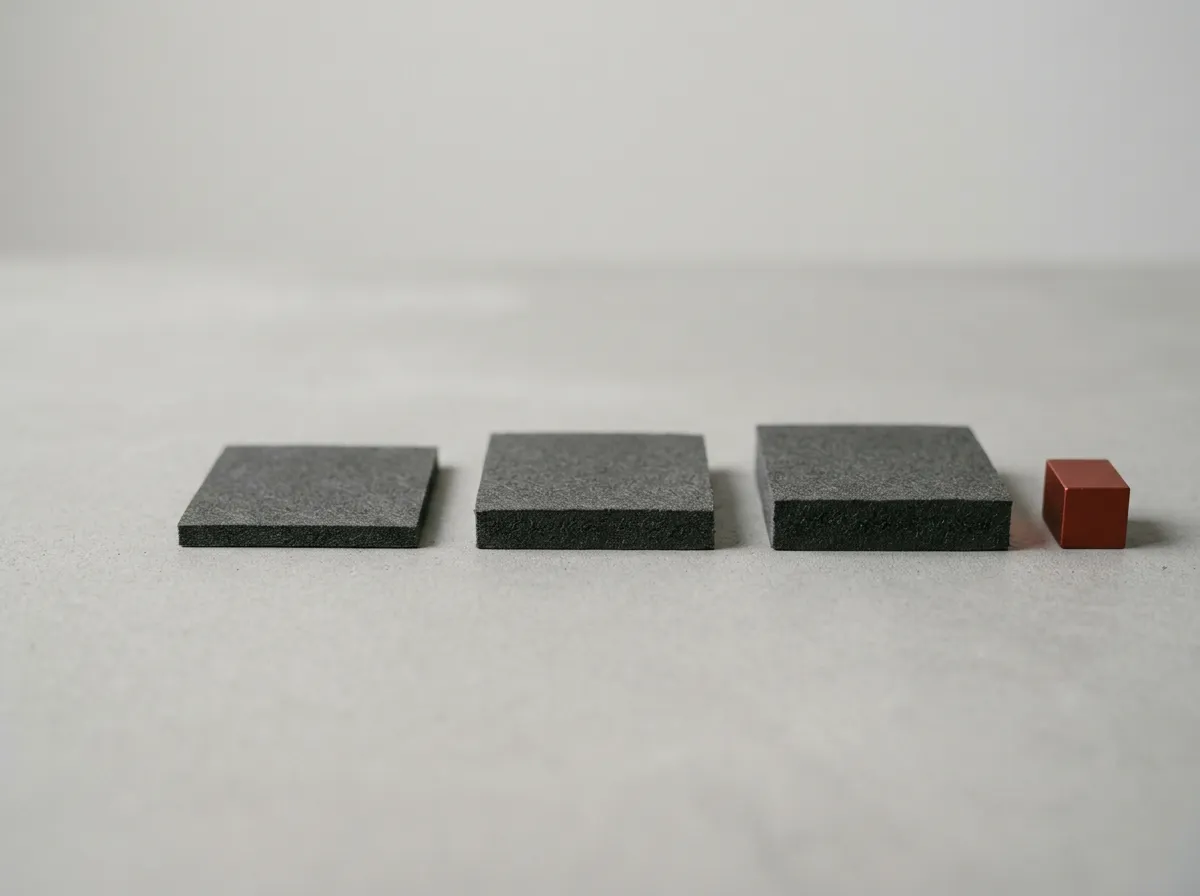
Illustrative render. The same formulation at three thicknesses is three different specimens in absolute terms.
The Report Fields to Request Before You Approve a Pad
A datasheet line is a claim; a report is evidence. Before you commission an ASTM E595 outgassing test, or accept one a supplier ran, ask for these, and treat a missing item as an open question.
- Standard revision tested — E595-15(2021) is current; older revisions should be named.
- Laboratory identity, accreditation, report number and date.
- Specimen description: mass, dimensions, thickness, construction (liner, adhesive, carrier), cure state if uncured.
- Pre-test conditioning — the standard's 23 °C / 50% RH protocol, and whether it was followed.
- TML, CVCM and WVR separately, plus a note on whether TML excluding WVR is available.
- Chamber pressure, specimen temperature and collector temperature actually used, not the nominal ones.
- Deviations — non-standard collector geometry, a different test temperature, a shorted soak, a specimen cut from a laminate.
- Lot traceability, if the number releases a production lot.
If the pad sits in line of sight of an optical surface, add system-level evidence: a witness-sample run, a fogging test on the assembled module, or a deposition model using CVCM as an input. That is a different test with a different owner; no material report substitutes for it.
Matching the Test to a Sealed, Optical or Vacuum Environment
Sealed electronics, moderate temperature, nothing optical in line of sight. E595 screening plus an acceptance line you wrote down is proportionate. Check service temperature against §5.2's 65–70 °C guidance: a pad at 90 °C is screened under conditions the standard says to adjust.
Optical assemblies with a view path from pad to lens. E595 is necessary and not sufficient — the 25 °C collector cannot see condensates that form only on a colder surface, and says nothing about how much reaches the lens. Pair material data with a witness-sample or module-level check, and treat CVCM as an input to that test rather than a verdict. Pads near sensors and lenses in 5G and optical modules hit this constantly, which is why thermal materials for 5G base stations and optical modules treats contamination as a layout problem as much as a material one.
High vacuum or spaceflight. Screening follows agency practice: NASA-STD-6001 sets out flammability, offgassing and compatibility requirements and procedures, and ECSS-Q-ST-70-02C is the European thermal vacuum screening standard. Published results can be checked against the NASA outgassing database, which holds over 13,000 material records with TML, CVCM and WVR columns plus each test's own temperature and duration.
The supplier request has the same shape in all three cases: the stack, the environment (temperature range, pressure, line of sight), your acceptance limit, and the grade. Send those four to the applications team and Z-Paster non-silicone grades can be quoted against them, with the E595 report for that grade where one exists — or arranged as part of qualification — plus a sample at the thickness you are buying. The report for the specific grade, never the family, belongs in your file.
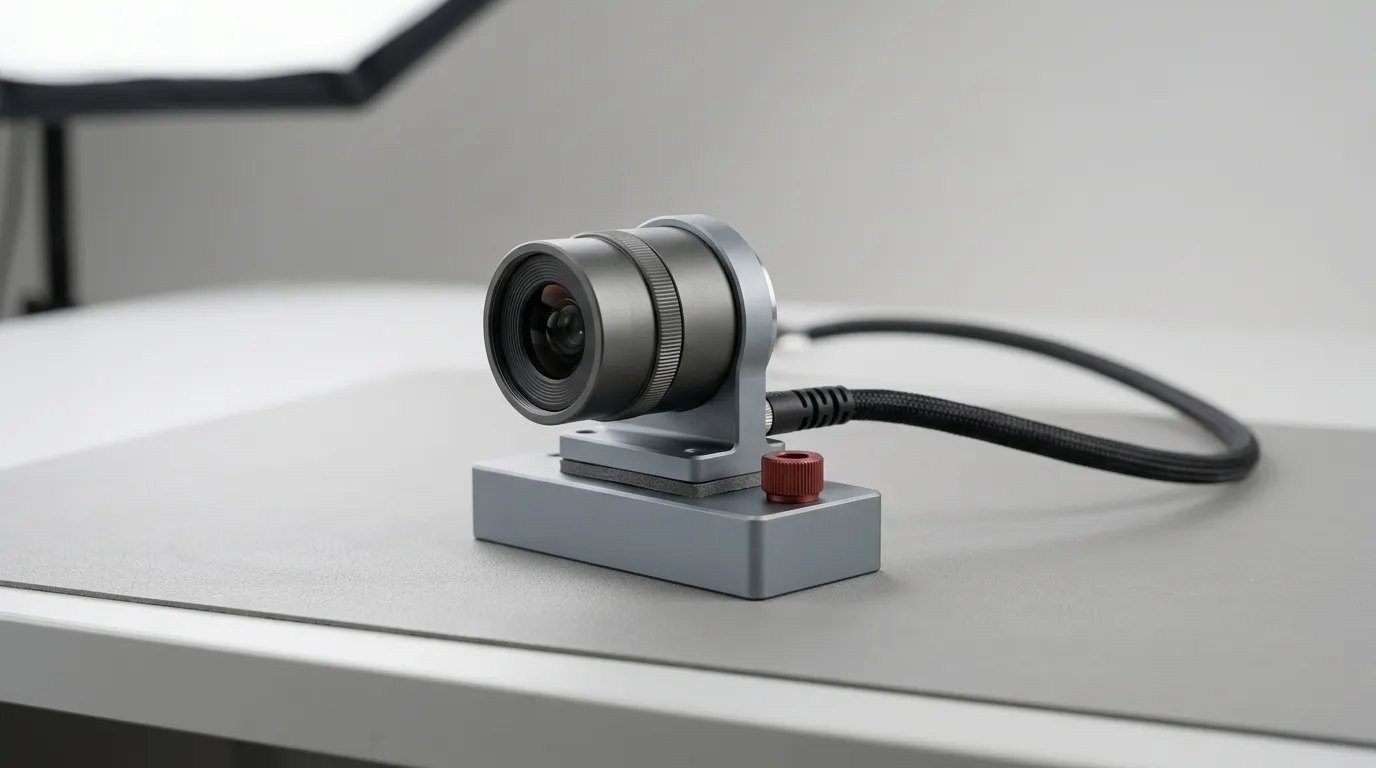
Illustrative render. Where a pad sits in the optical path, material data and layout are evaluated together.
Frequently Asked Questions
Is 0.30% TML considered low?
Against the historical 1.00% screening level, yes. Whether it is low enough depends on the limit your program set, and on CVCM, which the same datasheet may not list.
Does low outgassing mean a lens will not fog?
No. E595 does not detect materials that condense only below 25 °C, does not model how much condensate reaches a surface, and does not measure optical effect. Fogging risk is managed by combining material data with geometry and the coldest surface in the assembly.
Is non-silicone always lower outgassing than silicone?
Not automatically. The non-silicone binder removes the siloxane pathway, but plasticizers, processing aids and liner adhesives still volatilize, and some silicone formulations are deliberately stripped of low-molecular-weight fractions. Compare measured values for the two grades at the same construction.
What is the difference between TML, CVCM and WVR?
TML is the total percentage of mass lost. CVCM is the percentage that condensed on the 25 °C collector. WVR is the water the specimen took back up afterwards — which is why high TML and high WVR often appear together: most of that loss was moisture.