UL94 V-0 Silicone Foam: Flame-Retardant Sealing
Looking for UL94 V-0 silicone foam? V-0 is a flammability pass, not a sealing proof. Criteria, foam ratings, and a spec checklist that verifies the claim.
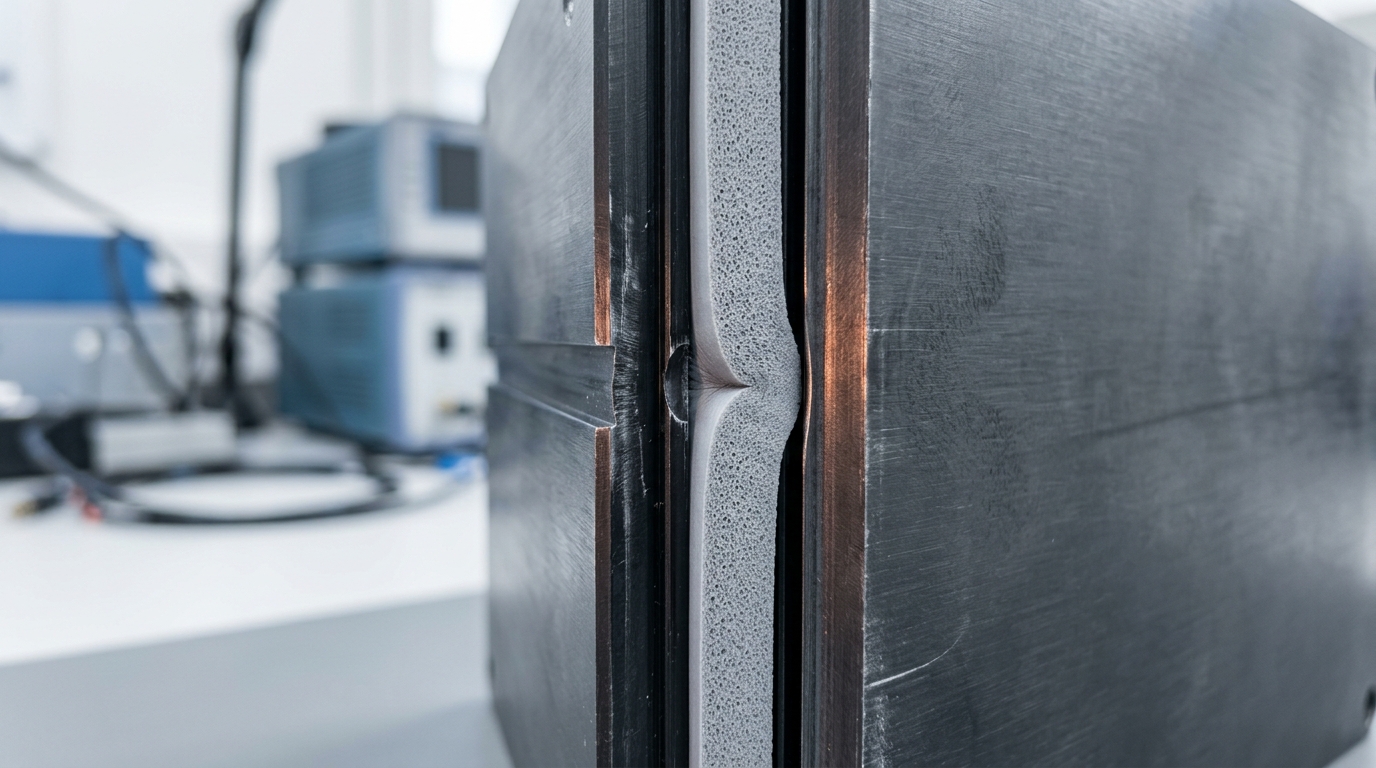
Your enclosure needs a gasket that seals against dust and water, and the compliance checklist next to it reads "flame rating: UL 94 V-0." Most suppliers will answer with a material name and a confidence that you cannot verify. UL94 V-0 silicone foam is real, and it is the right call for a lot of sealing jobs — but the rating proves less than the name suggests, and getting it wrong means either a failed audit or a seal that leaks.
This guide covers what the V-0 test actually measures, why silicone foam needs special chemistry to pass it, the foam-specific ratings that sit alongside V-0, and the specification checklist engineers use to verify a flame-retardant claim instead of trusting it. For the wider material family — densities, hardness grades, and how silicone foam fits alongside sponge and solid rubber — see our silicone foam sealing materials guide.
What the UL 94 V-0 Rating Actually Measures
UL 94 is the standard UL Solutions runs to classify how plastic materials, including rubber and foam, behave under small ignition sources. The V-0 rating comes from a vertical burn test: a bar-shaped specimen, typically 125 by 13 mm at the thickness you want approved, is clamped upright and exposed to a controlled flame twice for ten seconds each. To earn V-0, the specimen must stop burning within 10 seconds after each flame application, the five-specimen set must total no more than 50 seconds of burning, and nothing may drip burning material that ignites a cotton indicator placed underneath. Afterglow must also stop within 30 seconds. UL Solutions' overview of its UL 94 combustion tests publishes the criteria side by side, and this UL 94 classifications explainer from Protolabs walks through what each rating means in plain language.
Three implications matter more than the headline rating. First, V-0 is a specimen-level result: it applies to the material at the thickness that was tested, not to every sheet thickness a supplier sells. Second, it is a pass/fail gate — V-0, V-1 and V-2 differ only in how long burning is allowed to continue and whether dripping is permitted, not in any measure of smoke, toxicity or heat release. Third, the test says nothing about your assembled product: UL 94 ratings are one input to system-level fire safety decisions made under standards such as UL 62368-1 for ICT equipment, where the enclosure and its ventilation design share the responsibility with the gasket.
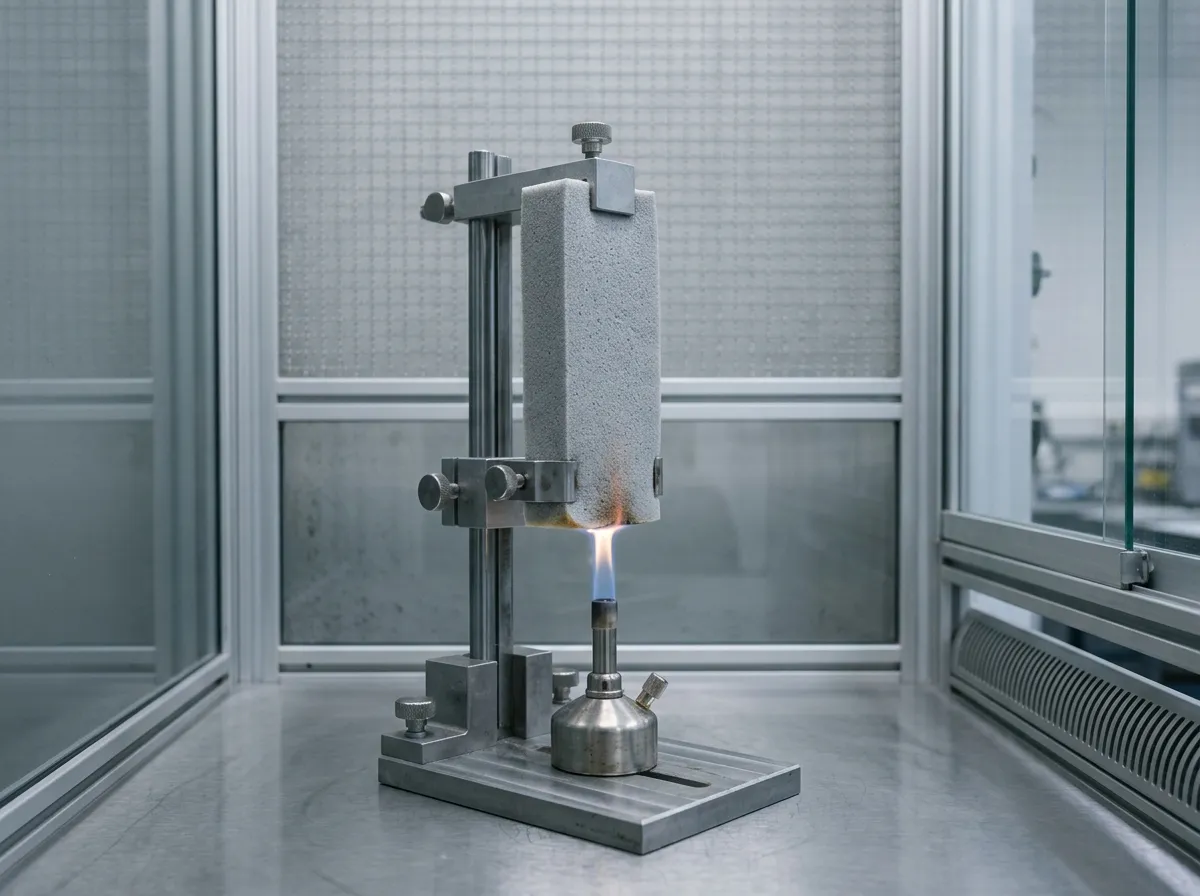
A V-0 verdict depends on a vertical specimen stopping burning within 10 seconds of each flame application, with no flaming drips.
Why Silicone Foam Needs Chemistry to Reach V-0
Unformulated silicone rubber is heat-stable but not fireproof: its organic methyl groups will burn once a flame is present, which is why suppliers of flame-rated silicones describe standard grades as capable of burning. Getting a silicone foam to V-0 is a formulation problem, not a material inheritance. Manufacturers add flame-retardant chemistry — typically platinum-catalysed systems, ceramic or metal-hydroxide fillers, or combinations that interrupt combustion — and those additions change the foam's behavior in ways a designer can feel: softness, color (flame-rated silicone foam is usually grey, black or off-white rather than translucent), density, and cost.
Foam makes the job harder in one specific way. A solid sheet burns from its exposed surfaces; a foam multiplies those surfaces into thousands of thin cell walls with a large surface-to-volume ratio. The same polymer that passes V-0 as a 3 mm solid bar may behave differently as a low-density foam, because thin walls ignite and propagate more easily. That is why a flame-retarded foam is engineered as a foam — cell size, wall thickness and density are tuned together with the chemistry, and why the flame rating on a foam datasheet is meaningful only when it was earned on a foam specimen.
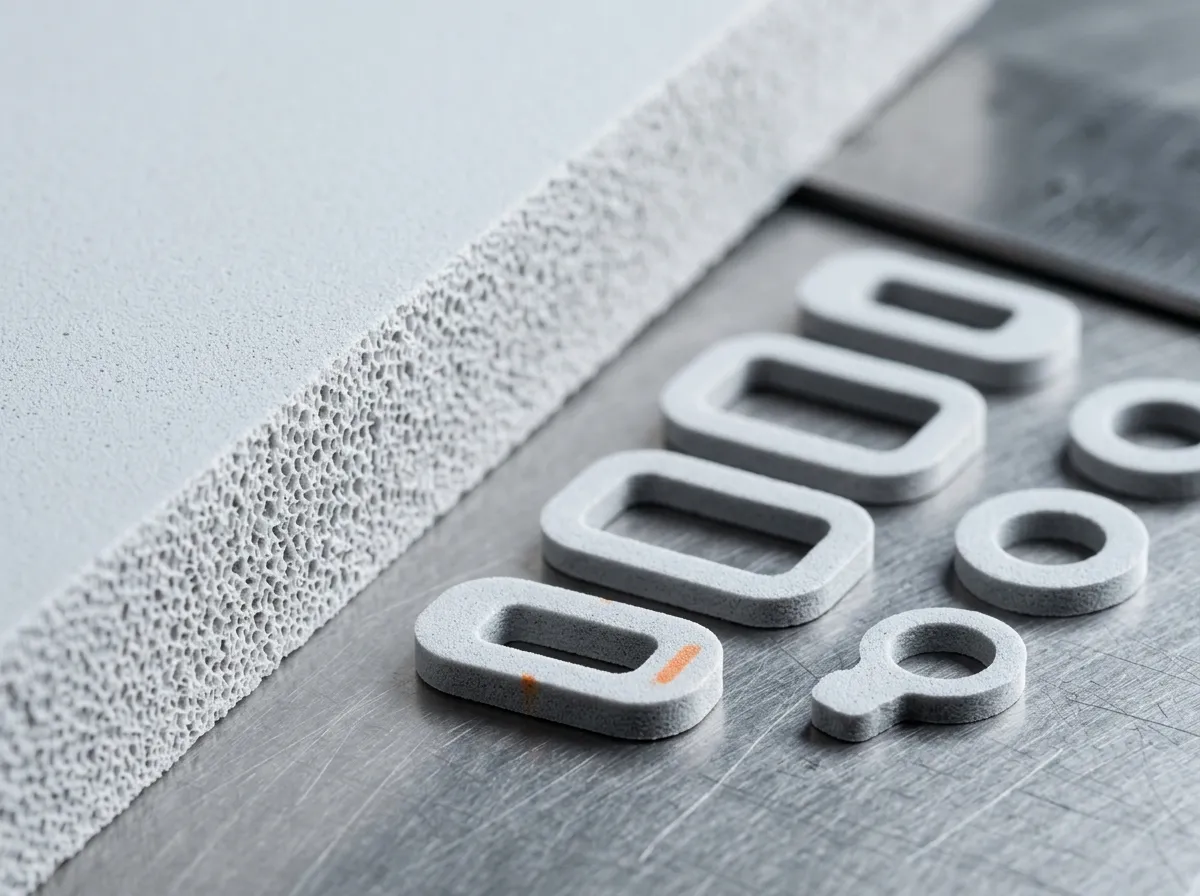
Flame-retarded silicone foam is a formulation choice: grey or black grades carry the chemistry, cell structure and fillers tuned as one system.
Foam Has Its Own Ratings: HBF, HF-1, and Where V-0 Fits
A common point of confusion on the SERP is worth clearing up: UL 94 does not treat foam and solid plastic as the same specimen. Foamed materials are also classified under dedicated horizontal-burning procedures — HBF, HF-1 and HF-2 — where a horizontal foam specimen is exposed to a flame and judged on burn rate and whether it self-extinguishes before a reference mark. Very thin materials get their own vertical-burning classification, the VTM family (VTM-0, VTM-1, VTM-2). The UL 94 entry on Wikipedia maps the whole family, and UL Solutions' test overview lists the foamed-material ratings alongside the V ratings.
So when a supplier says "UL 94 V-0" about a silicone foam sheet, they mean the foam was tested under the vertical procedure and passed — which is legitimate for sheet goods of sufficient thickness. When they say "HBF" or "HF-1," they mean the foam-specific horizontal procedure. Both are real flame-retardant statements; they are just different tests with different severities.
| Rating | Specimen tested | Test procedure | What the rating tells you |
|---|---|---|---|
| V-0 | Solid bar, e.g. 125 × 13 mm | Vertical burn, two 10-second flame applications | Self-extinguishes within 10 s per application; no flaming drips that ignite cotton |
| HBF, HF-1, HF-2 | Foamed material | Horizontal burn of foam | Burn rate or self-extinguishing before a reference mark; drips tolerated only at HF-2 |
| VTM-0, VTM-1, VTM-2 | Thin film or sheet | Vertical burn of thin material | Same self-extinguishing logic as V-0, adapted for thin substrates |
Two questions separate the careful supplier from the careless one: which test was actually run, and at what thickness? If the datasheet does not name the procedure and the thickness, the claim is incomplete. Note also that "silicone sponge" and "silicone foam" are used almost interchangeably in product listings — sponge is the denser, fully closed-cell cousin — so match the rating to the exact grade you are buying, not to the category page you found it on.
V-0 Does Not Make a Seal
Here is the sentence that saves the most engineering time:
A V-0 rating says nothing about whether the material seals. The vertical burn test does not involve water, pressure, compression or aging.
A foam can self-extinguish beautifully and still be open-cell, sponge-like and leaky. Flame retardance and sealing are two independent spec sheets that happen to be printed on the same material.
If your application needs both, treat V-0 as the gate and then specify the sealing properties on their own terms:
- Cell structure. Closed-cell foam blocks water and dust; open-cell foam absorbs and wicks. This single choice decides whether the material can seal at all.
- Compression set. The percentage of original thickness a foam loses after being held compressed at temperature. Low set (roughly 5% or below at service temperature) means the gasket keeps pushing against the housing for years. This is the number that predicts seal life.
- Density and hardness. Softer grades seal with low closure force on thin-walled plastic housings; firmer grades resist extrusion and hold shape during die-cutting.
- Temperature range. Outdoor and automotive electronics cycle daily; a range around -55 to 200 °C covers most enclosure duty with margin.
- Water absorption. A low number confirms closed-cell integrity. If the datasheet does not state it, ask — the number is the fastest canary for an open-cell impostor.
The mechanical values on a silicone foam datasheet are normally measured under ASTM D1056, the standard specification for flexible cellular rubber (sponge or expanded), which also defines how cell type and compression properties are characterized. For the groove design, squeeze and test-condition details that turn these specs into an IP-rated assembly, our guide to silicone foam gaskets for electronics sealing goes deeper — the flame rating buys you compliance, but the seal still has to be engineered.
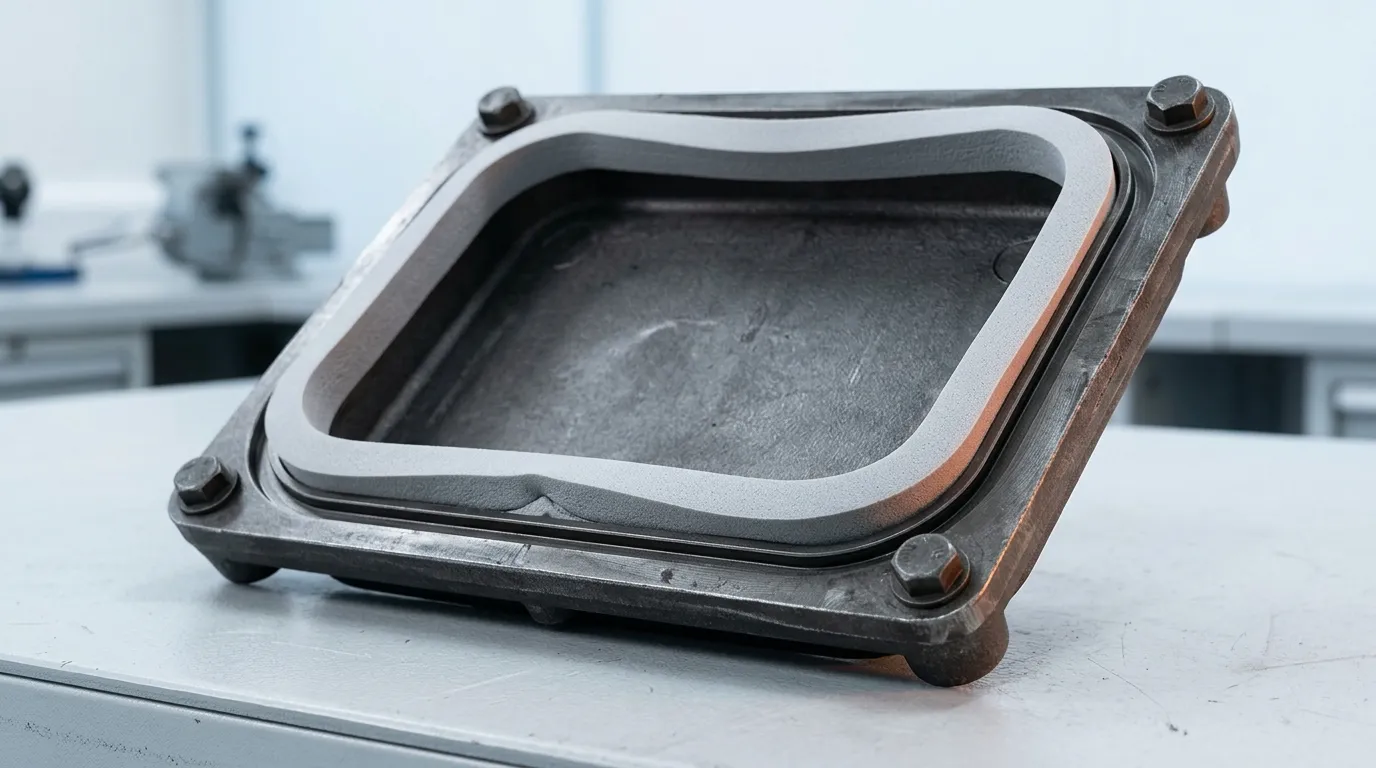
V-0 and sealing live on separate spec sheets: the burn test never touches water, pressure or compression set.
Where V-0 Silicone Foam Seals Earn Their Keep
Flame-retarded foam earns its keep wherever a seal or cushion sits inside equipment that carries electrical energy and a flammability requirement. The pattern repeats across industries:
- Electronics enclosures and IP-rated housings, where the gasket is part of the flame path review under product safety standards such as UL 62368-1 and IEC 62368-1.
- EV battery packs and charging infrastructure, where cell cushions, cover seals and module gaskets sit close to high-energy components. Manufacturers of UL 94 V-0 silicone sponge and foam routinely target battery seals and EV battery insulation, and flame-retarded cushioning reduces the fuel a fire could spread through — without pretending the gasket itself contains a thermal event.
- LED drivers, power supplies and HVAC controls, where heat, dust and flammability reviews meet in one small enclosure.
- Outdoor telecom and charging piles, which add UV, ozone and weather aging on top of the fire-safety requirement.
The through-line: in all of these, the flame rating comes from the end-product standard or the customer's specification, and the material answers it grade by grade. For a full map of where foam, pads, gap fillers and heating films each do their job inside a battery pack, see our EV battery pack sealing and thermal management guide.
Spec It Right: Verifying V-0 Claims Before You Buy
A UL 94 rating is only as trustworthy as its paper trail. Here is the verification sequence that separates a real V-0 foam from a marketing claim.
1. Ask for the UL file, then check it yourself. A genuine rating sits on a UL-recognized component program: the manufacturer holds a file (the "yellow card" for plastics and rubbers) that lists the grades, thicknesses and ratings UL actually tested. UL Solutions explains how to read the yellow card, and the public UL Product iQ database lets anyone search certification records by company, model or file number. If the supplier cannot name a file you can look up, treat the rating as unverified.
2. Confirm the rating on the grade, not the family. A product line can carry V-0 on most grades while a soft grade goes without it. The Z-FOAM®800 silicone foam family from ZIITEK is a good example of how grade-level honesty looks: the range page lists seven of nine grades as UL 94 V-0, and the two 10SC grades — Z-FOAM-800-10SC and Z-FOAM800-10SC-NS3 — are explicitly shown without the rating. Always read the line for the exact part number.
3. Match thickness. Confirm the rating was earned at or below the thickness you plan to use, or ask the supplier to confirm the thinner gauge is covered by the same file entry.
4. Read the datasheet numbers, not the bullet points. A published grade shows what a complete, verifiable sheet looks like — the Z-FOAM-800-10SEC flame-retardant silicone foam below is transcribed from its official datasheet, with the UL file published alongside the rating:
| Property | Z-FOAM-800-10SEC (typical) | Why it matters |
|---|---|---|
| Flame rating | UL 94 V-0 (UL file E331100) | The flammability gate, with a file you can look up |
| Density | 0.35 ± 0.03 g/cm³ | Confirms a true low-density foam, not a rubber sheet |
| Compressive stress at 25% deflection | 65 ± 10 kPa | The closure force the housing must supply |
| Compression set | ≤ 5.0% | Predicts whether the seal still pushes back in years |
| Service temperature | approx. -60 to 200 °C | Thermal-cycling margin for outdoor and battery duty |
| Thermal conductivity | approx. 0.06 W/(m·K) | Insulating — chosen when the seal must not conduct heat |
The manufacturer publishes this data on the Z-FOAM-800-10SEC product page, and the full Z-FOAM-800 silicone foam gasket range documents all nine grades with the same grade-by-grade transparency.
5. Ask how the grade is supplied. Flame-retarded foam is normally die-cut to a two-dimensional outline or supplied as sheet and roll stock, often with a pressure-sensitive adhesive backing. Tolerances and edge quality depend on the grade's density and hardness, so confirm converting capability with the supplier rather than assuming it.
Five Answers to Demand From Any UL94 V-0 Silicone Foam Supplier
Before you specify, put these five questions in front of the supplier — the answers cost them nothing and save you a failed audit:
- Which UL 94 test procedure and what thickness earned the rating on this exact grade?
- What is the UL file number, and can I find this grade in UL Product iQ?
- Is the material closed-cell, and what is the water absorption number?
- What is the compression set at the service temperature, and the 25% compression stress?
- What thickness range, sheet/roll formats and die-cutting or adhesive options are available?
Flame-retardant silicone foam is a mature, specifiable material: closed-cell grades carry real V-0 ratings, seal against dust and water when the mechanical specs are right, and survive decades of thermal cycling. The discipline is in the verification — let the datasheet and the UL file do the arguing, not the sales page. When you have drawings and a target thickness, ZIITEK's applications engineers will confirm grade-level ratings and compression behavior before you commit to a part number.