TIR26000-120 Graphene Thermal Pad Test on an RTX 5080
Ziitek's October 2026 product introduction reports a 15-hour, 360 W NVIDIA RTX 5080 evaluation in which TIR26000-120 recorded a GPU temperature of 69 °C. This laboratory reference helps engineers frame a thermal-interface qualification test; it describes the reported setup rather than a customer deployment or a temperature guarantee for another GPU assembly.
The engineering question
Selecting a thermal interface for a high-power GPU requires more than comparing material conductivity figures. The contact area, assembled thickness, clamping pressure and electrical clearances affect which material can be qualified in the hardware.
This reference examines the temperature readings reported for five material entries on an RTX 5080. It provides a concrete starting point for evaluating the TIR26000-120 graphene thermal pad alongside liquid-metal and grease alternatives. The source does not identify an external customer, a server installation or a production qualification programme.
Reported test setup
Item | Information provided by Ziitek |
|---|---|
Test device | NVIDIA RTX 5080 graphics card |
Reported test power | 360 W |
Reported test duration | 15 hours |
Workload software | FurMark 2.10.2 |
Monitoring software | HWiNFO 8.48 |
Reported measurement | GPU temperature, °C |
Source | TIR26000 graphene thermal pad product introduction, updated 10 October 2026, slide 11 |
The brief does not fully specify ambient temperature, heatsink and fan settings, mounting pressure, installed material thickness, the GPU sensor definition or repeat-run uncertainty. Those details should accompany a qualification comparison. The 15-hour duration does not establish a long-term service-life rating.
Temperature readings in the reference
Material entry | Material type | Reported GPU temperature |
|---|---|---|
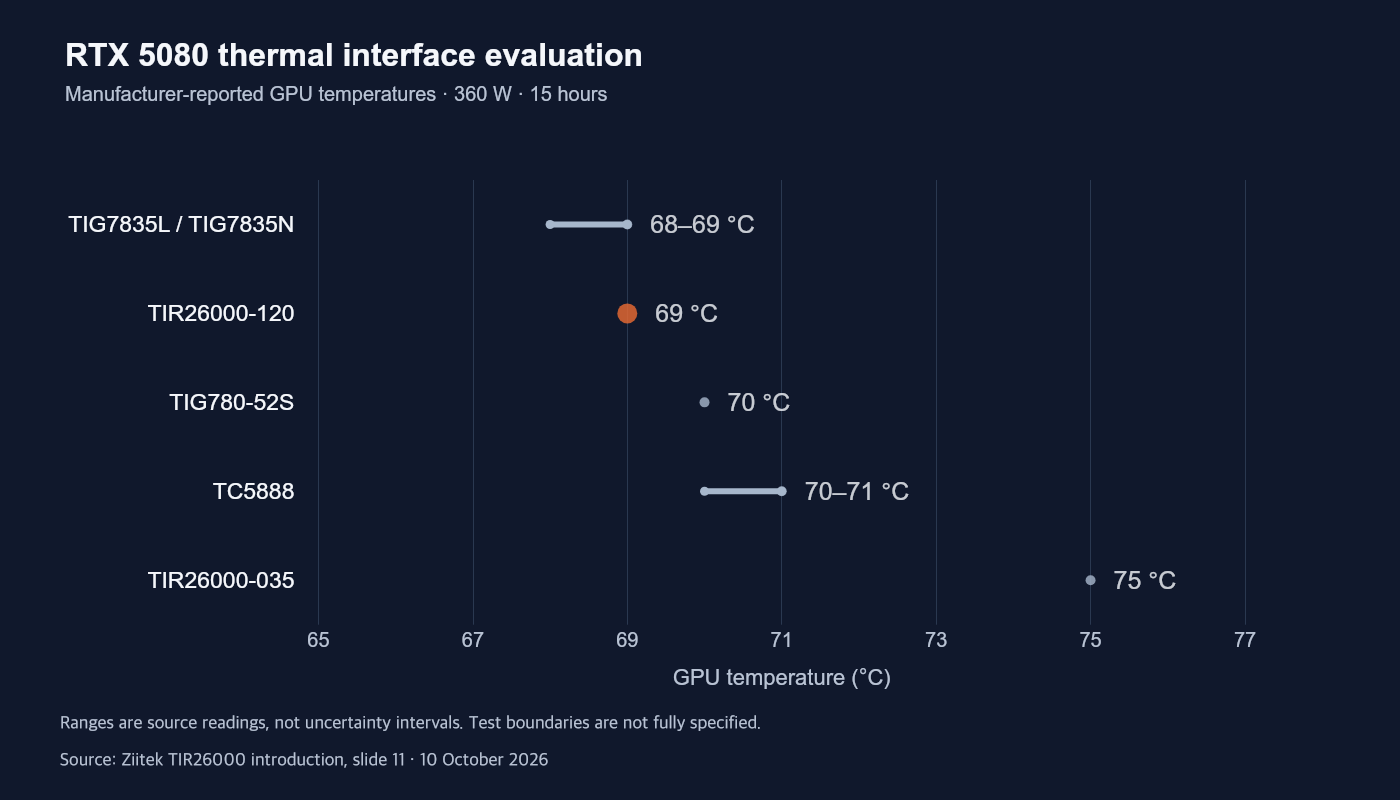
TIG7835L / TIG7835N | Liquid metal; grouped in the source | 68–69 °C |
TIR26000-120 | Graphene thermal pad | 69 °C |
TIG780-52S | Thermal grease | 70 °C |
TC5888 | Thermal grease | 70–71 °C |
TIR26000-035 | Graphene thermal pad | 75 °C |
These are the values printed in the reference, including its grouped liquid-metal entry and temperature ranges. The ranges are not stated measurement-uncertainty intervals. No averages, statistical significance or universal material ranking can be established from this table alone.
What this result supports
TIR26000-120's reported 69 °C reading was close to the liquid-metal readings in this reference. It makes the pad a candidate for a controlled comparison when an engineering team is considering a pad-format interface for a GPU assembly.
The result does not show that a graphene pad will match liquid metal on every device. Differences of one or two degrees should be interpreted with the missing environmental, assembly and measurement details in mind. The table also does not demonstrate lower system power consumption, increased clock speed, reduced maintenance cost or production yield improvements.
TIR26000-035 serves a different selection requirement involving thickness and compressibility. Its reported GPU temperature should not be used alone to decide whether it fits another assembly's gap and force limits.
Keep the GPU result separate from the material specification
The TIR26000-120 product page lists a 0.30 mm nominal thickness, a 90 × 90 mm standard sheet and thermal impedance ≤0.009 °C·in²/W at 50 psi, measured using ASTM D5470.
That thermal-impedance value is a separate material/interface measurement. It is not the GPU temperature, and ASTM D5470 is not identified as the method for the RTX 5080 bench run. A GPU temperature reading cannot be converted into an interface thermal resistance without the necessary temperature differences, heat-path information and boundary conditions.
The pad is electrically conductive. It must not be used as an electrical insulation layer. Review exposed circuitry, clearance and pad placement before evaluating a candidate part.
How to plan a comparable assembly test
- Define the heat-source contact area, available gap and target compressed bond-line thickness.
- Record the heatsink, airflow or fan control, ambient temperature and mounting arrangement.
- Specify the workload and monitoring channel, and identify whether the reading is GPU temperature, hotspot temperature or another sensor output.
- Compare materials under documented assembly conditions and repeat the evaluation to assess variability.
- Add the thermal-cycling, contamination and handling checks required by the intended application. A short bench run does not replace these checks.
The purpose is to qualify a complete stack. A material property, a single reported temperature and a long-term reliability result answer different engineering questions.
Request a grade-specific review
For a TIR26000-120 sample or die-cut review, provide the interface drawing, contact area, nominal gap, available clamping pressure, electrical-isolation requirements, device power and intended environment. Include the baseline material and the acceptance criteria for the assembled hardware.
- Review TIR26000-120 specifications and request a sample.
- Compare the thermal graphite and interface-material range.
- Discuss a GPU interface evaluation with Ziitek.
Source: Ziitek TIR26000 graphene thermal pad product introduction, updated 10 October 2026, slide 11. Product-specification context comes from the linked TIR26000-120 datasheet. These are manufacturer-reported results, not an independent review or a named customer's production deployment.
Cover chart: GPU temperature readings reproduced from the Ziitek reference table. The plotted ranges are source readings, not uncertainty intervals; the chart is not a photograph of a customer installation.
Related thermal-management references
AI servse.webp)
Frequently asked questions
Does the test prove that graphene pads perform as well as liquid metal?
It reports 69 °C for TIR26000-120 and 68–69 °C for the grouped liquid-metal entry in this reference. It does not establish equivalent performance across different devices or mounting conditions. Request the complete protocol before using the comparison for qualification.
Does a 15-hour test demonstrate long-term reliability?
No. It documents the reported run duration. Service-life, cycling, contamination and mechanical requirements need their own qualification evidence.
Is the 69 °C reading a thermal-impedance specification?
No. It is a reported GPU temperature. The material's area-normalized thermal impedance is specified separately, with thickness, pressure and a test method.
Can this pad provide electrical insulation?
No. TIR26000-120 is electrically conductive. An application that needs electrical isolation requires a separately qualified insulating solution.