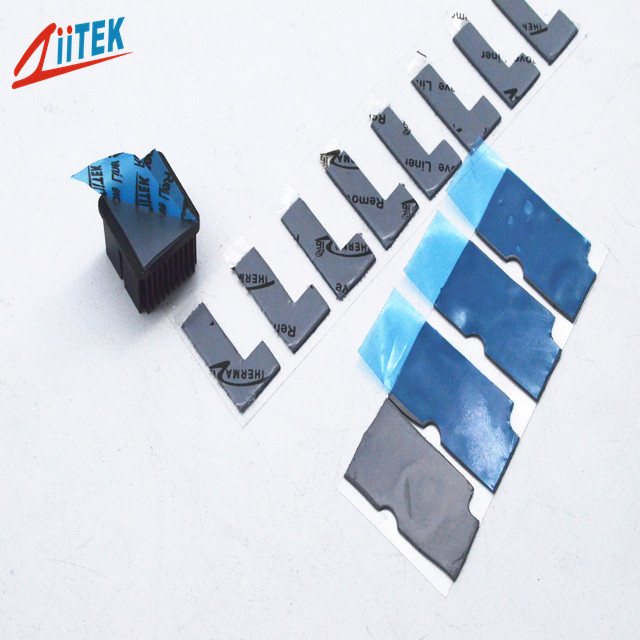
TIF800TS Silicone Thermal Pad
- Hardness (Shore OO)
- 45
- Density (g/cm³ )
- 3.3
- Recommended Operating Temperature (°C)
- -40~200
- Breakdown Voltage (V/mm)
- ≥5500
- Dielectric Constant @1MHz
- 7.0
- Thermal Conductivity (W/m·K)
- 16.0
TIF®800TS Series — Product overview
TIF®800TS Series is a high-end compressible thermal pad that meets top-level cooling requirements while also ensuring excellent assembly workability. Through an innovative material formulation, it successfully achieves an ideal combination of ultra-high thermal conductivity and moderate hardness. This unique performance balance allows it to efficiently handle the cooling challenges posed by extremely high heat fluxes, while also possessing good mechanical strength and compressibility, making it easy to manufacture and install. It provides a thermal interface material solution with both outstanding heat dissipation performance and high reliability for high-power-density electronic devices.
TIF800TS — what to validate in production
Excellent thermal conductivity
Good softness and filling properties
Self-adhesive without the need for additional surface adhesive
Good insulation performance
What is the application of thermal conductive pad?
thermal conductive pad widely uesd in 5G, Aerospace, AI, AIoT, AR/VR/MR/XR, Automotive, Consumer Devices, Datacom, Electric Vehicle, Electronic Products, Energy Storage, Industrial, Lighting Equipment, Medical, Netcom, Panel, Power Electronics, Robot, Servers, Smart Home, Telecom, etc.

TIF800TS — datasheet specifications
Values below are transcribed from the official datasheet. Use the linked PDF for sign-off and lot-specific CoA.
Request application engineering support| Parameter | Value (typical / as stated) | Method / note |
|---|---|---|
| Color | Gray | Visual |
| Construction | Ceramic filled silicone elastomer | - |
| Density (g/cm³) | 3.3 | ASTM D792 |
| Thickness range (inch/mm) | 0.030"(0.75mm) / 0.040"~0.200"(1.00~5.00mm) | ASTM D374 |
| Hardness (Shore OO) | 45 | ASTM D2240 |
| Recommended Operating Temperature (°C) | -40~200 | - |
| Breakdown Voltage (V/mm) | ≥5500 | ASTM D149 |
| Dielectric Constant @1MHz | 7.0 | ASTM D150 |
| Volume Resistivity (Ohm·cm) | >1.0×10¹² | ASTM D257 |
| Thermal Conductivity (W/m·K) | 16.0 | ISO22007 |
| Flame Rating | V-0 | UL94 (E331100) |
* Match values to the PDF revision cited on your purchase order.
Related silicone thermal pads models
| Model | Series | λ (W/m·K) | Hardness | View |
|---|---|---|---|---|
| TIF100-10-02S | TIF100 | 1 W/m·K | 45 Shore 00 | Details |
| TIF100-12-66U | TIF100 | 1.2 W/m·K | 27~65 Shore 00 | Details |
| TIF100-15-11U | TIF100 | 1.5 W/m·K | 27~65 Shore 00 | Details |
| TIF100-18-02S | TIF100 | 1.8 W/m·K | 45~65 Shore 00 | Details |
| TIF500-18-11US | TIF500 | 1.8 W/m·K | 20~65 Shore 00 | Details |
| TIF100-20-05E | TIF100 | 2 W/m·K | 35~65 Shore 00 | Details |
| TIF200-20-14S | TIF200 | 2 W/m·K | 45±5 Shore 00 | Details |
| TIF400 | TIF400 | 2 W/m·K | 45 | Details |
TIF800TS — common questions
Replacing another vendor's TIM or need a stack review? Send drawings — applications responds quickly.
Talk to an engineerWhat is a Thermal Silicone Pad?
A thermal silicone pad is a pre-formed TIM typically made of a silicone-based material and thermally conductive fillers. It is designed to fill gaps between heat sources and heat sinks. Depending on the product formulation, thermal silicone pads can also provide electrical insulation.
What are the advantages of Thermal Silicone Pads?
Key advantages include easy installation, controlled thickness, good flexibility, and effective gap-filling capability. Depending on the application, thermal silicone pads can also be designed with different levels of thermal conductivity, hardness, flame resistance, and electrical insulation.
Is a thinner Thermal Silicone Pad always better?
Not necessarily. If the pad is too thin to adequately fill the actual gap, proper interface contact may not be achieved. The appropriate thickness should be selected based on the actual structural tolerances and application requirements.
Can Thermal Silicone Pads be used in AI servers?
Yes. Thermal silicone pads can be used between GPUs, CPUs, memory modules, power modules, and other heat-generating components and their corresponding cooling structures. They are commonly considered for thermal management in high-performance computing systems.

Your next thermal solution starts here.
From rapid prototyping to full-scale production — our engineers are ready to design a custom thermal solution for your application. Trusted by 7,000+ clients across EV, 5G, and consumer electronics.