Plastic Heat Sinks for LED Housings: TCP200 Project
Plastic heat sink case study: ADC12 die-cast LED housing to molded nylon TCP200-50-02A — 30% lighter, yield 82% to 94%, rise within 2.8 °C of the aluminum.
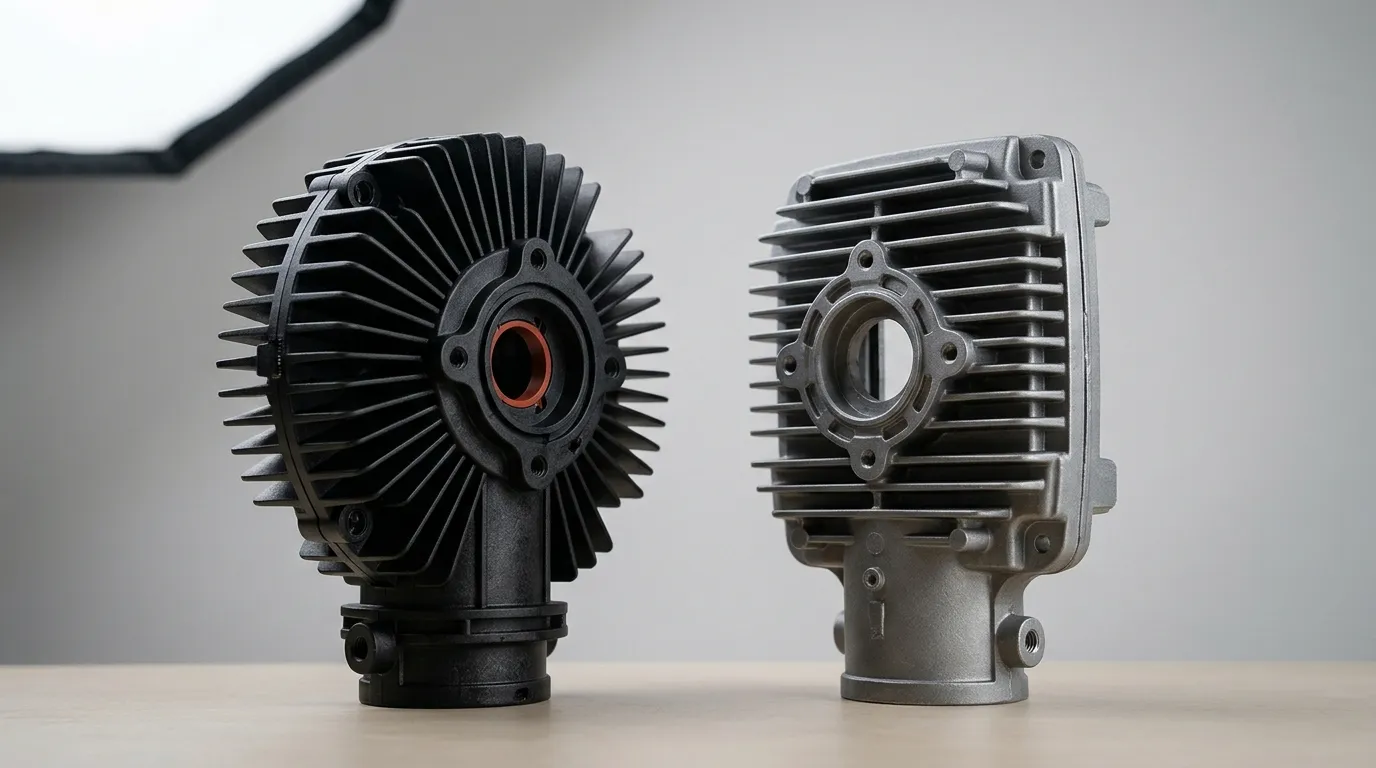
A plastic heat sink can carry an LED housing, but only where the part is judged as a whole instead of on a datasheet number. In this client-approved LED housing reference, the molded nylon housing came out 30% lighter than the die-cast aluminum it replaced, with production yield at 94% against 82% and case temperature rise within 2.8 °C — all client-reported for that program, not a specification.
The material argument and its resistance arithmetic are worked through in ZIITEK's comparison of thermally conductive plastic against aluminum; what follows stays with the housing — design, tooling trial, acceptance.
The LED Heat Sink Housing That Started the Project
An LED housing does three jobs at once, so the material choice decides which one it may fail at: conducting heat to the outside air, carrying driver, gasket and mounting interface, and standing between a live circuit and whoever touches the fixture.
The baseline part did all three in ADC12, the high-pressure die-casting alloy much of the lighting supply chain defaults to. Published figures put it near 96 W/m·K, 2.74 g/cm³ and a thermal expansion coefficient around 21 µm/m·°C, per this ADC12 material data from JIS H5302; other die-cast grades run higher, which is where the 150 W/m·K figures for die-cast aluminum in general come from. The cost sits around them: a die-cast housing normally needs a casting tool, trimming, machining for the driver and cable gland, a coating step and, where the fixture must be isolated, a separate barrier. The baseline carried that chain plus its bracket and washer.
Count those operations and the part count climbs before anyone discusses heat. That, not conductivity, is why the project looked at a molded housing: the steps between casting and finished part were being paid for twice, in labor and scrap. The application side is covered in ZIITEK thermal materials for LED lighting.
Plastic Heat Sink vs Die-Cast Aluminum, Compared at Two Levels
Most plastic-versus-metal arguments compare a material property with a part property and present the two as one claim. A datasheet conductivity belongs to a coupon; weight, temperature rise and yield belong to the housing you ship. The plastic heat sink material question splits the same way: what the compound is, and what the housing does.
| Level | ADC12 die-cast aluminum | Molded thermally conductive nylon, TCP200-50-02A | What the row can and cannot show |
|---|---|---|---|
| Material | ~96 W/m·K, isotropic, 2.74 g/cm³ | 5.0 W/m·K through-plane, specific gravity 1.45 | Bulk gap only; the wall is one resistance in a series |
| Material | 71 GPa elastic modulus | 15.8 GPa flexural modulus, HDT 150 °C | Stiffness and deflection limits. HDT is a loaded-bar result, not a service temperature |
| Material | Conductive, so isolation lives elsewhere in the stack | Dielectric constant 4.5 at 1 MHz; electrical data is grade-specific | Direction of the electrical argument, never proof a fixture passes |
| Process | Cast, trim, machine, coat, assemble | One shot: fins, bosses, snap-fits, insert pockets | Which operations disappear; not by itself a cheaper part |
| Part | Baseline weight and temperature rise | 30% lighter, rise within 2.8 °C, yield 94% | A project result, valid under that project’s conditions only |
Two rows invite misreading. The 5.0 W/m·K figure is through-plane, measured by the flash method under ASTM E1461; a filled polymer is rarely isotropic, and the in-plane value can run several times higher. The 150 °C is a heat deflection temperature under ASTM D648, where a loaded bar bends a fixed distance, and it is not a continuous-operation rating. Neither value travels to the finished part unchanged: wall thickness, flow orientation and rib geometry sit in between.
The per-grade sheet for TCP200-50-02A, the top grade in the TCP200 family, is on the TCP200-50-02A page.
The span from 0.7 to 5.0 W/m·K across resin backbones is on the thermally conductive plastic family page.
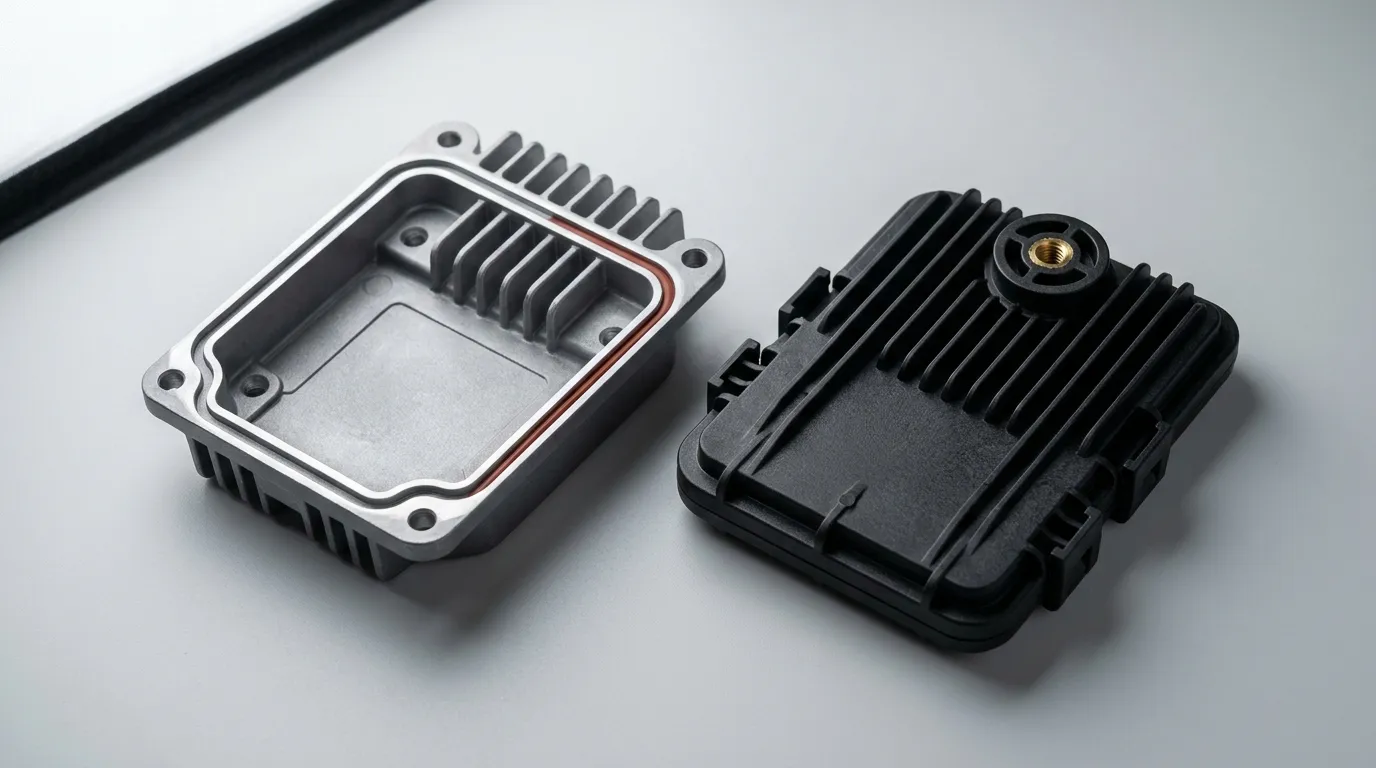
Illustrative render of the two process routes, not the production parts: cast fins and a machined gasket groove on the aluminum side, thin molded fins, clips and an insert boss on the nylon one.
The Thermal Path, Traced Through the Housing
Heat leaving an LED die crosses a chain of resistances — die to board, interface, board-to-housing contact, the wall and its spreading, then convection off the outer surface — and in still air the last term dominates while the wall, the one term the material choice touches, does not. That ordering decides whether a plastic LED heat sink works, and it is the comparison's argument, not the compound's.
On this housing the term the design could move was the board-to-wall contact: pad area under the board, how evenly the bosses loaded it, and whether the molded face stayed flat through the first shots. Contact pressure and interface come out of the design, not the compound.
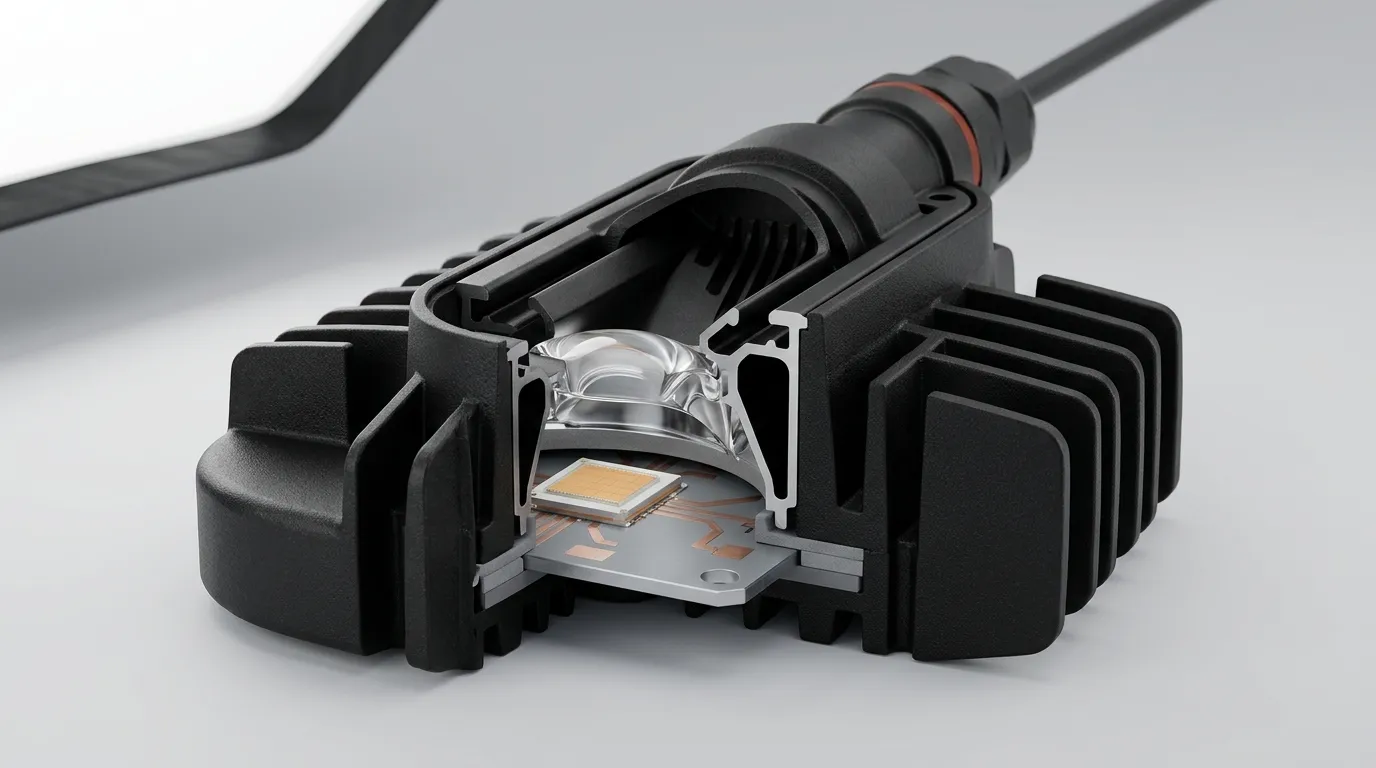
Illustrative section, not the tested housing: die and board, the molded wall carrying the fins, and still air outside. Each layer is a resistance, and only one of them changed material.
The reported result is a case temperature rise within 2.8 °C of the aluminum housing, measured on the client’s part — a magnitude of difference between the two, read on one fixture, in one ambient, across one interface, not a cooling improvement or a junction temperature. A housing 2.8 °C warmer is still compliant if the LED keeps its voltage and flux margin, and one 2.8 °C cooler proves nothing across a different rig. The conditions were the project’s own and are not published, so rerun the figure on your geometry and worst-case ambient before it becomes a target.
Weight: What 30% Off the Part Actually Buys
Specific gravity 1.45 against 2.74 gives the arithmetic everyone runs first: the same volume of nylon weighs about 47% less. The project reported 30%, and the distance between those figures is the design. Walls, ribs, bosses and insert pockets changed; a molded housing is not a casting with the same section, so compare two finished parts on one scale.
Thirty percent still matters where a head hangs from a bracket or ships in a carton: lighter heads for a pole class, cheaper freight.
The structural side belongs here. A flexural modulus of 15.8 GPa against roughly 71 GPa leaves the nylon part about four and a half times less stiff, so an identical section deflects roughly four and a half times as far (flexural against tensile modulus — check the tensile value for a real calculation). Ribs, shorter spans and molded-in inserts close most of that, and a metal insert at the mounting interface is normal practice. What ribs do not fix is creep: under sustained clamp load at temperature a molded part keeps moving where a casting does not. If the housing holds a gasket in continuous compression or a driver on a self-tapping screw, that behavior belongs in the validation plan.
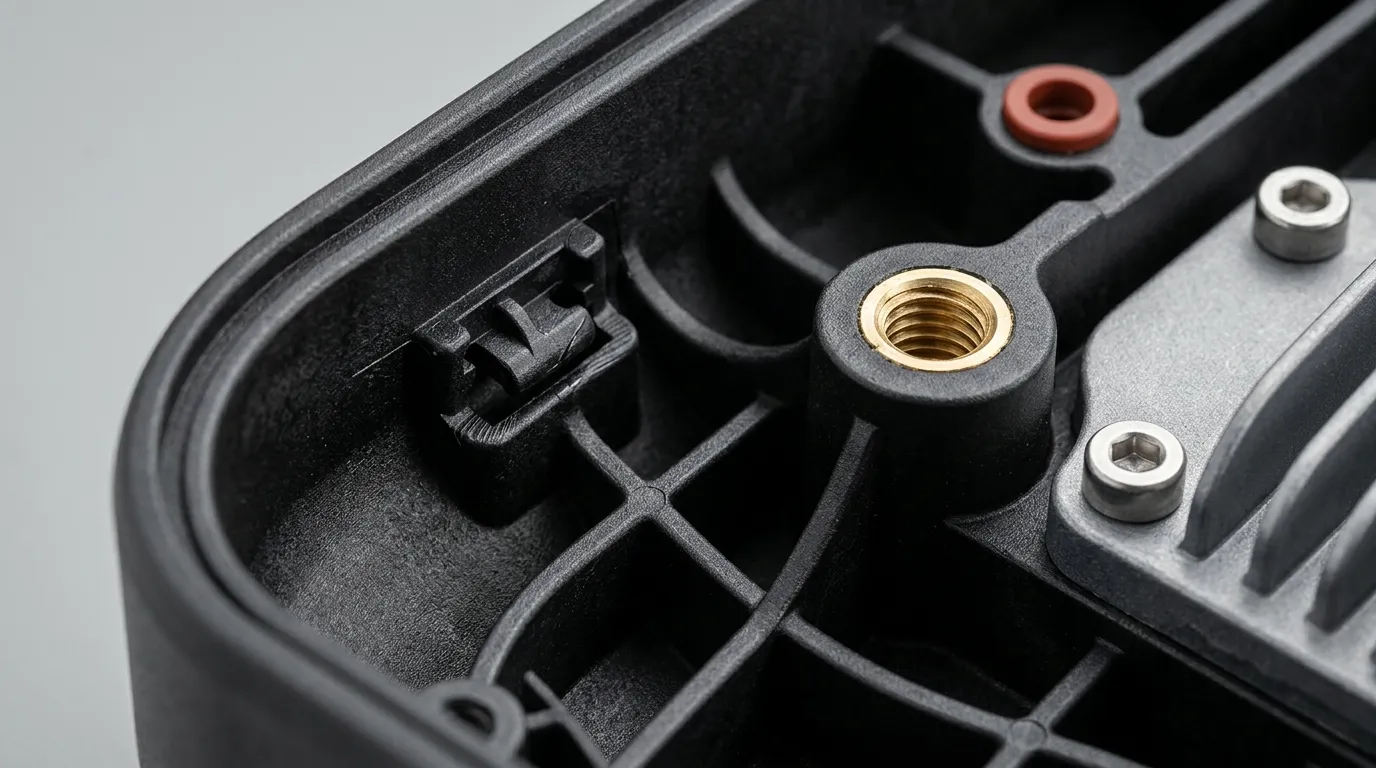
Illustrative render: where the stiffness comes back — ribs in the inside wall, a brass insert at the mounting boss, and clips that replace fasteners.
Yield and Cycle Time: Reading the Production Numbers
These are the numbers a thermal datasheet cannot anticipate.
| Metric | Die-cast aluminum baseline | Molded nylon result | Change | Source |
|---|---|---|---|---|
| Part weight | Baseline | 30% lower | −30% | Client-reported project result |
| Production yield | 82% | 94% | +12 percentage points | Client-reported project result |
| Molding cycle time | Baseline | 42% shorter | −42% | Client-reported project result |
| Case temperature rise | Baseline | Within 2.8 °C | Difference in magnitude | Client-reported project result |
Twelve points of yield is easier to feel as scrap. At 82%, every 1,000 good housings need about 1,220 shots and leave 220 parts to scrap or rework; at 94%, the same 1,000 need about 1,064 and leave 64. The scrap count falls by roughly seventy percent for the same output, and that is why yield moved the economics.
The 42% is a cycle-time figure and nothing more. It replaces a casting cycle plus trimming, machining and coating with one shot, shortening the time each part occupies a machine. It is not a 42% cut in cost. Cost is set by mold amortization, compound price, the scrap rate above, and the finishing steps that genuinely disappear and the ones that do not. A program that saves cycle time but adds an inspection station can still come out behind. Injection molding is a net-shape process with a fixed upfront cost, and the volume forecast decides whether that cost is small or fatal.
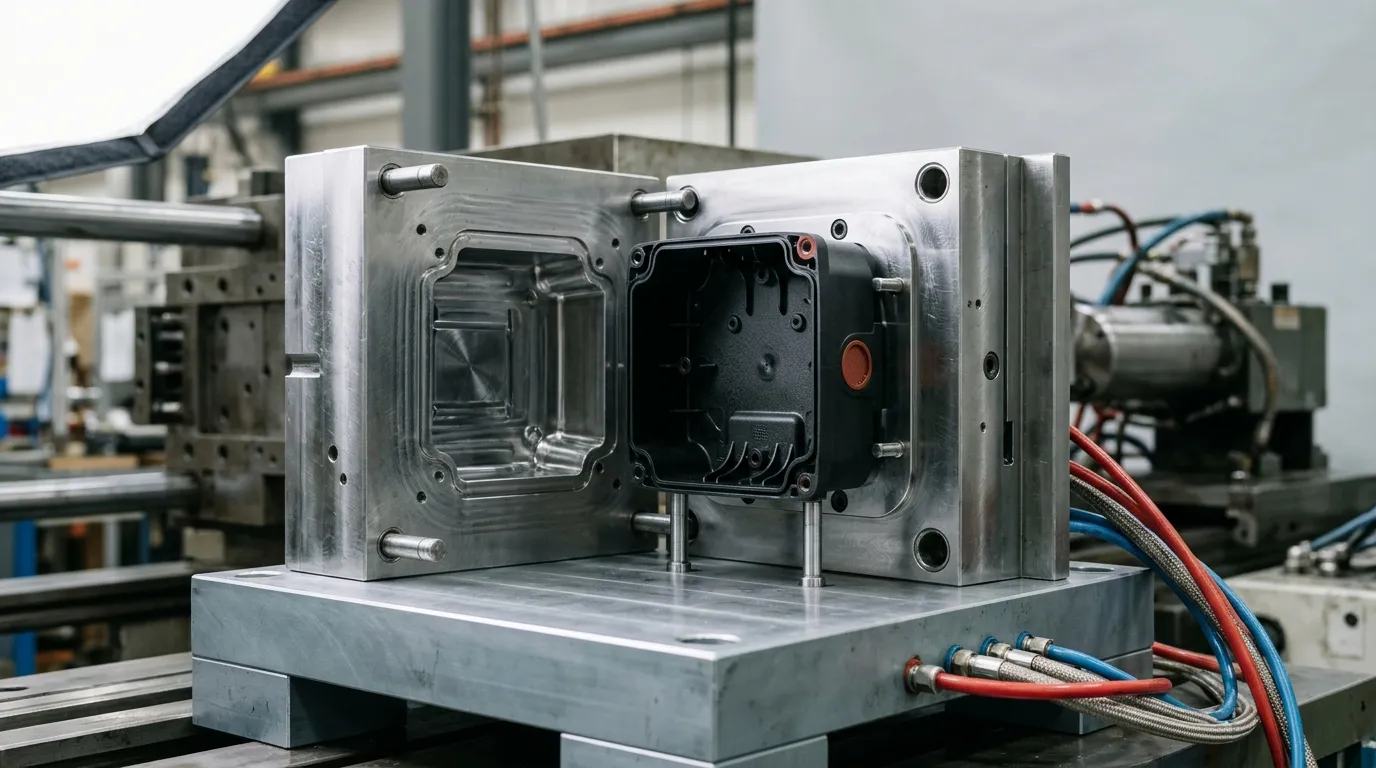
Illustrative render of a mold trial: one shot, one part, no trimming or coating behind it — and a tool whose cost the annual volume has to carry.
What the Electrical File Still Has to Prove
A UL 94 V-0 rating is a flammability classification, not an insulation rating. The grade data — dielectric constant 4.5 at 1 MHz under ASTM D150 and 10,000 Ω·m under ASTM D257, which is 10⁶ Ω·cm and dissipation rather than insulation — is a material figure; the isolation section of that comparison sets out what it does and does not settle.
That is why the washer stayed through the first build, and why it comes out only when the assembled fixture passes without it at the specified wall thickness: insulation resistance, electric strength, and creepage and clearance, run as IEC 60598-1 lays them out against the declared pollution degree and overvoltage category. Thin a wall for weight or mold flow and electric strength is the first of the three to go, because the quoted withstand is tied to the thickness that was tested.
General claims do the most damage here: graphite-filled grades conduct current as readily as heat, and a V-0 label speaks to neither. Read the grade, then test the fixture.
Where a Molded Housing Stops Being the Right Answer
Plastic heat sinks stop being right where these conditions land:
| Condition on an LED housing | What happens |
|---|---|
| Driver and LED heat on the same wall face | Two sources on one convection area; spreading, not conductivity, becomes the limit |
| A gasket held in continuous compression | Creep relaxes the seal; compression set must be qualified on the molded grade |
| Wall thinned for weight or mold flow | Electric strength and creepage fall with it; a V-0 label does not follow the wall down |
| An outdoor mounting, UV and weather | Resin and color stability qualify per grade; the housing class proves nothing |
| Volume under the mold break-even | Tool amortization never lands; casting or machining stays cheaper in cash |
Between those limits sits the hybrid, more common than either pure route: a molded housing with a metal insert or a local aluminum spreader at the hottest interface — plastic where geometry and isolation help, metal where flux is concentrated.
Running the Same Evaluation on Your Housing
- Fix the baseline and model the stack: the existing housing’s surface temperatures, weight and yield under defined conditions, then wall thickness, fin area, contact pressure, interface and filler orientation.
- Mold trial parts in the intended grade and measure them on one fixture, in one ambient, across one interface — a gap read across two rigs is not a result.
- Close the electrical file and the durability tests on the assembled luminaire at the specified wall thickness before deleting the washer: insulation resistance, electric strength, creepage and clearance, then thermal cycling, vibration and UV with production fasteners and clamp load.
ZIITEK reviews LED housing designs against the materials in this cluster.
The fastest way to compress steps one and two is to send geometry, not a specification. Useful inputs are housing CAD, wall and fin thickness, LED and driver power, ambient and airflow, baseline weight, and insulation and flame requirements — send them through the contact page and ask for a material and tooling trial evaluation.
Engineering Questions From the Design Review
Can a plastic heat sink really replace a die-cast aluminum LED housing?
It can, when the housing is convection-limited and the part is validated as an assembly. Not when heat is concentrated on a small footprint, service temperature sits near the deflection limit, or volume cannot carry a mold — the honest answer is a measurement on your geometry.
What does 5.0 W/m·K cover on a thermally conductive plastic heat sink?
It is a through-plane conductivity on the compound, measured by the flash method. It does not cover contact resistance, spreading in a thin wall, fin efficiency or airflow — the terms that usually set housing temperature. Use it to compare grades, not to predict a housing.
Can the insulating washer be removed?
Only after the finished luminaire passes insulation resistance, electric strength and creepage tests at the specified wall thickness. A flame rating is not evidence, and neither is a family-level claim about thermally conductive plastics.
Does a 150 °C HDT mean the housing runs at 150 °C?
No. Heat deflection temperature is where a loaded bar deflects a fixed amount under a defined load, a short-term index. Continuous service temperature comes from long-term aging data, and the two are often far apart.