Open-Cell vs Closed-Cell Foam for Gaskets
Open-cell foam cushions and absorbs sound; closed-cell foam seals water out. Compare compression set, water absorption, IP ratings and flame behaviour.
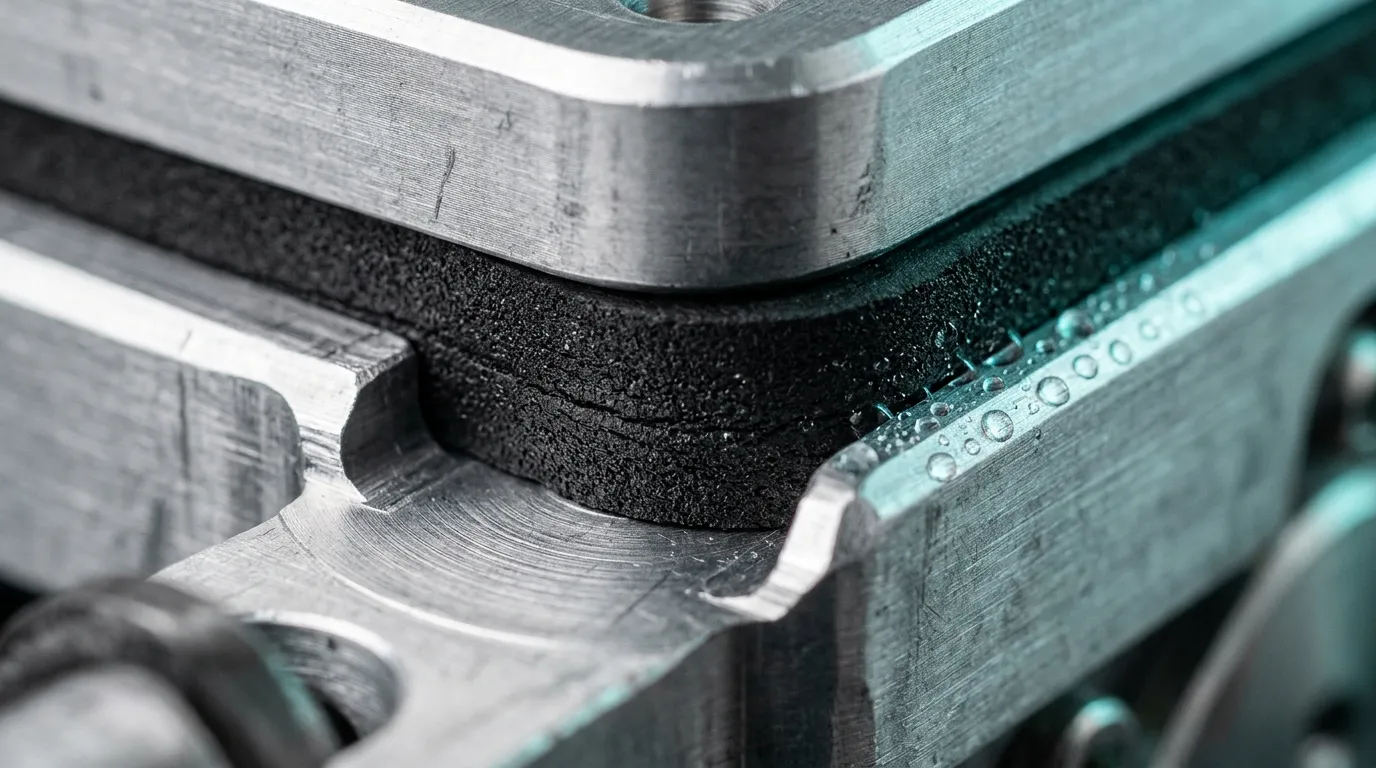
If the gasket has to keep water out, closed-cell foam is the correct default: every cell wall is intact, so nothing wicks through the part. If the joint has to cushion shock, absorb sound or breathe, open-cell foam is the right answer — same polymer, cell walls deliberately left open. The choice is not a quality ranking; it is a decision about which mechanism the joint depends on. Here is how cell structure changes compression set, seal force, water absorption, flame behaviour and cushioning, the values worth demanding on a datasheet, and a decision table for design review. For the wider material family, see the silicone foam sealing materials guide.
What "Open Cell" and "Closed Cell" Actually Describe
Both materials begin the same way: gas is dispersed into a polymer that cures around it. The difference is what happens to the thin walls between bubbles. In closed-cell foam the walls survive, so each cell is a sealed pocket of gas. In open-cell foam they rupture during expansion, so neighbouring cells merge into connected pores and air can travel from one face of the part to the other.
That single fact propagates: a sealed cell is a tiny pressure vessel, which is why closed-cell foam pushes back after compression and resists water; a connected pore is a capillary, which is why open-cell foam wicks, damps and vents.
"Foam" is a structure, not a material. Polyurethane, EPDM, neoprene and silicone can all be produced either way, and the base polymer sets the temperature range and the compression-set floor. For enclosure gaskets the usual base is silicone, whose inorganic backbone stays flexible from about -55 °C to 200 °C. EPDM is the other common base, and it is a genuinely good outdoor rubber — it resists water, steam, ozone and sunlight — so the comparison that decides between them is not weathering but heat: EPDM's continuous ceiling is around 120 °C, and above that the material has chosen itself. If the polymer is still open, the trade-offs are in rubber vs silicone gaskets.
Cell type is a classified property, not a marketing adjective. ASTM D1056, the specification for flexible cellular materials — sponge or expanded rubber — treats cell structure as one of the characteristics that define a material, alongside its compression-deflection grade and fluid resistance. A datasheet that says only "foam" and quotes a density has told you nothing you can design against.
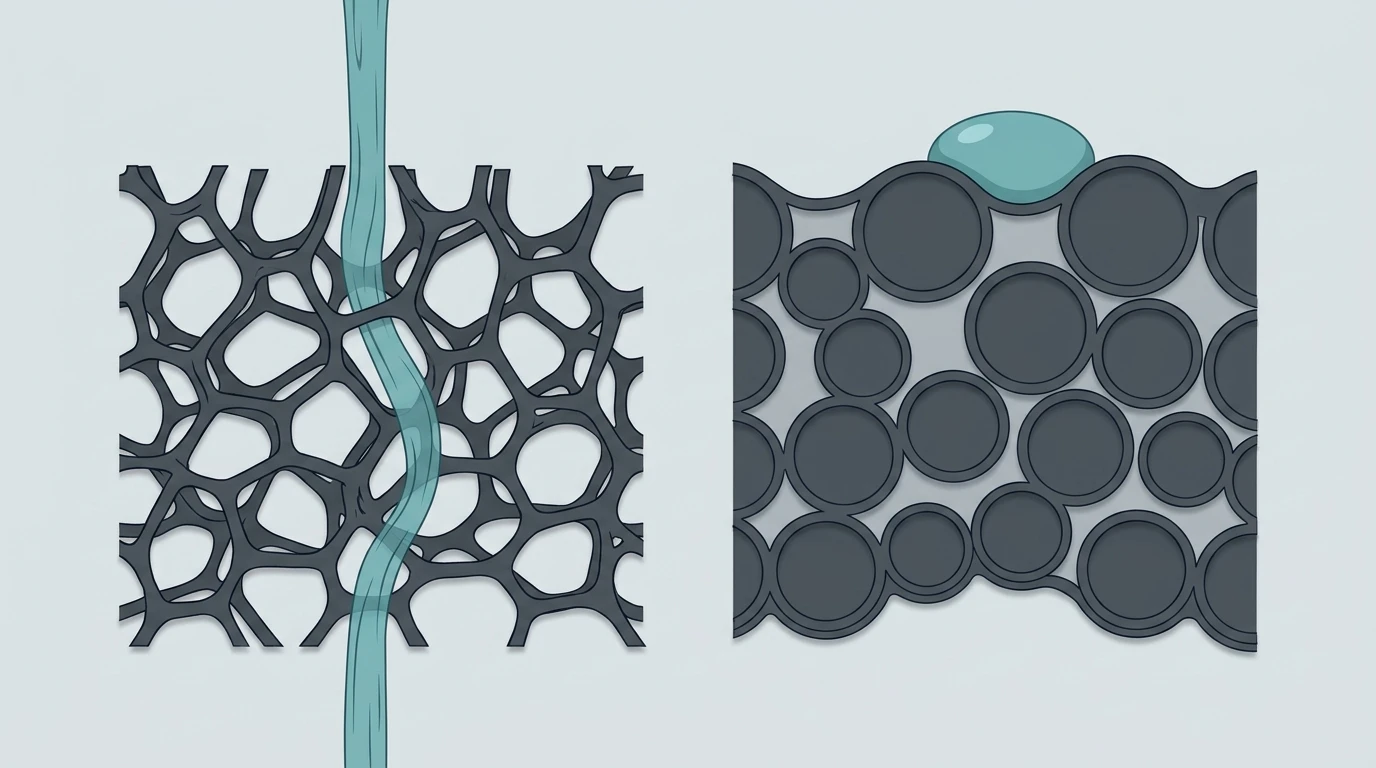
Left: connected pores give water a path straight through. Right: sealed cells stop it at the surface.
Why Cell Structure Decides Compression Set and Seal Force
A gasket seals by keeping contact stress on the mating surfaces above the pressure trying to get past it — and by still doing that after years of compression, thermal cycling and vibration. Compression set is the number that says whether it will.
Compression set is the permanent thickness loss left after a specimen is held at a fixed deflection, usually at elevated temperature, for a set time, reported as a percentage of the deflection applied: a specimen squashed by 25% that returns to within 1% of its original height has a set of about 4%. For silicone sponge the standards that govern the number are ASTM D1056, the material specification, and ASTM D395 Method B, which is the compression-set test itself. ASTM D3574 is often cited here and is the wrong trace: it is written around slab, bonded and molded urethane foams, so a D3574 line on a silicone datasheet is a borrowed number rather than a test result for that part.
The physics parts company here. Closed-cell foam has two recovery mechanisms. Trapped gas acts as a pneumatic spring and the cell walls an elastic shell; when load comes off, both push back. Well-formulated closed-cell silicone foam sits at a few percent set: ZIITEK's Z-FOAM®800 series is specified at ≤3–5%, and the company positions that against conventional EPDM sponge, which it quotes as commonly setting above 15% — the point at which a seal has stopped pushing and merely occupies space.
Open-cell foam has a weaker one. There is no trapped gas to push back, because the gas left during compression. Recovery depends on polymer struts unbuckling, and repeated buckling is what fatigues them; water taken into open pores adds swelling and softening. Open-cell foam still cushions well — that is what it is for — but it is a poor spring for a joint that must hold force for a decade.
Seal force is the other half of the budget. A closed-cell silicone foam gasket in the Z-FOAM®800 range develops roughly 20–110 kPa at 25% compression depending on grade, about 2.9 to 16 psi. That spans the useful design space: the soft end seals a thin-walled plastic housing with a handful of screws, the firm end resists extrusion under higher clamp load. Open-cell foam instead gives a flatter, more progressive curve — it feels soft and keeps feeling soft, because it is collapsing cells rather than compressing gas.
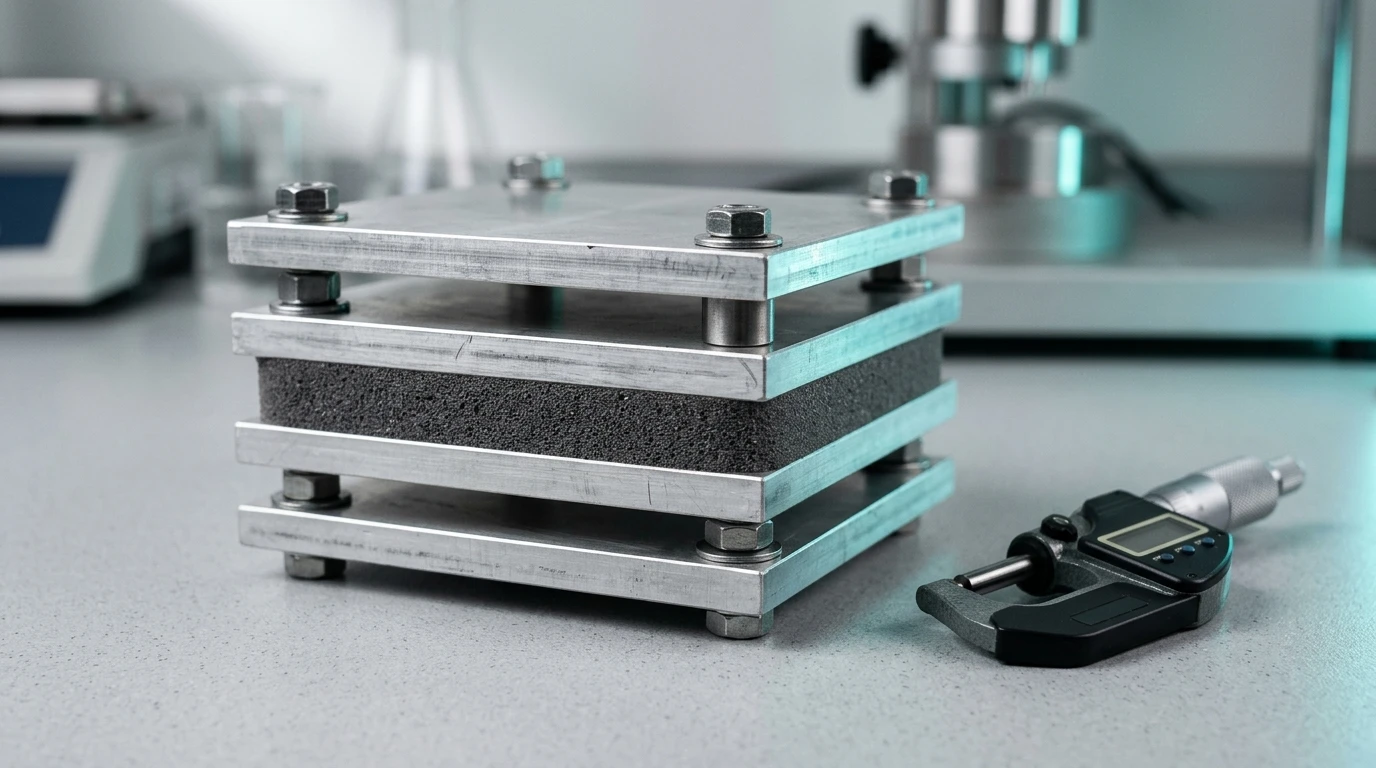
Two consequences follow. Specifying softness alone specifies the wrong variable — ask for stress at 25% compression, because that is what the housing has to resist. And set and seal force are linked: a grade that sets at 5% still delivers most of its initial stress years later; one that sets at 20% delivers almost none, though both felt identical on the bench.
Water and Ingress Protection: Where the Cell Wall Earns Its Keep
Ingress protection is defined by IEC 60529, which codes enclosures with two digits: solids first, water second. The water digits that matter here are IPX7 — temporary immersion, conventionally 1 m for 30 minutes — and IPX8, continuous immersion under conditions agreed between manufacturer and user. IPX8 therefore has no single universal test condition, so an "IP68" claim without depth and duration attached is not a specification.
Water crosses a gasket by two routes, and cell structure controls both. In capillary wicking, the pores of open-cell foam form a continuous network: water enters at the outer face, surface tension draws it inward, and once the network is saturated any hydrostatic head pushes it further. A 300 mm column of water is only about 2.9 kPa — far below what a closed-cell gasket's contact stress resists, and enough to drive flow through an open pore. Pressure-driven permeation is the other route: a wetted closed-cell surface takes water into the outermost cell layer only, and the sealed cells behind stop the front. That is why water absorption is the honest proxy for cell integrity: Z-FOAM®800 is specified below 0.1% by weight, which is what makes an IP68 claim on that material plausible rather than hopeful.
Open-cell foam does have a legitimate enclosure role: a dust-protected seal at IP5X, and a breather that equalises pressure so temperature cycling does not pump air past the seal or pull condensate in through cable glands. It cannot be dust-tight (IP6X) or immersion-proof, because both need a barrier it does not have. If the requirement is IP67 or IP68, the gasket must be closed-cell and the joint designed around it — 15–30% squeeze, foam confined on three sides in a groove, fastener spacing tight enough that the housing does not gap between screws. Groove and squeeze design is covered in silicone foam gaskets for electronics sealing.
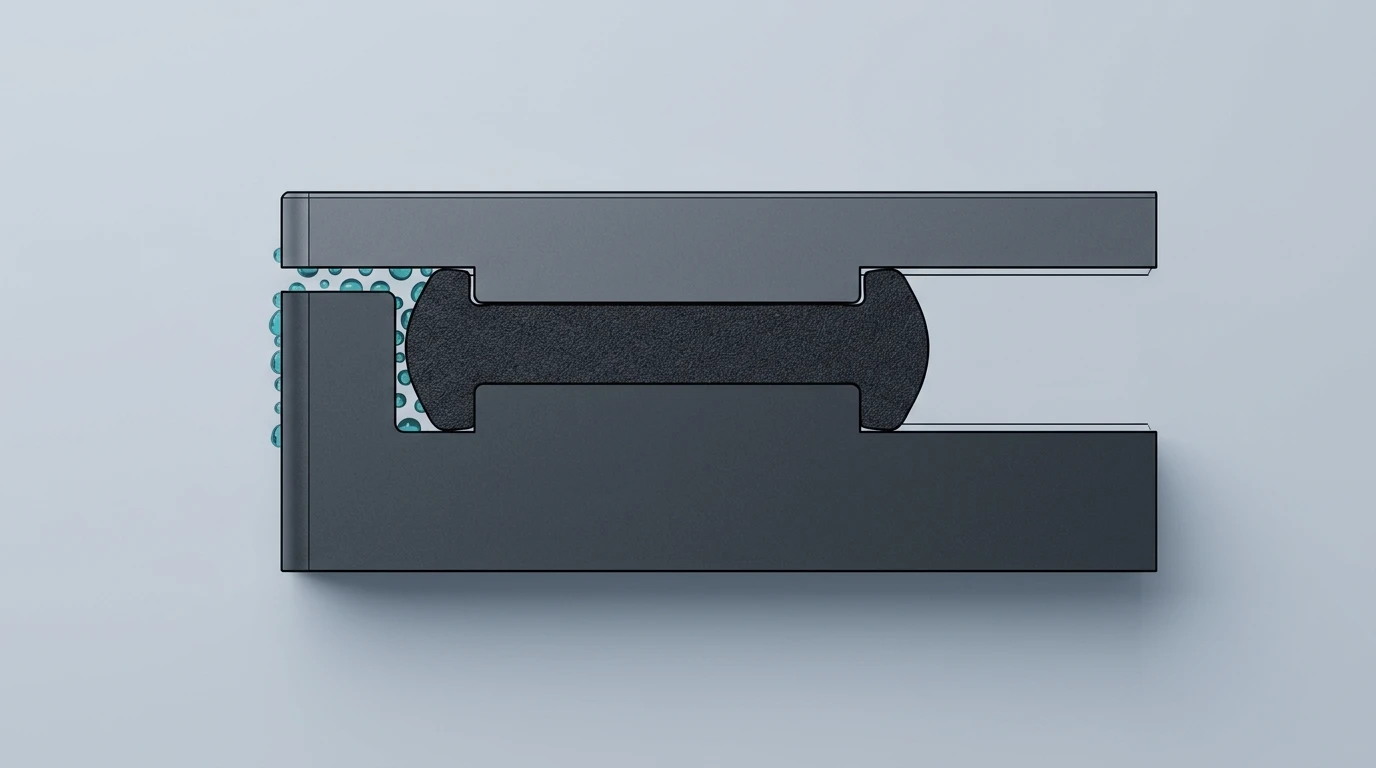
A closed-cell gasket seals where it is compressed and confined. The water line stops at the foam, not at the housing face.
One number worth checking: IPX7's own 1 m depth is only about 9.8 kPa, so at 1.5 m the hydrostatic pressure is about 14.7 kPa and at 3 m about 29 kPa. Against the 20 kPa low end of a soft grade at 25% compression, the margin is roughly 2× at the standard immersion depth and shrinking from there — deep immersion needs a firmer grade or more squeeze, not a thicker gasket.
Flame Behaviour: Surface Area Changes the Fire Story
Enclosure requirements usually read UL 94 V-0, so be precise about what it means. UL 94 is a small-scale laboratory test: in the vertical burning test, a specimen takes two 10-second flame applications, and V-0 requires extinction within 10 seconds after each, with no burning drips that ignite cotton below. UL's flammability testing programme is the authority on the classification, and the rating is thickness-specific — a material rated V-0 at one thickness is not automatically V-0 at half of it.
Cell structure changes the behaviour for reasons of air and surface area:
- Open-cell foam has a chimney. Connected pores feed oxygen into the interior, so the flame front travels through the part rather than across its surface, and the internal area exposed to oxygen is enormous. Those pores also wick spilled oils and solvents into the core, storing fuel inside the gasket.
- Closed-cell foam has a barrier. Sealed cells restrict internal oxygen, so burning stays at the surface and the material chars into an insulating ash layer. Silicone helps: its inorganic backbone leaves a silica-rich residue rather than the flowing drip of a thermoplastic.
That is why flame-retardant silicone foam is normally closed-cell, and why V-0 is achievable at realistic gasket thicknesses. ZIITEK's Z-FOAM®800 is rated UL 94 V-0 under UL Yellow Card file E331100 — ask for the card, because it lists recognized thicknesses and colours, so you can confirm the grade you are die-cutting was the one tested. More on that choice in UL 94 V-0 silicone foam for flame-retardant sealing.
Cushioning, Sound and Heat: Where Open Cell Wins
Open-cell foam is not a failed gasket; it is a good energy absorber. The collapse mechanism that makes it a poor seal makes it a good cushion: struts buckle progressively, so load rises gently instead of spiking. That is why open-cell foam is standard for packaging cushions, impact liners and isolation pads.
Sound absorption follows the same logic: a porous absorber draws acoustic energy into the pore network, where air motion against cell walls converts it to heat. Closed-cell foam reflects more and absorbs less at equal thickness.
Heat flips the ranking back. Sealed gas cells are poor conductors, so closed-cell foam insulates better — Z-FOAM®800 is specified at about 0.06 W/m·K, roughly 17–50× below a thermally conductive potting compound at about 1–3 W/m·K and 50–100× below a conductive pad at 3–6 W/m·K. That is why foam is not a thermal interface material: where a joint must both seal and conduct, use a die-cut closed-cell gasket for the seal and a separate interface material for the heat path, both normally die-cut from different stocks and assembled in one operation. The selection logic for the interface layer is in what is a thermal pad.
Cost is settled long before the quote arrives. Four drivers do most of the work: the polymer (silicone costs more than EPDM or polyurethane), the density (foam is bought by volume, so density sets the mass you pay for), the thickness (thicker stock costs more and takes more squeeze), and the die-cut geometry (a plain rectangular frame is the cheapest cut there is; adhesive backing, liner handling and a tight cut-edge tolerance are not). Open-cell stock is usually the cheaper input at equal polymer. The comparison worth making is cost per year of service rather than cost per part — a cheaper foam that sets, leaks and gets replaced has cost more than the part it saved.
None of that makes closed-cell silicone risk-free. Silicone foam carries a low-molecular siloxane fraction that can outgas over time, a real contamination concern next to optics, open contacts, relays and any vacuum or plasma process. Where that is the binding constraint, the honest answer is a silicone-free foam or pad, not a lower-outgassing claim.

Side-by-Side: The Property Comparison
| Property | Open-cell foam | Closed-cell foam | Why it decides the choice |
|---|---|---|---|
| Cell structure | Ruptured walls, connected pores | Intact walls, sealed gas cells | Sets every property below |
| Water absorption | Wicks through the part | <0.1% by weight on a good silicone grade | Barrier vs pathway |
| Achievable ingress rating | IP5X (dust-protected), breather duty | IP6X and IP67/IP68 capable | IP6X and immersion need a barrier |
| Compression set | Higher; struts fatigue and buckle | ≤3–5% on a good closed-cell silicone | Predicts seal force years later |
| Stress at 25% compression | Low and progressive | Roughly 20–110 kPa, grade dependent | Must be under what the housing can clamp |
| Thermal conductivity | Same class at best; never a heat path | ~0.06 W/m·K | Insulation vs heat path |
| Acoustic absorption | Good — porous absorber | Poor at equal thickness | Noise control |
| Shock / vibration damping | Good — progressive collapse | Moderate | Cushioning duty |
| Flame behaviour | Chimney effect, wicks fuels | Surface char, V-0 achievable | Fire safety compliance |
| Service temperature (silicone) | About -55 °C to 200 °C | About -55 °C to 200 °C | Polymer, not cell type, sets this |
The Datasheet Values to Demand
Most gasket failures that reach a failure analysis were never specified, only assumed. Ask for each value with its test method, and treat "typical" as unverified.
A datasheet number without a method and a condition attached is a claim, not a measurement.
- Cell type, stated explicitly — open or closed, ideally with an ASTM D1056 line callout. Everything else is interpretation until this is fixed.
- Density — 0.2 to 0.42 g/cm³ across the Z-FOAM®800 range; it correlates with strength and with the force the part develops.
- Stress at 25% compression — the number to design clamp load against; 20–110 kPa across that range.
- Compression set — demand the temperature, deflection and duration, not just the percentage. ≤5% at service temperature is the target for a sealed joint.
- Water absorption — below 0.1% by weight for anything claiming IP67 or IP68. No value, no IP claim.
- Thermal conductivity — about 0.06 W/m·K for insulating closed-cell silicone; a much higher figure means filler was added, so ask what and why.
- Flame rating with thickness — UL 94 V-0 plus the yellow card file number, so tested thickness and colour match your part.
- Service temperature and thickness tolerance — about -55 °C to 200 °C continuous for silicone foam, and free-thickness tolerance stated separately, because on foam that tolerance becomes tolerance on squeeze. Ask which low-temperature figure the grade is qualified to: -40 °C shows up on battery-enclosure specifications because that is the pack's cold-soak window, not the material's floor.
Decision Table for Enclosure Engineers
| If your requirement is… | Choose | Because |
|---|---|---|
| Water or dust ingress at IP6X / IP67 / IP68 | Closed-cell, low set | Only a sealed cell is a barrier |
| Long life with infrequent service access | Closed-cell, ≤5% set | Seal force must survive years of compression |
| Thin plastic housing, few screws | Closed-cell, soft grade | Seals at low clamp force |
| Metal housing, high clamp load, extrusion risk | Closed-cell, firmer grade, confined groove | Resists creep and extrusion |
| Noise reduction or impact absorption is the goal | Open-cell | Porous absorption; progressive collapse |
| Enclosure must breathe to avoid condensate | Open-cell, or a dedicated vent | Deliberate air path |
| Both sealing and heat transfer | Closed-cell gasket plus separate TIM | Foam cannot conduct usefully |
| Cost per part dominates, with no water, dust or immersion duty | Open-cell | Cheaper stock at equal polymer; density and cut geometry set the rest |
FAQ
Can open-cell foam be used as a gasket at all?
Yes, for dust exclusion, cushioning and pressure equalisation — duties where nothing is pushing water through the part. It is the wrong material for immersion or IP6X, because connected pores are a continuous path by construction.
How can I tell open-cell from closed-cell foam without a datasheet?
Squeeze a sample: closed-cell foam rebounds firmly and resists air passing through, open-cell foam collapses softly and lets air out. A drop of water on the cut edge is the quick field test — it beads on closed-cell foam and is drawn in by open-cell. Neither replaces the datasheet, but both catch a mis-shipped lot.
What compression should I design into a closed-cell gasket?
Target 15–30% of free thickness, set by the grade's stress curve and by what the housing can clamp. Below that the seal may not be continuous; well above it, closure force climbs and compression set accelerates.
Does a closed-cell gasket guarantee IP68?
No material specification guarantees a rating — the rating belongs to the assembled enclosure. Low water absorption makes IP68 achievable; groove design, squeeze, fastener spacing and housing stiffness decide whether you get it.
Bottom Line
Cell structure is the first decision and it is binary: a sealed cell is a barrier and a spring, an open pore a pathway and a damper. Closed-cell foam is the default for any joint that must hold water, dust or seal force over time, and the numbers that matter — set at or below 5%, water absorption below 0.1%, 20–110 kPa at 25% compression, UL 94 V-0 with a yellow card — are all askable. Open-cell foam belongs where the joint is meant to absorb, soften or breathe. Specify the duty first, then the foam.