Laird Tputty 607 Alternative: ZIITEK TIF070-11
Compare Laird Tputty 607 with ZIITEK TIF070-11: published specs, test-method differences, and what to validate before you swap a one-part thermal gel.
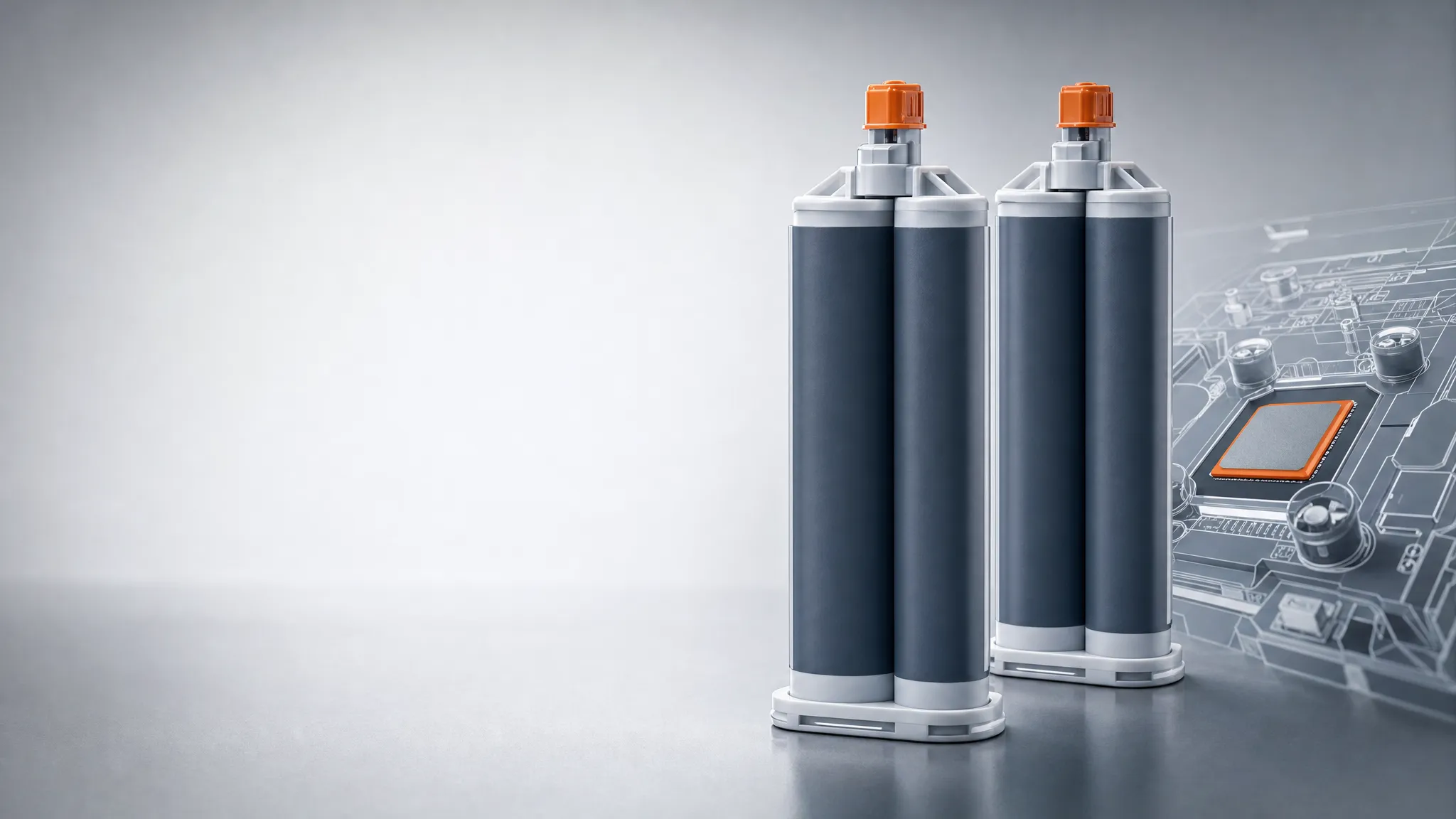
If you are searching for a Laird Tputty 607 alternative, you are probably not shopping — you are qualifying a second source. The incumbent is on allocation, its price or lead time moved, or a customer's bill of materials now requires a qualified backup for a specific line. Laird Tputty 607 is a well-documented one-part dispensable liquid gap filler, and ZIITEK TIF070-11 is a one-part silicone gel gap filler in the same class. This page puts their published numbers side by side, states plainly where the two datasheets are not directly comparable, and lists what you should confirm on your own stack before you commit to a swap.
| At a glance | Laird Tputty 607 | ZIITEK TIF070-11 |
|---|---|---|
| Type | One-part dispensable gap filler | One-part silicone gel gap filler |
| Thermal conductivity | 6.4 W/mK (Hot Disk) | 7.0 W/mK (ASTM D5470) |
| Colour | Blue | Gray |
| Operating temperature | −40 to 200 °C | −45 to 200 °C |
| Flame rating | V-0 (UL 94) | V-0 (UL 94) |
| Outgassing published? | Yes (ASTM E595) | No — confirm with ZIITEK |
The full spec-by-spec comparison, including the test-method caveats that sit behind those numbers, is in the sections below.
Why Engineers Look for a Laird Tputty 607 Alternative
A liquid gap filler is rarely chosen for its thermal conductivity alone. It is chosen because the gap between a heat source and its sink varies from unit to unit, it must be dispensed automatically, and it must stay put while the assembly is handled and while it thermal-cycles. That combination — dispense, variable gap, minimal stress — is exactly why one-part dispensable gap fillers (often called thermal putty) sit on so many boards, and exactly why substituting one is more involved than swapping a solid pad.
Three situations send engineers looking for an alternative:
- Supply risk. The incumbent material is on allocation, backordered, or single-sourced where the program now demands a second qualified source.
- Commercial pressure. Price or lead time moved, and the design's thermal budget can tolerate a re-evaluation.
- End-of-life or consolidation. A grade is being retired, or the OEM wants to reduce the number of TIM SKUs across platforms.
All three are procurement triggers, not performance triggers. The sensible response is a cross-reference exercise: hold the incumbent's datasheet next to the candidate's, compare like for like, and then prove the swap on the real stack-up. The thermal material cross-reference library organizes this brand-by-brand; the pair worked through below is Laird Tputty 607 against ZIITEK TIF070-11.
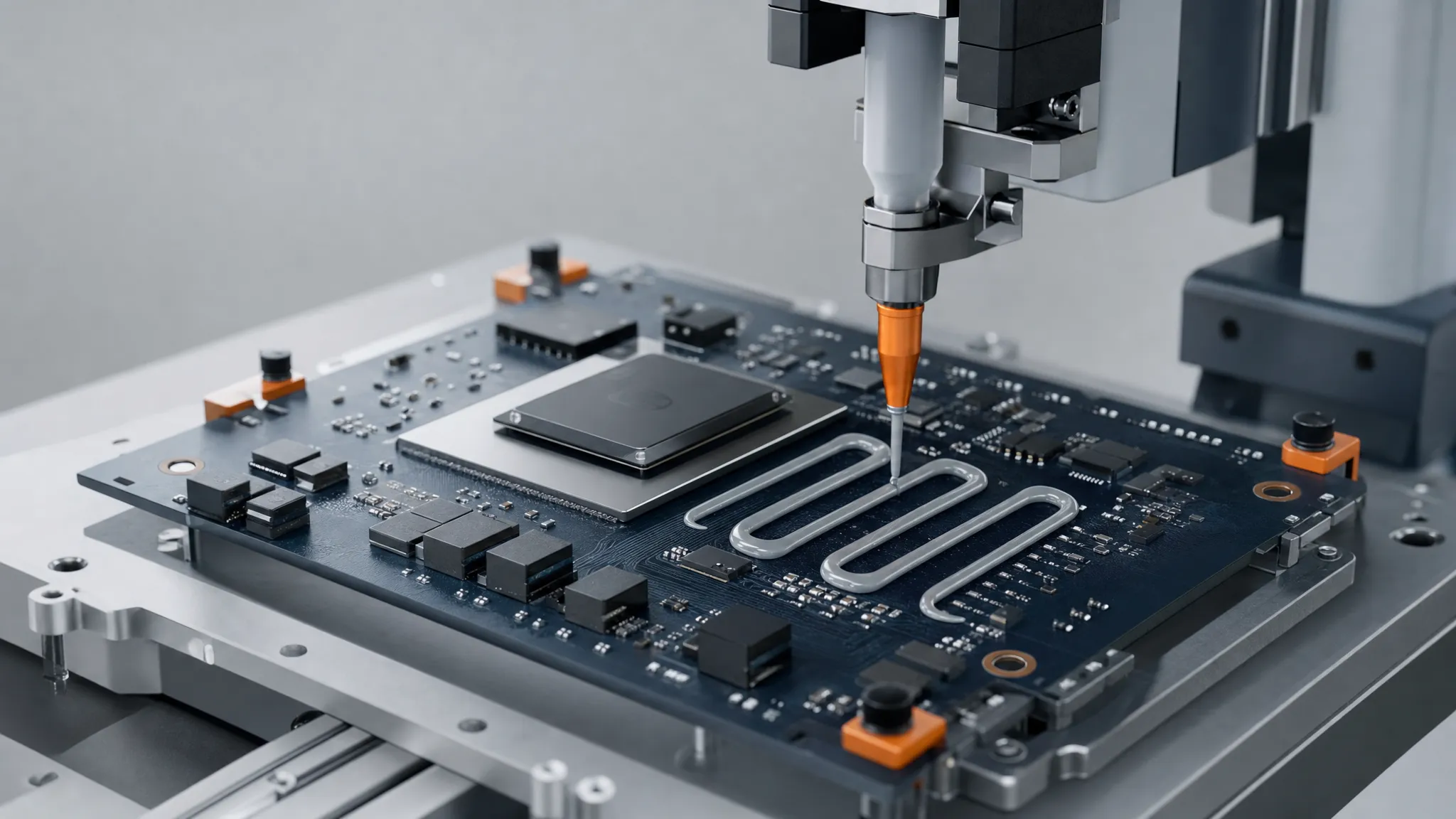
One-part dispensable gap fillers exist because the gap varies: the material is dispensed to fill whatever standoff the assembled unit presents.
Laird Tputty 607: The Documented Baseline
Laird describes Tputty 607 as a high thermally conductive, single-part dispensable material designed with automation and vertical stability in mind, intended for applications with variable gaps where it can reduce SKU count and exert minimal stress on components. It is a ceramic-filled silicone. The properties below are transcribed from Laird's published datasheet for the 607 (THR-DS-Tputty 607, revision 04212025); the product is also listed on Laird's product page.
| Property | Laird Tputty 607 (as published) | Method |
|---|---|---|
| Construction | Ceramic-filled silicone, dispensable | — |
| Colour | Blue | Visual |
| Thermal conductivity | 6.4 W/mK | Hot Disk |
| Density | 3.45 g/cc | Helium pycnometer |
| Minimum bond line thickness | 0.150 mm (0.006 in) | Laird test method A16112-00 |
| Flow rate | 60 g/min (75 cc taper tip, 0.125 in orifice, 90 psi) | Laird test method A16724-00 |
| Operating temperature range | −40 to 200 °C | Laird test method |
| Flammability | V-0 | UL 94 |
| Dielectric breakdown | >6000 VAC (at 1 mm) | ASTM D149 |
| Dielectric constant @ 1 MHz | 8 | ASTM D150 |
| Volume resistivity | 10¹³ ohm·cm | ASTM D257 |
| Outgassing | TML 0.204 %, CVCM 0.01 % | ASTM E595 |
| Compliance | RoHS compliant | — |
| Packaging | Cartridges 30–600 cc; pails 1 gal and 5 gal | — |
Two points worth keeping in view. First, the datasheet also reports demonstrated thermal cycling stability and low outgassing, which matters for sealed or optical assemblies. Second, Tputty 607MF is a separate part — several distributors list the "MF" variant alongside the standard 607, and it should not be assumed to carry identical properties. Confirm which revision and suffix your incumbent is before you compare anything.
ZIITEK TIF070-11: The Candidate Grade
ZIITEK TIF070-11 is a soft, single-part silicone gel-based gap filler formulated to combine thermal conductivity with low compression force. ZIITEK's own product description notes that its higher viscosity relative to conventional thermal grease resists filler separation and migration, and that it is applied with commercial dispensing tools or automated equipment with no cure step — a like-for-like process model against a dispensable one-part material. Its stated application targets include flip-chip microprocessors, PPGA and BGA packages, DSP chips, LED lighting and other high-power electronics, plus heat sinks and frames, engine controllers and telecom equipment.
The property table below is transcribed from ZIITEK's live product page for the grade (TIF070-11), which carries the TIF070-11 datasheet PDF; the values are quoted exactly as published there and should be matched to the datasheet revision named on your purchase order.
| Property | ZIITEK TIF070-11 (as published) | Method |
|---|---|---|
| Construction | Ceramic-filled silicone | — |
| Colour | Gray | Visual |
| Thermal conductivity | 7.0 W/mK | ASTM D5470 |
| Density | 3.50 g/cm³ | ASTM D297 |
| Bond line thickness | 0.20 mm | ZIITEK test method |
| Flow rate | 30 g/min (30 cc syringe, 2.5 mm orifice, 90 psi) | ZIITEK test method |
| Thermal impedance | 0.142 °C·in²/W @ 10 psi; 0.120 °C·in²/W @ 50 psi | ASTM D5470 |
| Operating temperature range | −45 to 200 °C | ZIITEK test method |
| Flammability | V-0 | UL 94 |
| Dielectric strength | ≥4000 V/mm | ASTM D149 |
| Shelf life | 12 months | — |
TIF070-11 sits near the top of ZIITEK's one-part gel family, which spans roughly 1.5 to 9.0 W/mK; the whole family is catalogued under thermal gels. Other grades trade conductivity for other properties, but ZIITEK does not publish a cross-grade comparison of compression force or hardness — so grade selection for a large or delicate gap should come from applications engineering, not from a lower W/mK number alone.
Tputty 607 vs TIF070-11: Spec-by-Spec Comparison
Read together, the two datasheets put these materials in the same functional class: single-part, ceramic-filled silicone, dispensable, with a V-0 flame rating and a similar operating window. The differences that matter are in the numbers and, just as importantly, in how those numbers were obtained.
| Property | Laird Tputty 607 | ZIITEK TIF070-11 |
|---|---|---|
| Type | One-part dispensable liquid gap filler | One-part silicone gel gap filler |
| Construction | Ceramic-filled silicone | Ceramic-filled silicone |
| Thermal conductivity | 6.4 W/mK (Hot Disk) | 7.0 W/mK (ASTM D5470) |
| Density | 3.45 g/cc | 3.50 g/cm³ |
| Bond line thickness | 0.150 mm (published as a minimum) | 0.20 mm (published as a typical value; no minimum stated) |
| Operating temperature range | −40 to 200 °C | −45 to 200 °C |
| Flammability | V-0 (UL 94) | V-0 (UL 94) |
| Dielectric breakdown | >6000 VAC at 1 mm (ASTM D149) | ≥4000 V/mm (ASTM D149) |
| Thermal impedance | Not published on the 607 typical table | 0.142 @ 10 psi / 0.120 @ 50 psi °C·in²/W |
| Flow rate | 60 g/min (75 cc taper tip, 0.125 in, 90 psi) | 30 g/min (30 cc syringe, 2.5 mm, 90 psi) |
| Outgassing | TML 0.204 % / CVCM 0.01 % (ASTM E595) | Not published for this grade |
| Compliance | RoHS compliant | RoHS-oriented formulation |
The conductivity numbers are not directly comparable. Laird reports 6.4 W/mK by Hot Disk, while ZIITEK reports 7.0 W/mK by ASTM D5470. These are different measurement techniques — a transient plane-source method versus a steady-state stack method (ASTM D5470) — and their results do not convert into one another on a datasheet. The honest reading is that both grades sit in the same conductivity band, with the candidate's nominal figure slightly higher on its own method; it is not a claim that TIF070-11 is 9 % better. If you need the comparison at matching conditions, the right move is to ask both suppliers for impedance data measured at the same thickness and pressure — which is what why W/mK alone is not enough is there to explain.
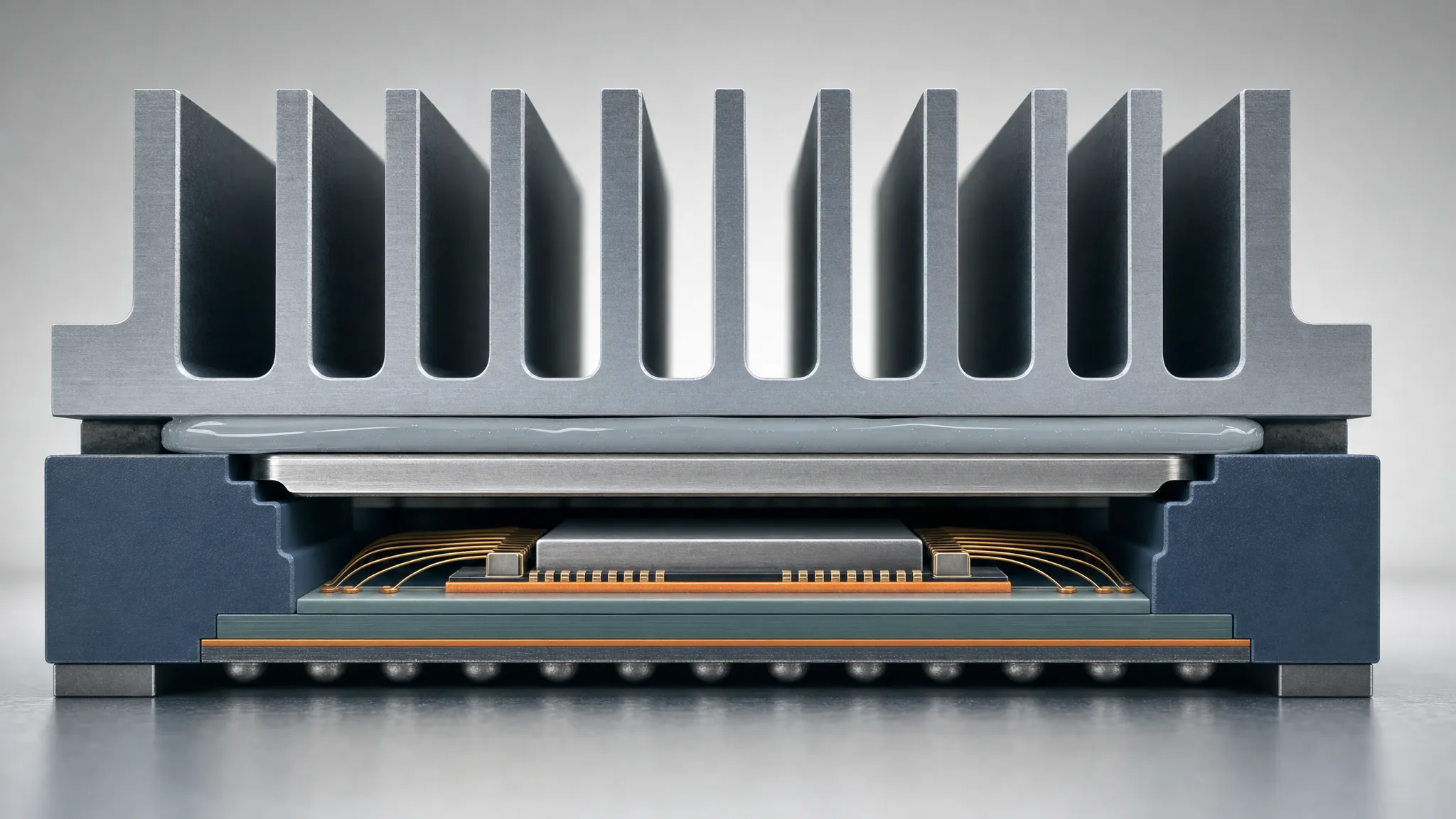
The property that actually governs the interface is the compressed bond line, not the bulk conductivity number on its own.
The flow-rate numbers are not directly comparable either. Laird's 60 g/min is quoted for a 75 cc taper tip with a 0.125 in orifice; ZIITEK's 30 g/min is quoted for a 30 cc syringe with a 2.5 mm orifice. Different orifices and different test rigs mean the two figures describe dispensing behaviour under different conditions. Use them as an indication that both grades are pumpable through standard equipment — then confirm the actual dispense rate on your own tooling.
Two properties are simply not published for TIF070-11 in the sources available here: outgassing (TML/CVCM, the ASTM E595 parameters) and volume resistivity. If your assembly is sealed, optical, or subject to a contamination class, do not assume; ask ZIITEK for the outgassing data. This page will not quote a number that is not published.
What "Drop-in" Does and Does Not Guarantee
It is worth being precise about the phrase, because it is doing a lot of work on pages like this one. In engineering terms, a drop-in alternative is a part that swaps in without changing the mechanical stack-up, the assembly process, or the thermal budget. Similar format, similar hardness and comparable or better conductivity are necessary conditions for that — they are not sufficient.
A one-part gel swap touches four things that a solid pad swap does not:
- Bond line thickness and compression. Laird publishes a minimum bond line of 0.150 mm for the 607; ZIITEK publishes 0.20 mm for TIF070-11 as a typical value and does not state whether it is a floor. Both materials are dispensed to fill a variable gap, so the assembled bond line is set by your standoff and your dispense volume, not by the datasheet alone. Confirm with ZIITEK whether 0.20 mm is a lower limit for your dispense volume and standoff before you commit.
- Dispensing tooling and flow. If your line is programmed to a specific shot size, dispense speed and valve, a material with different rheology will need the recipe re-tuned. The flow-rate caveat above is exactly this risk in numeric form.
- Vertical stability and reflow exposure. Laird markets the 607 specifically for vertical stability. If your assembly cures or travels through reflow with the gap vertical, that behaviour has to be validated for any replacement, not assumed from a conductivity match.
- Properties that are not on the table. ZIITEK's published page for TIF070-11 does not include outgassing or volume resistivity — both of which Laird publishes for the 607. If those are in your requirement set, they are open items, not matches.
Two smaller cautions. Make sure the incumbent is the exact revision you think it is — the standard 607 versus the 607MF variant — and that the candidate you sample is the exact TIF070-11 revision your supplier quotes. And remember that a comparison table matches nominal values — it does not absorb the tolerance bands on either side. If you want the general version of this discipline — the five specs to match and the order to match them in — it is laid out in how to find a drop-in replacement thermal pad; the section below is the validation step for this specific pair.
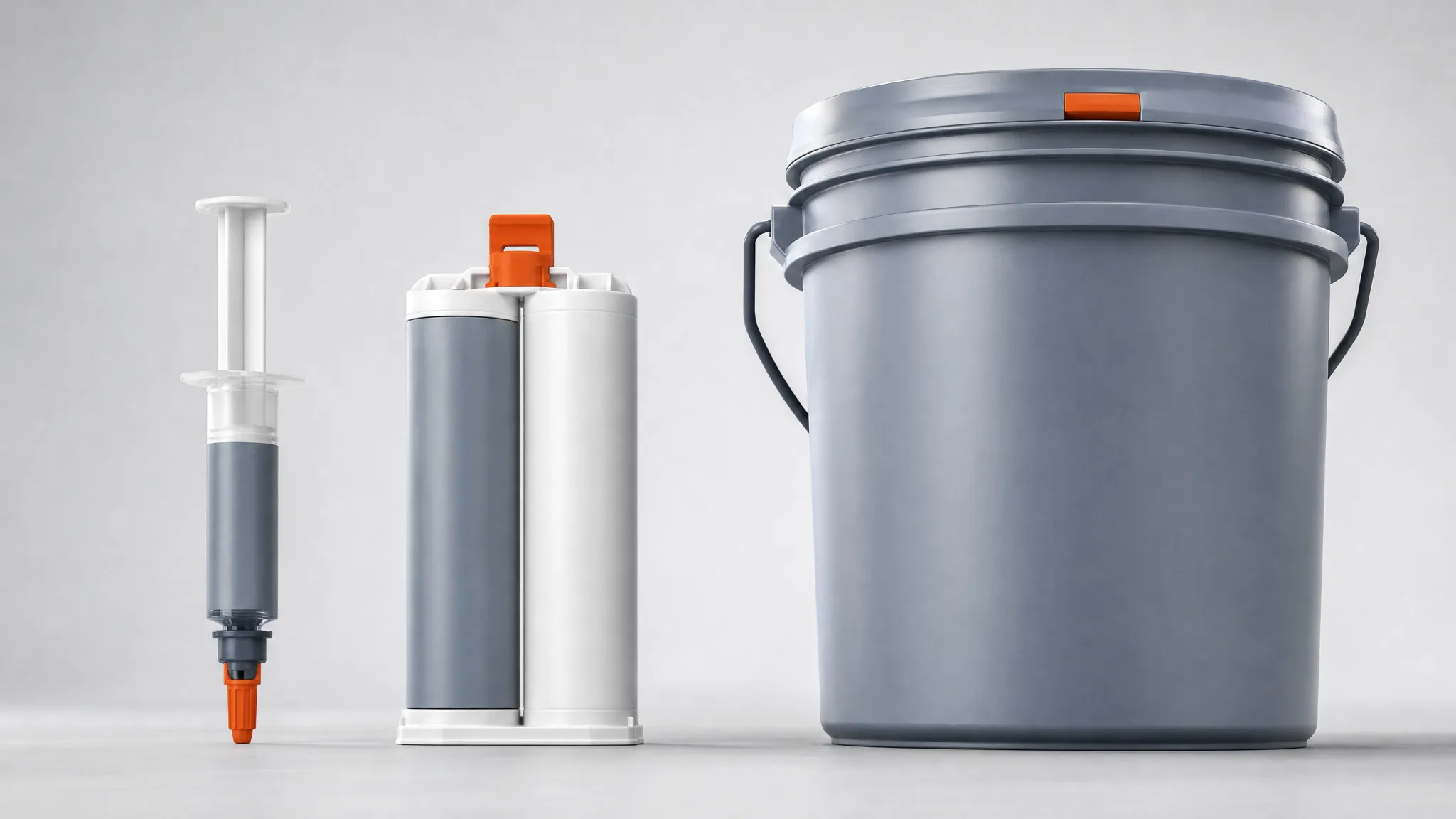
Dispensing format is part of the swap: syringe, cartridge and pail systems each imply a different tooling and recipe change.
How to Validate the Swap on Your Stack
None of the above is a reason not to use TIF070-11 — it is the reason the last step cannot be skipped. A practical order of operations:
- Confirm the incumbent, exactly. Part number, revision, and whether it is the standard 607 or the 607MF variant. Pull the current datasheet, not a brochure.
- Match the interface, not the label. Compare the two materials at the same bond line and the same pressure. Ask for impedance data at your production gap and clamp load; do not compare a number measured at a different thickness.
- Check the dispensing recipe. Put a small quantity through your actual valve and tooling and measure shot size and flow against the incumbent. This is where a rheology difference shows up first.
- Re-audit the requirement set. Temperature range, flame rating, dielectric strength, outgassing class, RoHS/REACH. Anything the candidate does not publish goes on a question list to ZIITEK before, not after, the sample run.
- Review the stack with the supplier. Send the incumbent's part number, the board drawing, the gap/standoff and its tolerance, the clamp load and the temperature profile. Applications engineering will confirm the closest grade and name the tests that still have to run.
- Sample test and thermal-cycle. Assemble TIF070-11 into the real stack-up, measure junction temperature and interface impedance under production conditions, and thermal-cycle if the application demands it. This step is the qualification; everything before it is a shortlist.
If a step turns up a mismatch you cannot close, the honest outcome is that TIF070-11 is not a drop-in for your design — and it is better to learn that from a datasheet than from a field return. The trade-offs between gel, pad and phase-change approaches are covered in gap filler vs gap pad vs phase change material.
When TIF070-11 Is Not the Right Answer
A cross-reference page that only ever points at one part is not a cross-reference page. TIF070-11 is the closest match to a 607-class application, but three adjacent options cover the cases it does not — and if what you actually want is a higher-conductivity Laird grade such as Tputty 910, that is a Laird-to-Laird comparison and is outside this page's scope.
- You need more conductivity headroom. ZIITEK's one-part gel family extends to 9.0 W/mK (TIF090-11), for higher-power-density designs where 7.0 leaves too little margin.
- Your gap is large and your stress budget is low. ZIITEK describes the lower-conductivity grade TIF050-11 (5.0 W/mK) with the same wording it uses for TIF070-11 — "soft with very low compression force" — and does not publish a cross-grade compression comparison, so a fragile package is a case for applications engineering rather than a spot pick.
- Your stack is silicone-sensitive. Optical modules and some sensor assemblies cannot tolerate silicone migration. There the right answer is a non-silicone pad such as ZIITEK's Z-Paster®100 series — and note that this changes the assembly form from a dispensed material to sheet stock or a die-cut part, which is a bigger change than the material itself. The non-silicone thermal pad range covers that class, and the silicone-free distinction matters more than any W/mK value.
Request a Sample or an Engineering Review
If your incumbent is a 607-class one-part gap filler and ZIITEK TIF070-11 looks like a candidate, the next step is a sample and a stack review rather than a purchase order. Send ZIITEK the incumbent part number and revision, the board or module drawing, the nominal gap and its tolerance, the clamp load and the operating temperature profile; applications engineering will confirm the closest grade and flag anything that needs a test before qualification.
Talk to a ZIITEK engineer about a TIF070-11 sample and a stack review, and bring the incumbent's datasheet to the call.