One-Stop Battery Thermal: Conduction, Seal & Heat
A one-stop battery thermal supplier only pays off when conduction, sealing and heating share one compression curve. Here is how to decide, and what to verify.
One-Stop Battery Thermal Is an Interface Question
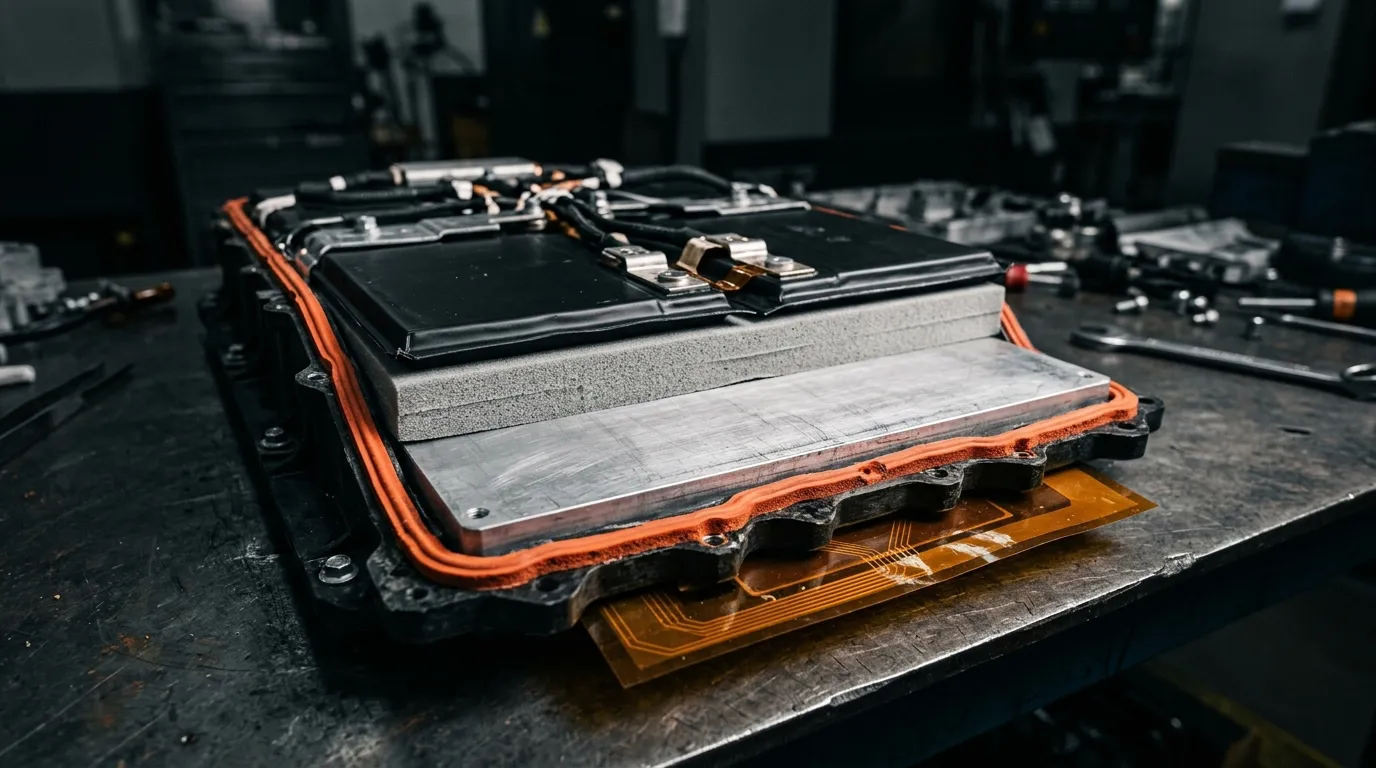
A pack team that consolidates conduction, sealing, and heating under one supplier usually does it for the paperwork: one purchase order, one quality contact, one set of declarations to file. Those are real gains. They are also not what decides whether one-stop battery thermal sourcing works. The materials decide it, and they decide it in the few millimeters between a cell and a cold plate, where all three of them have to share the same compression budget while the module is clamped shut and the pack is sealed for ten years.
That reframing matters, because "should we consolidate our thermal suppliers?" is usually answered as a purchasing question — vendors, purchase orders, what the last quoting round saved. Cost is the visible part. The engineering shows up eighteen months later as a leak, a void, or a hot cell.
The failure mode is local optimization. A gap filler supplier tunes for the lowest thermal resistance at whatever pressure its own datasheet assumes. A silicone foam supplier tunes for sealing performance at a compression ratio that suits its own foam. A heating film supplier tunes for watt density and for a bond that survives cycling. Each of those is an honest single-material curve, and each is measured on a bench with one material on it. Nobody in a three-supplier arrangement owns the stack curve — the one that says what happens to thermal resistance, sealing force, and film integrity when all three materials are compressed together by the module clamp load.
Add two more things the three families quietly share. They live inside the same temperature window, from a −40 °C cold soak to a 60 °C under-hood soak in an electric vehicle pack, and they are judged against the same evidence file — flame rating, ingress rating, material declarations, quality system. Consolidation is worth money exactly where those shared constraints are real, and worth almost nothing where they are not.
The stack curve is the measurement nobody in a three-supplier arrangement owns: thermal resistance, sealing force, and film integrity plotted against the clamp load the module actually applies.
If you want the wider material map for this application before deciding anything, start from our hub on EV battery thermal management materials.
Use the table below to place your own pack before reading the rest. Everything after it is the reasoning.
| Your pack looks like this | One-stop verdict |
|---|---|
| Bolted or bonded module with a finite clamp load shared by filler, gasket and heater | Strong case — one stack curve is the deliverable you actually need |
| Dispensed gap filler and dispensed gasket adhesive on the same line | Strong case — one process window, one curing schedule, one line qualification |
| Pack ships into the EU, so declarations must roll up from every material supplier | Strong case — one document owner instead of three |
| Cold-metal-to-metal stop that fixes the gap, so nothing competes for clamp load | Weak case — buy the best price, keep the vendors separate |
| Mature molded gasket and commodity pad bought at high volume from specialists | Weak case — you would be buying paperwork, not engineering |
| Low-volume variant where the three materials are already frozen by the platform | Weak case — consolidation saves admin, and admin is not your constraint |
The Three Jobs in a Pack, and the Constraint They Share
Take a liquid-cooled module apart and you find four material jobs stacked in one envelope. Three of them are the subject here.
Conduction carries heat from the cell base or cell side into the cold plate. In practice this is a dispensable gap filler or a compressible thermal pad sitting in a bond line that is rarely uniform — module gaps in production commonly land anywhere between about 0.5 mm and 5 mm once you add cell tolerance, tray flatness, and the swelling a lithium-ion cell develops over its life.
Sealing keeps water and dust out of the housing. That is a molded silicone foam gasket or a formed-in-place bead compressed between a composite flange and a lid, and it must still seal after years of compression, thermal cycling, and vibration.
Heating puts energy back into the pack when ambient is far below the chemistry's comfort zone. A lithium-ion cell performs and charges best in a fairly narrow band, and cold weather degrades both usable capacity and charge acceptance — which is why a low-temperature EV pack needs a heat source, not just insulation (Battery University BU-410).
The fourth job — a cell-to-cell thermal barrier that slows propagation from a failing cell, the thermal runaway case — sits in the same envelope but answers a different question. Propagation suppression is its own material family with its own test regime, and it is not covered here; the concern this article addresses is the operating stack, not the abuse case.
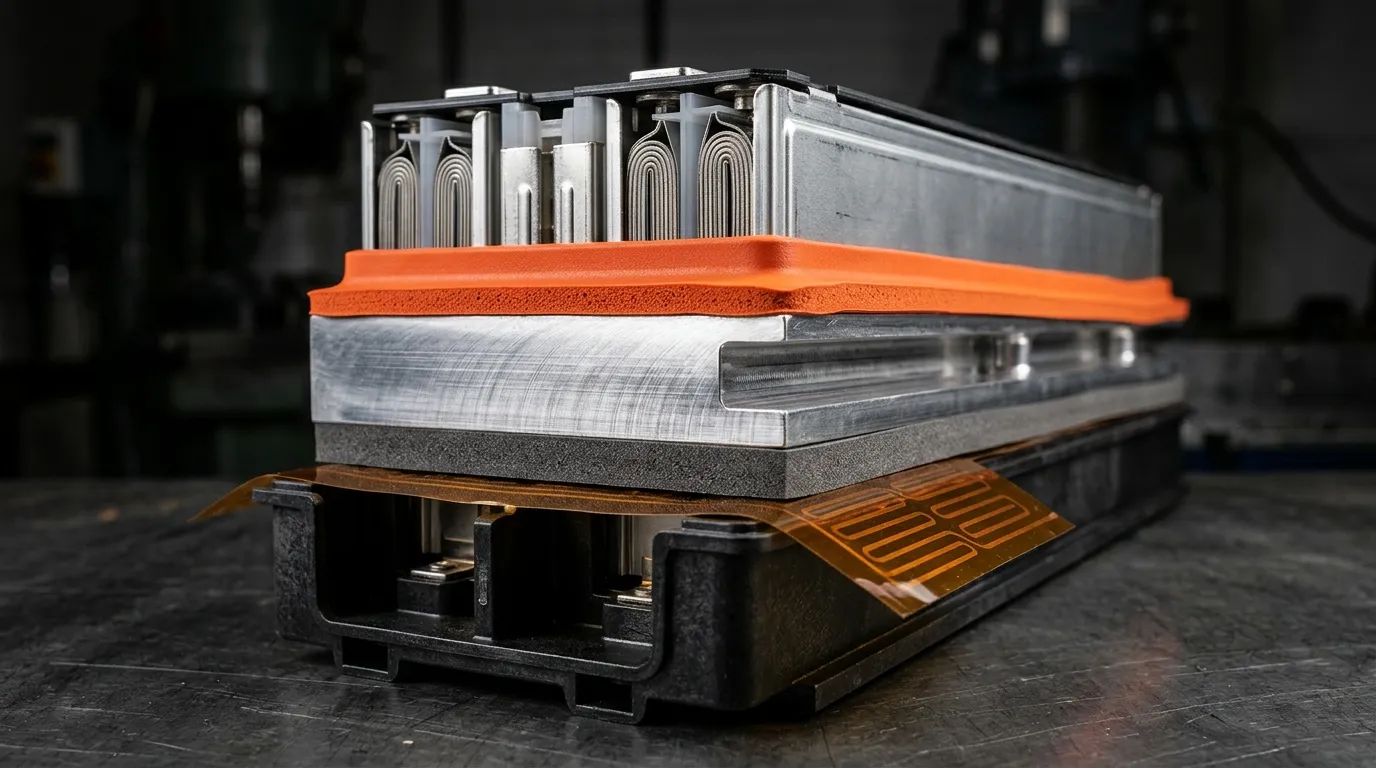
Now the part that three separate suppliers never put on one drawing. The module is bolted or bonded closed with a defined clamp load. That load is a single number, and every compressible material in the stack draws on it. If the gap filler wants to be compressed to 30 percent of its free thickness for its best thermal resistance, the foam gasket wants a specific deflection to seal without taking a permanent set, and the heating film must not be crushed beyond the point where its circuit or bond line survives, then the three of them are negotiating over one budget. A three-supplier arrangement resolves that negotiation the hard way: at first build, by trial.
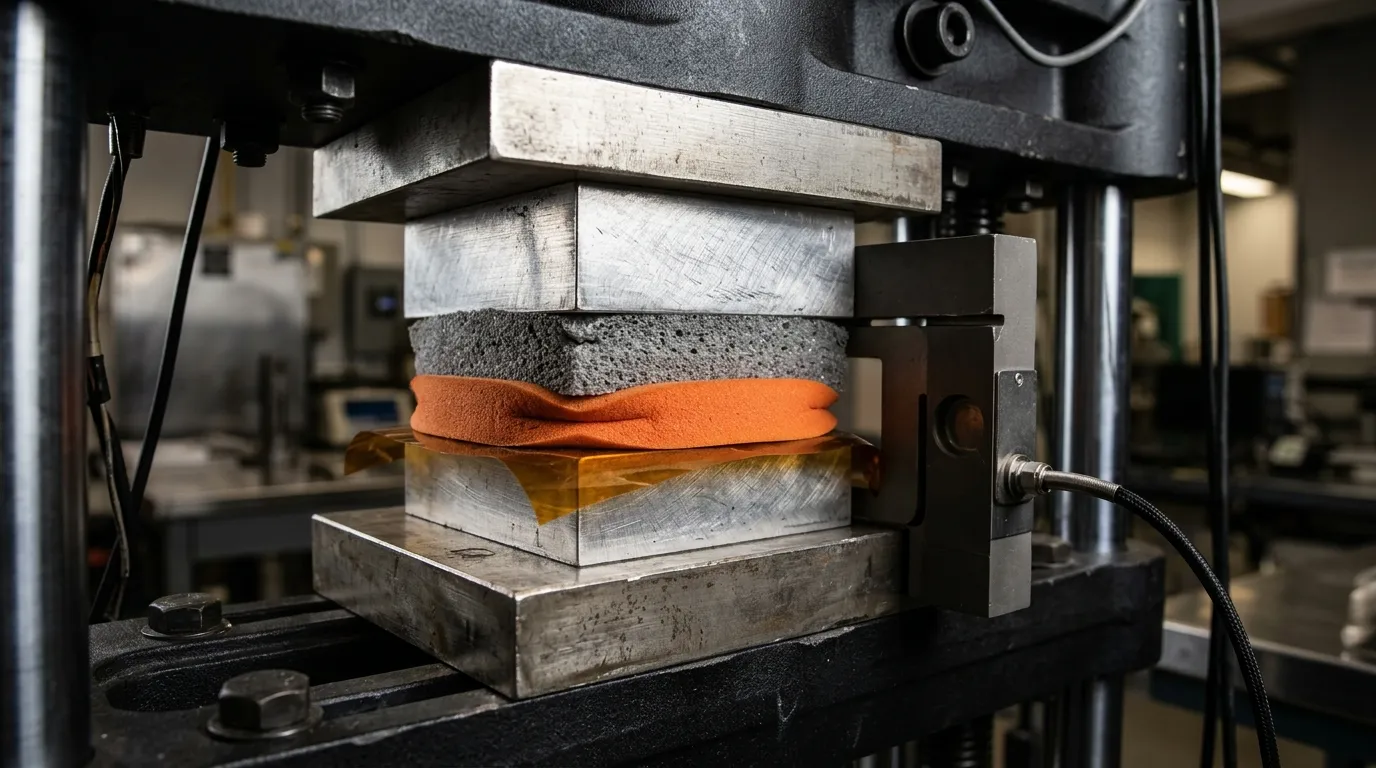
Whoever owns the whole stack can measure it once: compression versus load for the filler, deflection versus sealing performance for the gasket, and a load limit for the heater, all on the same fixture at the same displacement.
The stack also has to survive the same field duty. Modules see road vibration and shock, and they see accelerated aging — on one of our own battery programs a pack cleared an LV124 vibration profile and 1,000 hours at 125 °C before the material change was signed off. Those are assembly-level tests, and they only mean something when one party owns the specimen.
Conduction: Filling the Gap Without Loading the Cell
The conduction layer has one hard trade-off and it is not the conductivity number. Pushing a filler to high compression reduces bond line thickness and lowers thermal resistance, but every extra pound of clamp load is load the cell and the weld joints also feel. That is the design problem: get the heat out without squeezing the thing you are trying to cool.
The choice between formats follows from the gap and the volume, not from a preference. Compare them properly in our gap filler versus gap pad versus phase-change material breakdown. Which format suits your bond line and volume is a different question from which suits your datasheet.
Three practical points that a single-material datasheet will not give you:
- Dispensed gel absorbs gap variation; a pre-cut pad does not. A compressible pad is convenient and clean, but it only fills the gap it was cut for. Where the gap varies across a module or grows as cells swell, a two-component dispensable gel conforms instead of voiding. In one program we supported, a power-battery manufacturer replaced pre-cut pads with a dispensable two-component thermal gel and filled 0.5–5 mm gaps at over 50 percent compression, cutting BOM cost by about 35 percent.
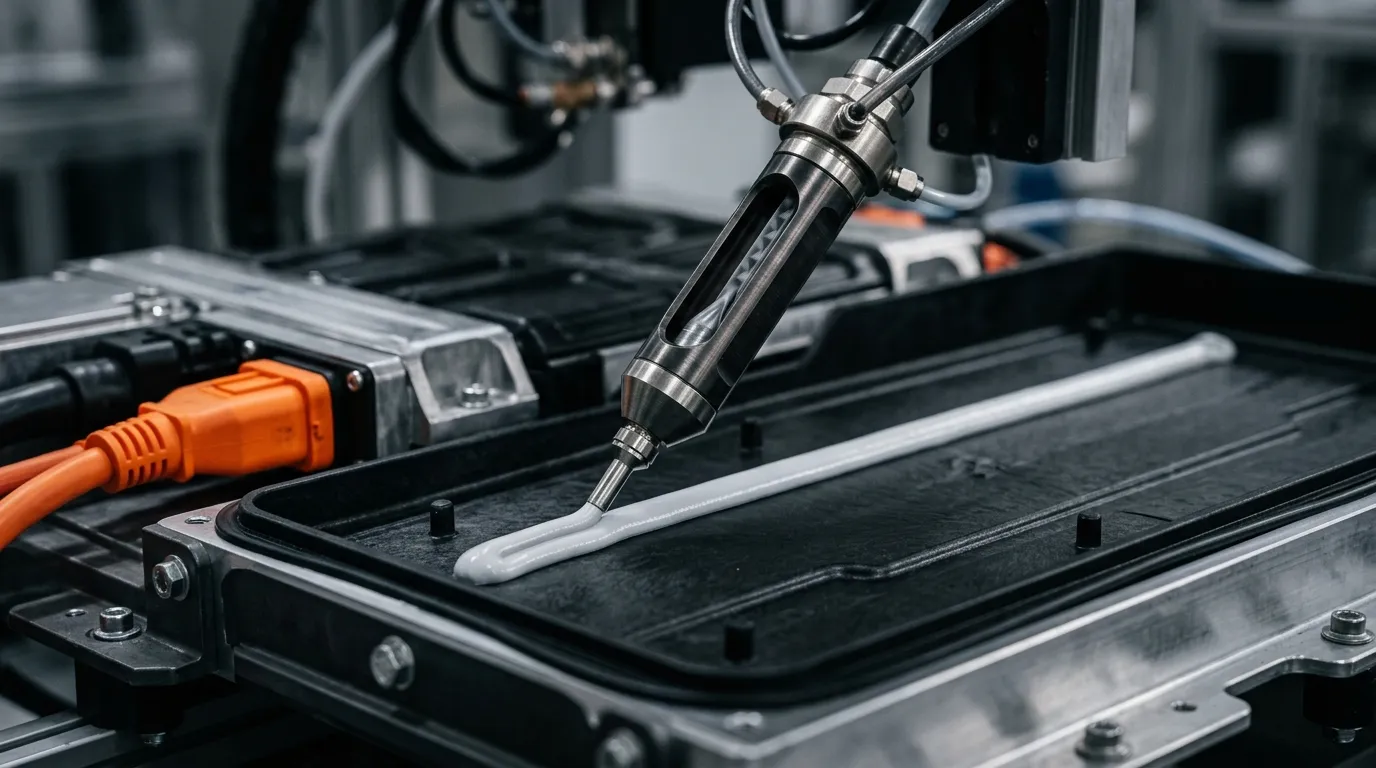
- Dispensing is an assembly-line decision, not a materials decision. A gel that cures on a schedule the line can absorb is worth more than a gel with a slightly better W/m·K number that forces a second curing oven. Automation is where the savings actually come from — around 35 percent lower processing cost in that same program — and it is a shareable benefit when the same supplier also supplies the sealing bead.
- Low-volatile and silicone-free options belong in the same conversation. Optical and contact assemblies inside a pack can be sensitive to siloxane outgassing, so a low-volatile pad or a non-silicone pad is sometimes the only acceptable answer. Ask about it at specification time; it is much cheaper than a redesign after a qualification failure.
Take one of ours as an example of what "conditions attached" looks like: TIF®035-05AB, a two-component thermal gel rated 3.5 W/m·K with a thermal resistance of 0.080 °C·in²/W measured at 10 psi. The pressure is the point. A thermal resistance figure without a pressure and a bond line is not a specification, it is a marketing number.
One adjacent job sits in the same envelope and outside this scope: potting, which fills a cavity rather than a gap. For the arithmetic on a gap you already know, the gap filler selection guide for battery modules works through format and bond line.
Sealing: The Same Curve, Seen From the Water Side
Sealing looks like a different discipline. It is the same curve read from the other end — the compression you are applying to the filler is also the compression the gasket has to hold, and the gasket is the material that must keep holding it after ten years.
Two numbers decide whether a foam gasket survives that duty. The first is compression set: how much of its original thickness the foam fails to recover after being compressed and released. A material that takes a permanent set stops sealing, because the force that pushed it against the flange is gone. A compression set of 5 percent or less is the target class for automotive pack sealing — that is the figure our own silicone foam is specified and tested to — and anything materially above it is a material you should expect to relax. Once the gasket relaxes, water finds the path it opens in the wet season.
The second number is the sealing claim itself, and this is the one most often misread. IP68 is a property of the sealed assembly, not of the gasket material. The IP code is defined in IEC 60529 (IEC on IP ratings), and it describes the enclosure that was tested. A gasket supplier can support your assembly test with compression data, water absorption figures, and material data — under 0.1 percent water absorption is the sort of figure to ask for — but no gasket datasheet can hand you IP68 on its own.
The same logic applies to flame rating. A pack material is normally expected to hold UL 94 V-0, and the rating belongs to the material as tested at a thickness, not to a product family as a whole (UL Solutions combustion and fire testing for plastics). Ask which thickness and which grade were tested; a V-0 claim that does not name a thickness is incomplete. If you need to tell V-0 apart from VTM-0 for thin films and tapes, our flame rating comparison for thermal materials walks through the difference.
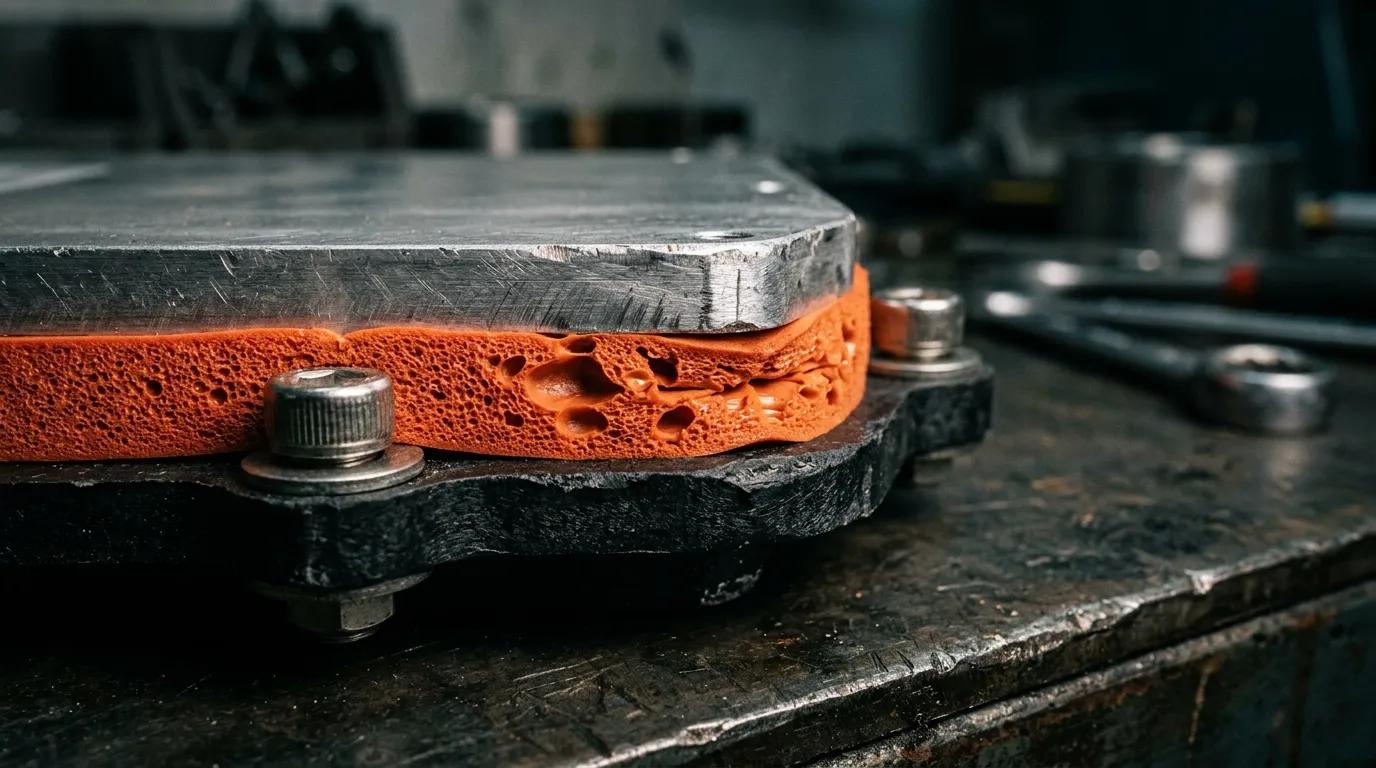
Here is where one-stop sourcing earns its keep on this job specifically. The compression that seals the housing is the same clamp load the filler is drawing on. If your gasket supplier and your filler supplier are different companies, both will give you a deflection curve measured on their own bench, and neither will have run the two materials together. A supplier that owns both has to, because it is the only way to quote a stack that works. For a deeper dive into foam sealing behavior, the IP68 silicone foam gasket guide covers the material side in detail.
Heating: The Third Job That Rarely Shares the Contract
Heating is the job most often bought separately, and the reason is organizational rather than technical. The conduction decision usually sits with the thermal engineer and the sealing decision with the mechanical or enclosure engineer. Heating gets picked up later, often by whoever owns the cold-weather requirement, and arrives at the end of the program as a component rather than part of the stack.
That is a mistake for one reason: the heater is inside the same envelope, under the same clamp load, and inside the same temperature window as everything else. A polyimide heating film is typically bonded or laminated into the module or pack base, 0.15–0.5 mm thick and rated from −40 °C to 180 °C; the silicone heating pad used for the same duty is thicker, around 1.4–2.0 mm with a 200 °C ceiling. Being thin is what makes the film usable there — and also what makes it vulnerable to a clamp load nobody re-checked after the heater was added. And the watt density you can use is set by the same bond line the filler is feeding, so a heater rating quoted in isolation from the stack is as incomplete as a thermal resistance quoted without a pressure. The control loop usually sits with the BMS, another reason the job drifts away from the thermal engineer.
The performance argument is straightforward and it is a range argument, not a comfort argument. Heating restores charge acceptance and usable capacity in cold weather, which is why a pack sold into a market with real winters is normally specified with a preheat function rather than more insulation. If you want the component-level view, our battery heating film for cold-weather preheat goes through film construction and control.
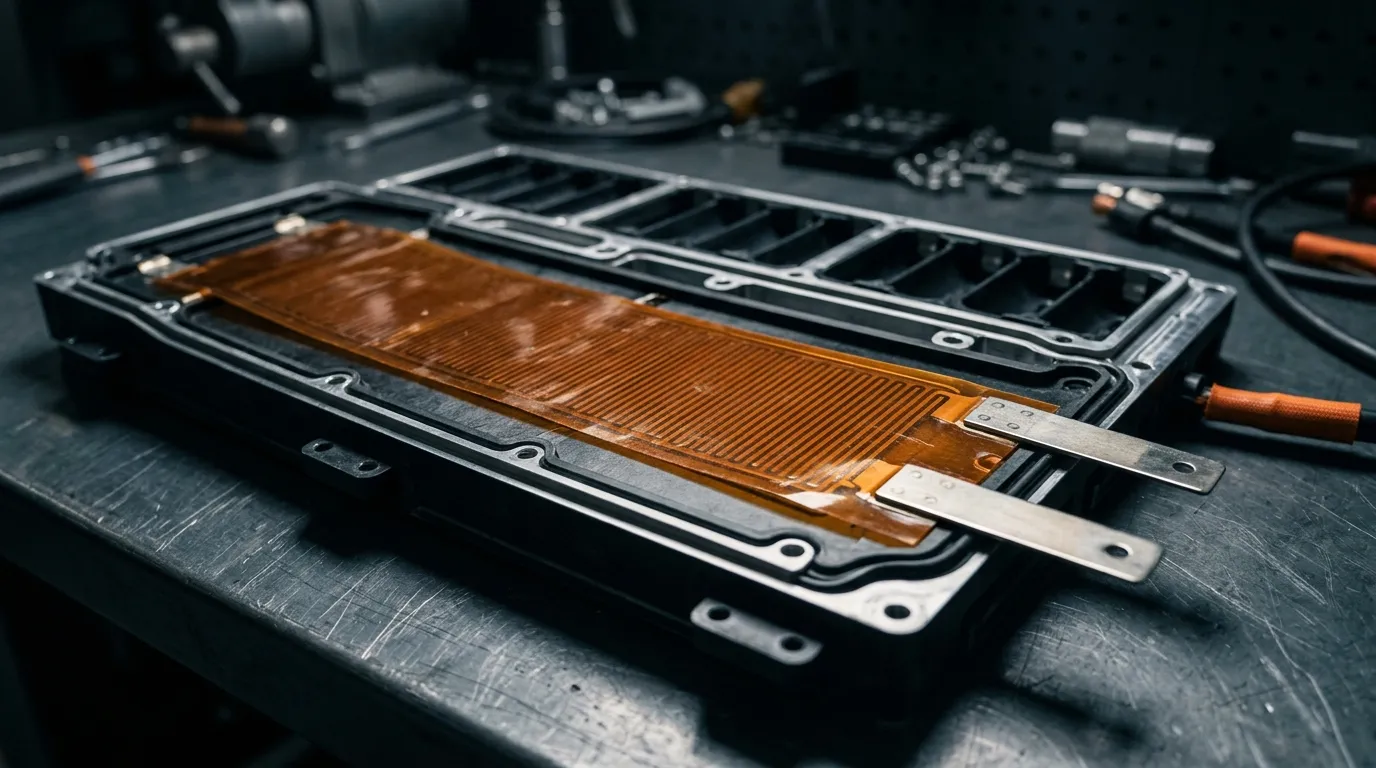
What changes when the heater joins the contract is small but real. There is one thermal interface for the heater bond to be compatible with, one curing schedule for the line, and one party to ask when the film delaminates after 300 cycles. It is also the cheapest of the three to move, because it is usually the least embedded in an existing supply agreement — which makes it the natural place to test a consolidation before committing the whole stack.
Where One-Stop Sourcing Pays — and Where It Does Not
Strip the sales language out and consolidation pays in five situations. It pays when the three materials compete for one clamp load, because then the stack curve is a real engineering deliverable and nobody else is producing it. It pays when they share a process window, because one line qualification beats three. It pays when declarations have to roll up to a single EU-facing obligation, which is increasingly the norm: Regulation (EU) 2023/1542 puts carbon footprint declaration, recycled-content disclosure and due diligence duties on batteries placed on the European market, and those duties reach back through the material supply chain (Regulation (EU) 2023/1542). It pays when assembly time dominates cost, which is where our own integrated-build figures come from: on the same pack we measured a 45 percent cut in assembly time against the three-supplier baseline it replaced. Test that on your own build before you quote it — the baseline is ours, not yours. And it pays when the pack is sealed and hard to rework, because then one accountable party matters more than three competitive quotes.
It does not pay in three situations, and this half of the list is the more useful one.
When the gap is fixed by metal. If the module uses a metal-to-metal stop that sets the bond line regardless of what the filler does, the materials are not competing for clamp load. The interface argument dissolves, and you should buy each material from whoever makes it best and cheapest.
When two of the three are already commodities. A mature molded gasket profile and a standard pad, both bought at volume from specialists with proven tooling, are not improved by being bought from one invoice. You would be paying a coordination premium for a coordination benefit you do not need.
When the platform is frozen and volumes are low. Consolidation is a change-management project. If the materials are locked and the volume will not repay a re-qualification, the savings are administrative and the risk is engineering.
The honest summary is that one-stop sourcing is a good answer to a specific question — who owns the stack curve? — and a poor answer to a general one. If nobody in your current arrangement can answer that question, consolidating is one way to create the role. Bringing in the range of EV battery pack thermal management materials as a single scope is another. Choosing between them is a decision about your team, not about your vendors.
One boundary: the same reasoning applies to a stationary battery container or an energy storage rack, but the stack there is usually flatter and the sealing duty lighter, so the shared-constraint argument is weaker. Do not reuse the conclusion — redo the table.
Four Things to Verify Before You Consolidate
A supplier that genuinely owns all three jobs can produce these four things. A supplier that is really three trading desks with a shared letterhead cannot.
1. One compression curve, tested on the stack. Ask for compression-deflection and thermal-resistance-versus-pressure for the filler, compression set for the foam, and a permissible load range for the heater — measured on the same fixture at the same displacement. Single-material datasheets are the baseline, not the answer. Where abuse testing is part of the qualification, reference the standard being used, for example SAE J2464 for battery abuse testing, so that you and the supplier mean the same test when you say "passed."
2. Flame rating with thickness and grade named. UL 94 V-0 for the foam, the filler and any tape in the stack, each tied to a tested thickness. For a true automotive part in the chain, look for an IATF 16949 quality system — the standard is maintained by the IATF Global Oversight and it is a hard gate for most OEM supplier lists, not a preference. It is a gate ZIITEK holds: IATF 16949:2016, alongside a UL yellow card (E331100) covering the foam and gel grades in this stack.
3. Ingress protection evidence at the assembly level. The gasket contributes compression data and water absorption figures; the IP test belongs to the enclosure. Agree up front who builds and submits the sealed assembly, and make sure the supplier's data will support your test rather than replace it. Our own silicone foam gasket range is specified and tested to the compression and water-absorption figures quoted above.
4. A documentary chain that survives an audit. RoHS, REACH and material declarations for each material, plus the carbon footprint and due diligence information your battery filing will need. A consolidation that reduces three document owners to one is real benefit only if the one owner can issue the whole set. Ask for a sample declaration package before you sign, not after.
What to Ask a One-Stop Battery Thermal Supplier
Bring these five questions to the first technical meeting. The answers separate a supplier of materials from a supplier of a stack.
- Can you show a compression-versus-load curve for the filler, the gasket and the heater on the same fixture? If the answer is three separate datasheets, you are talking to a distributor.
- What clamp load does your stack assume, and what is the upper limit for the heating film? The second half of that question is the one that reveals whether anyone has actually built one.
- Which material in the stack sets the sealing force, and what happens to it at 60 °C after 1,000 hours? Compression set is where seals fail, and it is where a single-supplier answer is most valuable.
- What does the declaration package contain, and can you issue it as one set? RoHS, REACH, UL 94 evidence with thickness, quality system certificate, and the inputs your EU filing needs.
- If the pack is re-qualified in two years, who runs the change? One accountable engineer is the whole point of consolidating. Confirm it exists before the purchase order does.
The point is not to find a supplier who answers yes to everything. It is to find out, in one meeting, whether anyone owns the interface between the three materials — because that interface is the only thing consolidation buys.
If your module is already through the first build and the stack curve does not exist on paper, talk to our EV battery thermal team — we supply the conduction, sealing and heating materials for battery packs as one scope, and we will tell you plainly which of the three your stack does not need.