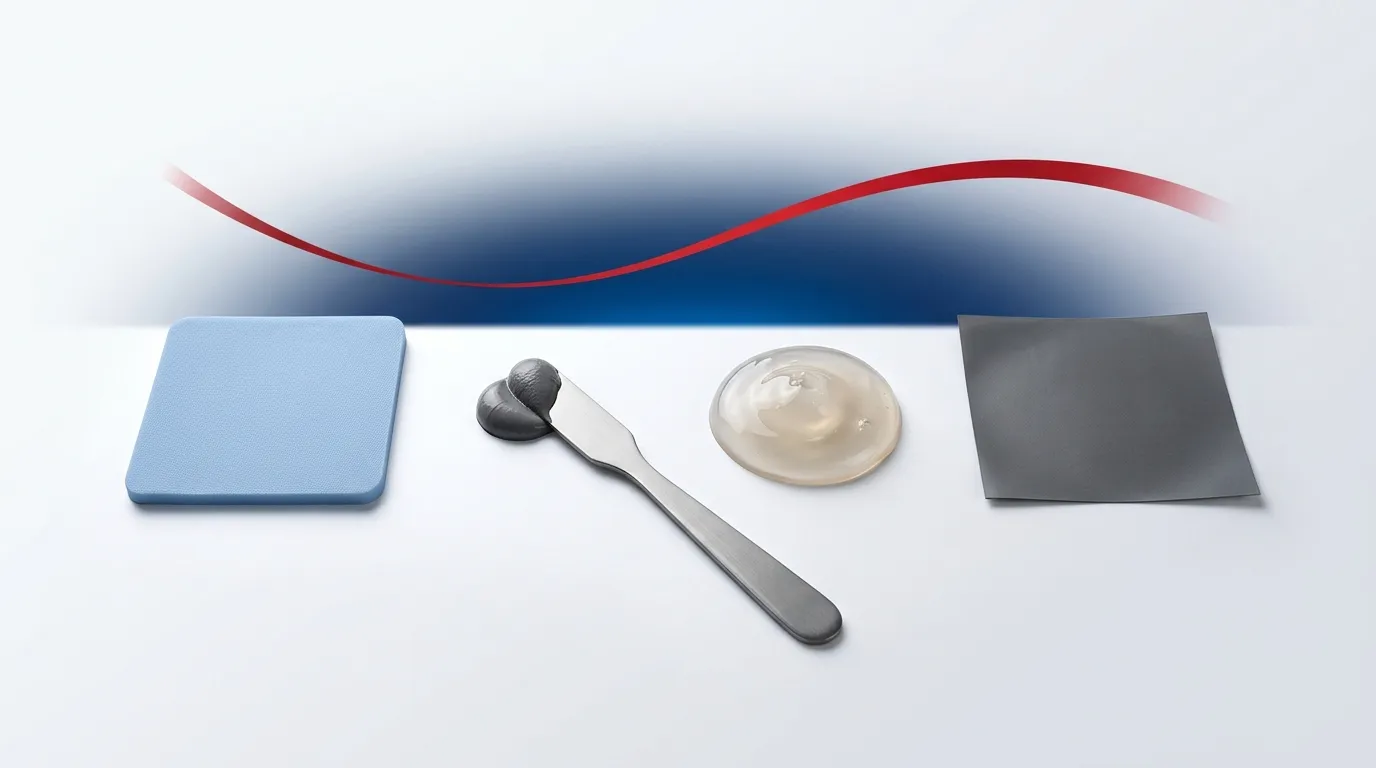
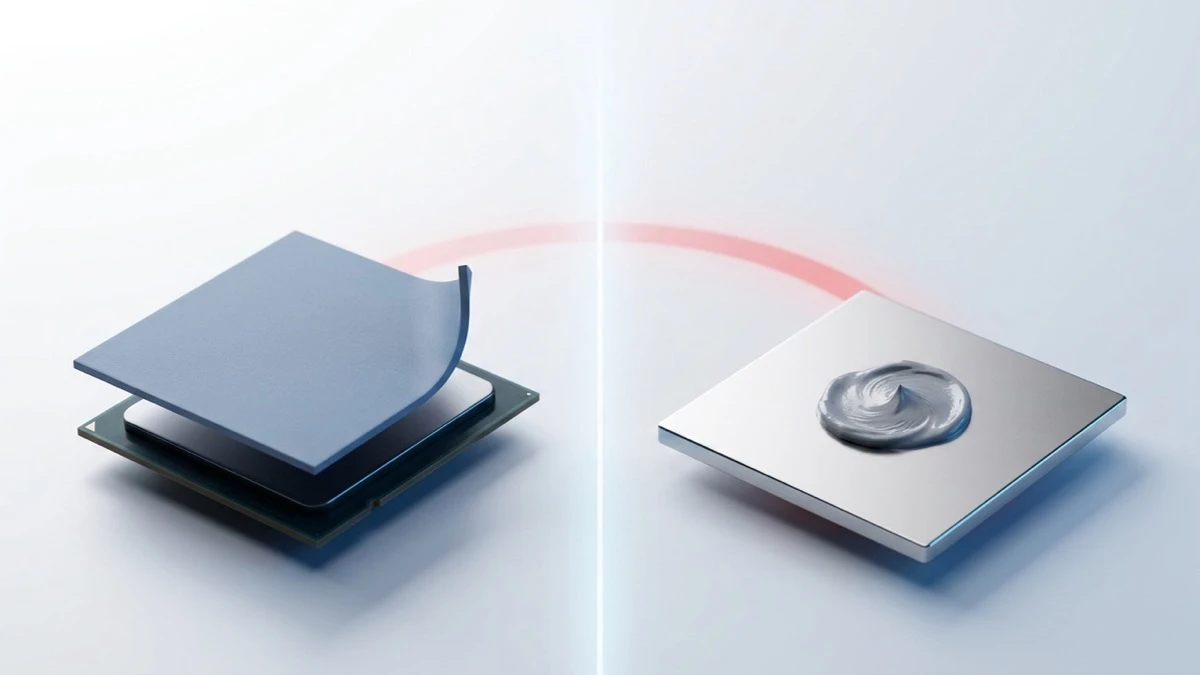
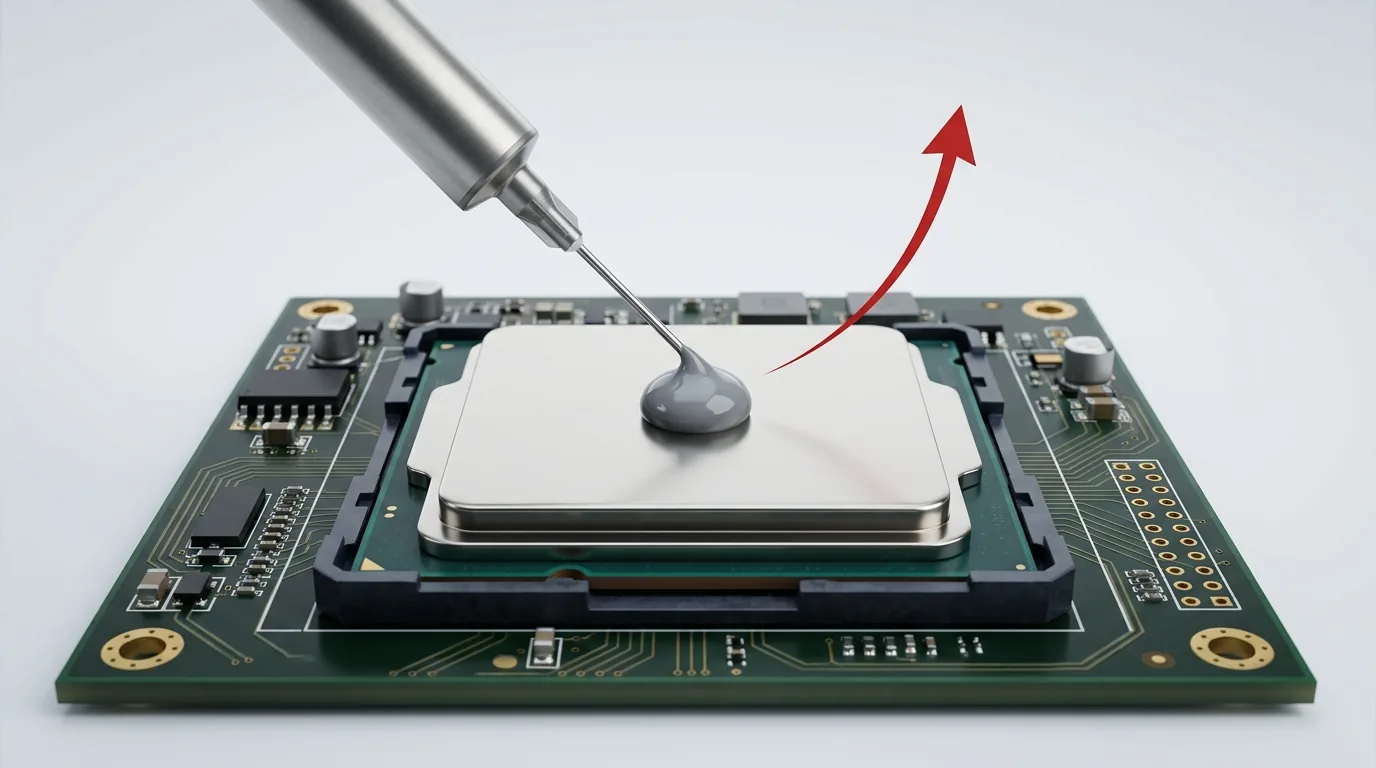
What Is Phase Change Material (PCM) TIM?
A phase change material (PCM) TIM is a solid pad that softens near 50–60 °C to flow like grease and set a thin bond line — without paste's pump-out. How it works.
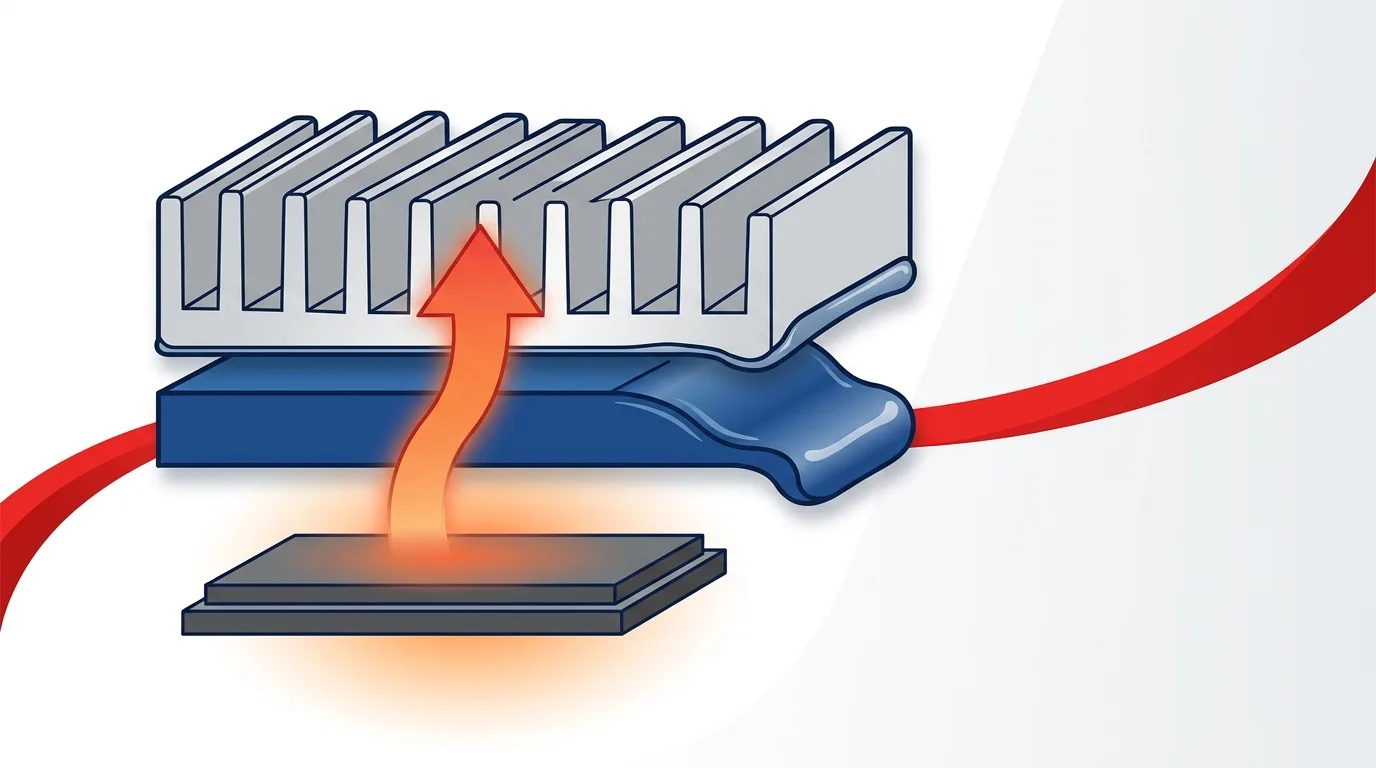
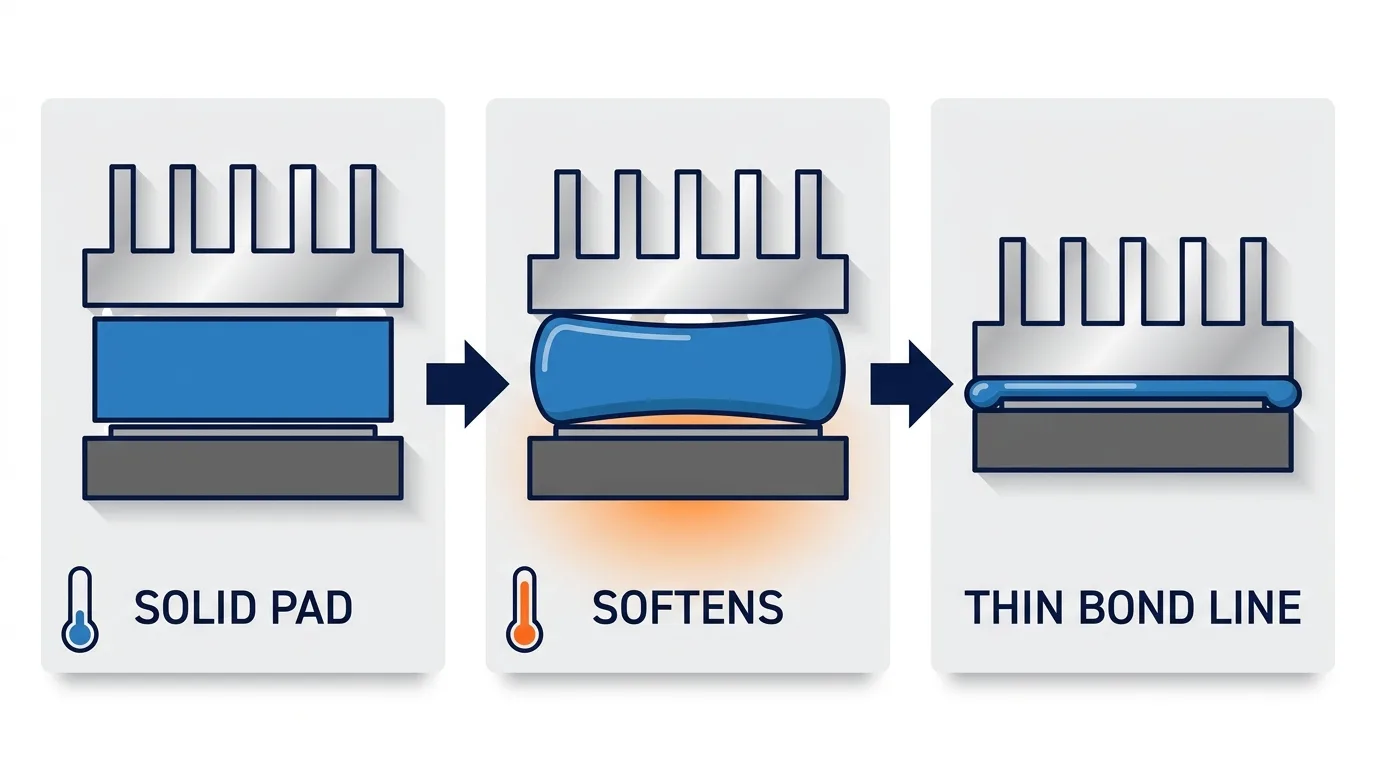
A phase change material (PCM) thermal interface material is a solid, pad- or film-like TIM that stays firm at room temperature and then softens — “changes phase” — near a set temperature (typically 50–60 °C for electronics) so it flows like a grease, wets both surfaces, and settles into a very thin bond line. Once installed, it behaves like a stable pad, giving paste-level performance without paste’s pump-out and dry-out. It’s the “best of both worlds” interface: the clean handling of a pad with the thin, conforming contact of a paste.
First, an important disambiguation, because the term is overloaded.
Two very different “phase change materials”
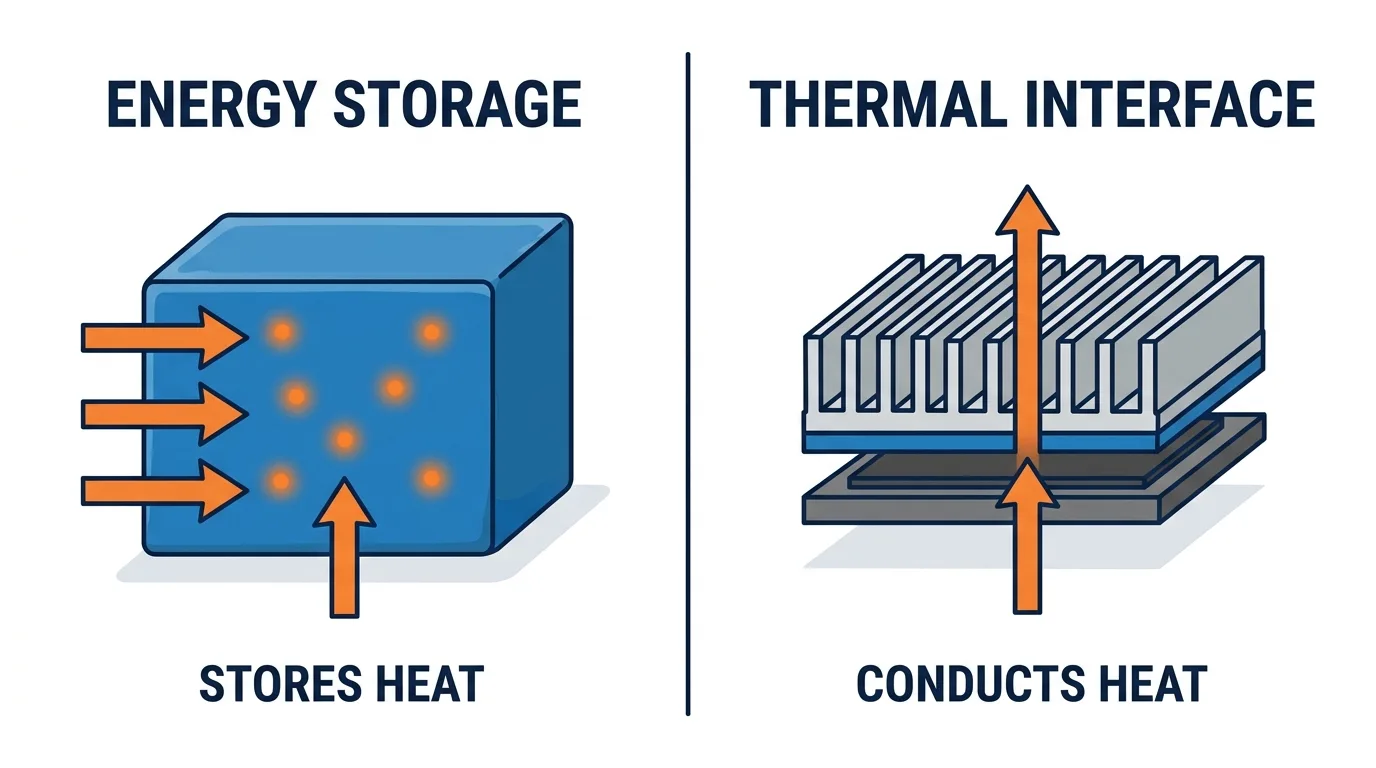
Search “phase change material” and most results are about thermal energy storage (TES) — waxes and salts that absorb large amounts of latent heat to buffer temperature in buildings, textiles, cold chains, and EV battery packs. That’s a real and useful technology, but it is not what this article is about.
Here we mean PCM as a thermal interface material (TIM-PCM): a thin material placed between a chip and its heatsink whose job is to conduct heat across that joint, not to store it. The “phase change” is a small, reversible softening used to achieve a great bond line — not a large latent-heat sink. If you came here about mattresses, buildings, or battery-pack heat buffering, that’s TES-PCM, a different topic. Everything below is TIM-PCM. This distinction is exactly what most pages blur.
How a PCM thermal interface material works
- Room temperature — solid. The PCM is a dry, tack-free pad or a screen-printed film. Clean to handle, easy to place, no mess. This is why it ships in pad-like or die-cut forms.
- First heat-up (“burn-in”). As the component warms past the material’s phase-change temperature (commonly ~50–60 °C for electronics), the PCM softens and flows under clamping pressure, wetting both surfaces and displacing trapped air.
- Thin bond line, set. It flows just enough to fill the micro-voids and form a very thin, low-resistance layer — then effectively stays put. On later cycles it re-softens slightly but doesn’t run out of the joint.
The composition is typically an organic binder (waxes/polymers with a designed melt point) loaded with ceramic conductive fillers (alumina, boron nitride, aluminum nitride, zinc oxide). Modern electronics-grade PCMs reach conductivities up to roughly 10 W/mK.
Why PCM instead of grease or a pad?
PCM exists to beat the failure modes of the two most common interfaces:
- vs thermal grease/paste: paste can pump out (migrate out of the joint under thermal cycling) and dry out over years, both of which raise resistance. PCM flows once to a thin line and then stays — so it holds its performance far more stably, while also being cleaner to apply at volume.
- vs a solid thermal pad: a pad never fully melts, so it can’t wet out to the same ultra-thin bond line PCM achieves — PCM generally gives lower thermal impedance on flat, high-power lids.
The trade-off: PCM targets flat, well-mated, higher-power interfaces (CPU/GPU lids, IGBTs, servers). It is not a gap filler — it won’t span large or variable gaps. For that job compare the three “filler” formats in gap filler vs gap pad vs phase change.
PCM vs paste vs pad vs gap filler — quick comparison
| PCM | Thermal paste | Gap pad | Gap filler | |
|---|---|---|---|---|
| Form | Solid pad/film → softens | Viscous compound | Solid pad | Dispensable, cures/soft |
| Bond line | Very thin | Very thin | Thicker (gap = pad) | Thick, variable |
| Best interface | Flat, high-power lids | Flat, tight lids | Defined gaps, insulation | Large/uneven gaps |
| Handling | Clean, die-cut, automatable | Messy, dosed | Clean drop-in | Dispensed |
| Pump-out / dry-out | Resists both | Prone to both | N/A | N/A |
| Rework | Moderate | Easy | Easy | Harder |
Where PCM is used
High-power, flat-interface electronics: desktop and server CPUs/GPUs, IGBT and power modules, telecom and networking silicon, and increasingly consumer hardware — the well-known PTM7950 that laptop owners repaste with is a phase change material. In production, PCM’s clean, die-cuttable, automatable format is a big reason OEMs choose it over hand-applied grease at volume.
ZIITEK’s own phase change line, TIC®800, illustrates the class: roughly 0.95–9.6 W/mK, a 50–60 °C phase-change temperature, supplied as roll or tab/die-cut stock for CPU/GPU, high-frequency microprocessors, servers, and IGBTs — with a TIC800K variant carrying a PI film for added electrical insulation where the interface sits near live potential.
How to spec a PCM TIM
- Phase-change temperature below your normal operating temperature so it activates in service (≈45–60 °C for most electronics).
- Thermal impedance at your clamping pressure — as always, compare impedance (°C·in²/W), not just bulk W/mK; see thermal conductivity (W/mK) in TIM.
- Electrical needs — choose an insulating (e.g. PI-backed) grade if the joint must isolate.
- Interface flatness — PCM rewards flat, well-mated surfaces; it is not for large gaps.
- Format — pad, tab, roll, or screen-printed film to suit your assembly.
Frequently asked questions
Is phase change material better than thermal paste? On flat, high-power interfaces, usually yes for longevity — it delivers paste-like thinness but resists pump-out and dry-out, so it holds performance over time. Paste can edge it on absolute first-day resistance and is easier to rework.
What temperature does PCM change phase at? Electronics-grade PCM typically softens around 50–60 °C — chosen to be below normal operating temperature so it activates during the first heat cycles.
Is a phase change material a thermal pad? It ships in a pad/film form and handles like one, but it works differently: it briefly softens and flows to a thin bond line, which a normal thermal pad never does.
Is PCM the same as the phase change material in mattresses or batteries? No — that’s thermal energy storage PCM (latent-heat buffering). TIM-PCM is about conducting heat across a chip-to-heatsink joint, not storing it.
The takeaway
A PCM thermal interface material gives you a clean, solid part that self-optimizes into a thin, stable bond line on first heat-up — paste-grade contact without paste’s mess or pump-out, on flat high-power joints. Where it fits, it’s often the best interface in the toolbox; where the gap is large or uneven, reach for a pad or gap filler instead (see the selection guide). For spec-level help matching a PCM’s phase-change point, impedance, and format to your design, ZIITEK’s engineering team can sample TIC®800 grades against your interface.
Background references: Thermally conductive pad — Wikipedia (covers phase-change TIM behavior); general PCM-TIM mechanism from Electronics Cooling magazine. Product data reflects ZIITEK’s TIC®800 phase change line.