What Is Thermal Paste? Types, W/mK & How It Works
Thermal paste is a conductive compound that fills the microscopic air gaps between a chip and its heat sink. Learn its types, W/mK ratings, and how it works.
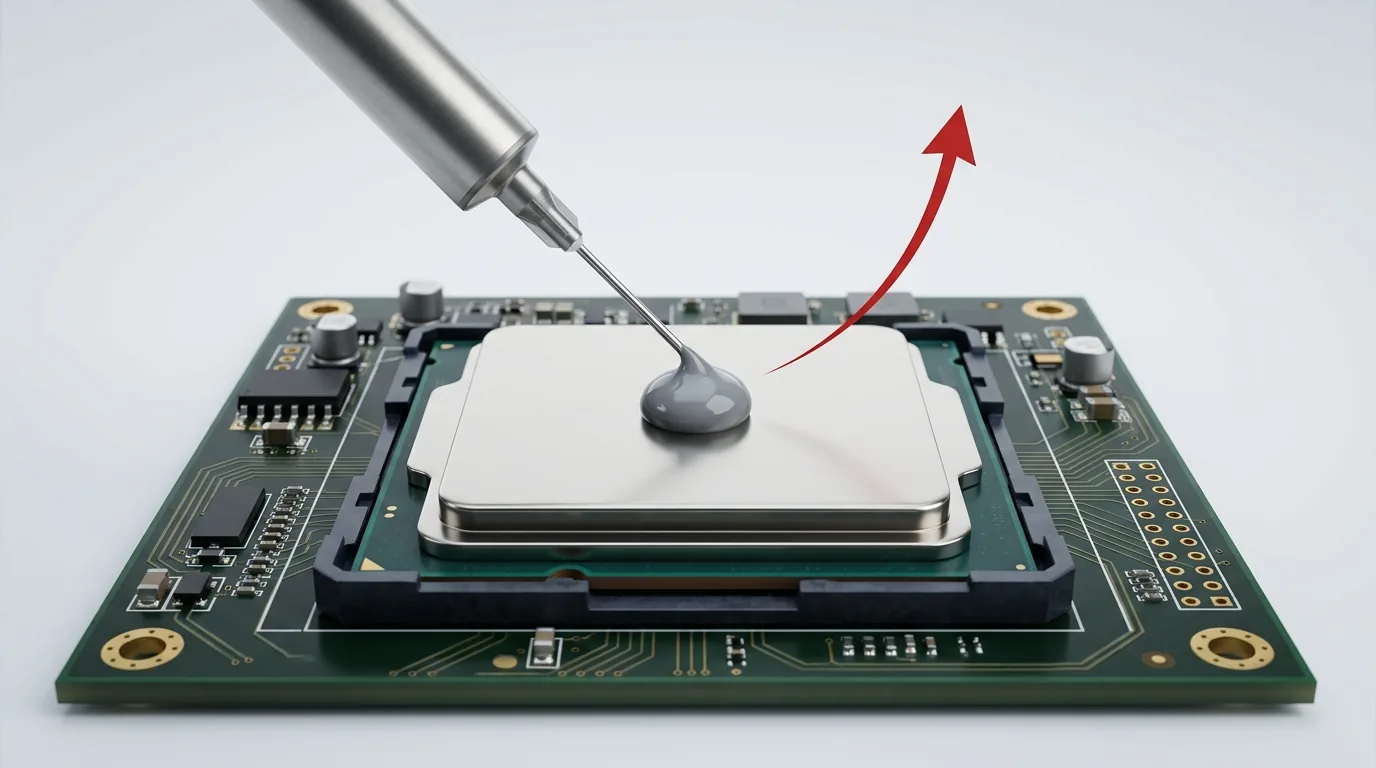
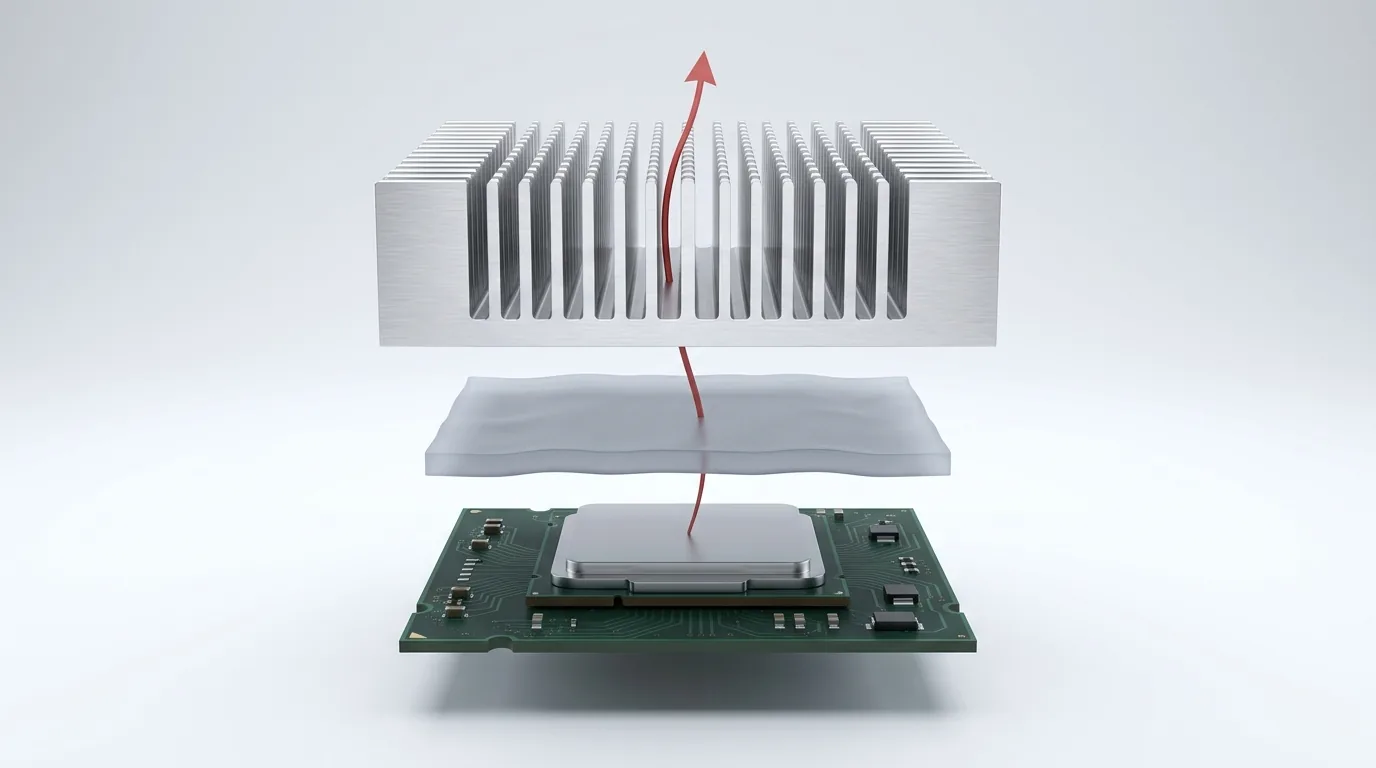
Thermal paste is a thermally conductive compound applied in a thin layer between a heat-generating component and its heat sink. It fills the microscopic air gaps between the two surfaces so heat can flow into the cooler instead of getting trapped. It is also called thermal grease, thermal compound, or a thermal interface material (TIM).
That component might be a CPU, GPU, power transistor, or LED — the physics is the same. This guide is written by the engineering team at ZIITEK, a thermal-management-materials manufacturer founded in 2006 that produces TIMs for power electronics, EV, telecom, and LED customers — so the focus is on the physics that governs real designs, not just PC builds.
What does thermal paste do?
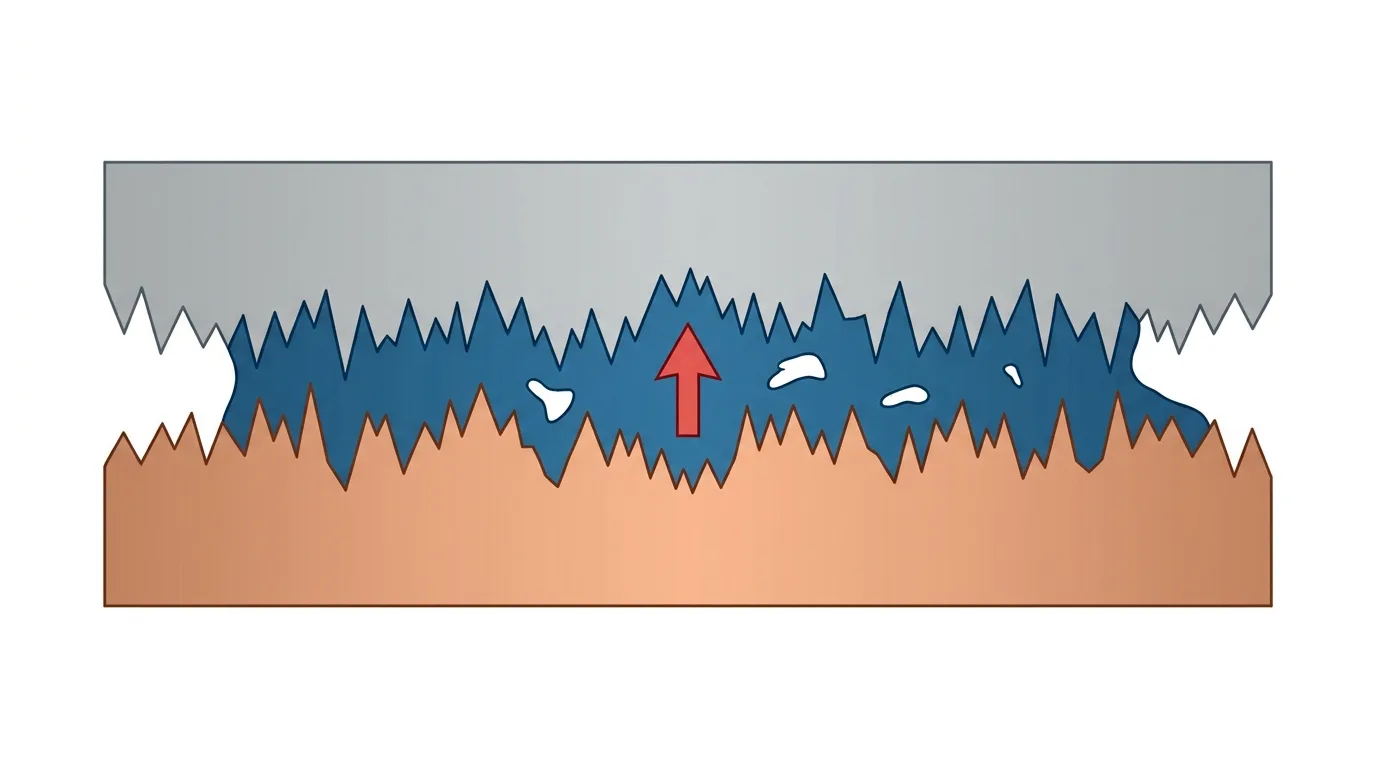
No two solid surfaces are truly flat. Even a machined copper integrated heat spreader (IHS) and a lapped heat-sink base look mirror-smooth but are covered in microscopic ridges, valleys, and waviness. When you press them together, they only touch across a tiny fraction of their apparent area — often less than 1–2%. The rest of the interface is filled with air.
Air is an excellent thermal insulator. Its thermal conductivity is only about 0.026 W/mK (Wikipedia: Thermal conductivity) — roughly ten thousand times worse than the copper (~400 W/mK) and aluminum (~237 W/mK) it separates. Those trapped air pockets act like a thermal blanket, forcing heat to bottleneck at the interface. The result is a hotter chip, thermal throttling, and shortened component life.
Thermal paste solves this by displacing the air. It flows into the valleys and voids and replaces the insulating air with a material that conducts heat roughly 20 to 3,000 times better. The paste does not out-perform direct metal-to-metal contact — its purpose is to eliminate the worst conductor in the stack. That is why thermal paste is essential wherever a rigid heat source meets a rigid heat sink.
How does thermal paste work?
The mechanism is entirely about surface contact and bond line thickness.
- Wetting the surfaces. A good paste has the right viscosity to spread under pressure and “wet” both surfaces, seeping into every microscopic pit rather than bridging over it.
- Filling the air voids. Once the paste occupies the gaps, the conductive filler particles inside it form heat-transfer paths where air used to be.
- Getting squeezed thin. As the cooler is mounted and clamped, most of the paste is pushed out. What matters is the layer that remains — the bond line thickness (BLT).
This last point is where most consumer advice goes wrong. A thinner bond line does transfer heat better than a thick one, and that is the real physics behind the classic “pea-sized amount” guidance. But it does not follow that using too much paste makes a chip run hotter — because the clamping pressure of the cooler squeezes the excess out for you.
That has actually been measured. When GamersNexus benchmarked paste quantity and application method on a 256 W delidded chip, every application — from a pea-sized dot to a deliberately excessive slather — landed within about one degree of the others. The real costs of over-application are mess, wasted paste, and, with electrically conductive compounds, the risk of shorting nearby components. Too little paste is the genuine failure mode, because it leaves part of the die uncovered with nothing but air to conduct through. Bond line thickness still matters in engineering terms, where a joint is designed and its BLT is actually controlled — it is simply not the variable a hand-clamped consumer joint loses degrees to.
The performance you feel at the chip is driven not by bulk thermal conductivity alone but by thermal resistance across the whole joint, which combines the paste’s conductivity, its bond line thickness, and the contact resistance at each surface. We break that relationship down in our guide to thermal resistance vs thermal impedance.
What is thermal paste made of?
Every thermal paste is a two-part system:
- A carrier matrix — usually silicone oil or a synthetic/polymer base — that gives the paste its spreadable, grease-like consistency and lets it flow into surface gaps.
- A conductive filler — the ingredient that actually moves heat. Fillers make up roughly 70–80% of the paste by mass and can include zinc oxide, aluminum oxide, aluminum nitride, boron nitride, ceramic micro-particles, silver, carbon, or a liquid-metal alloy.
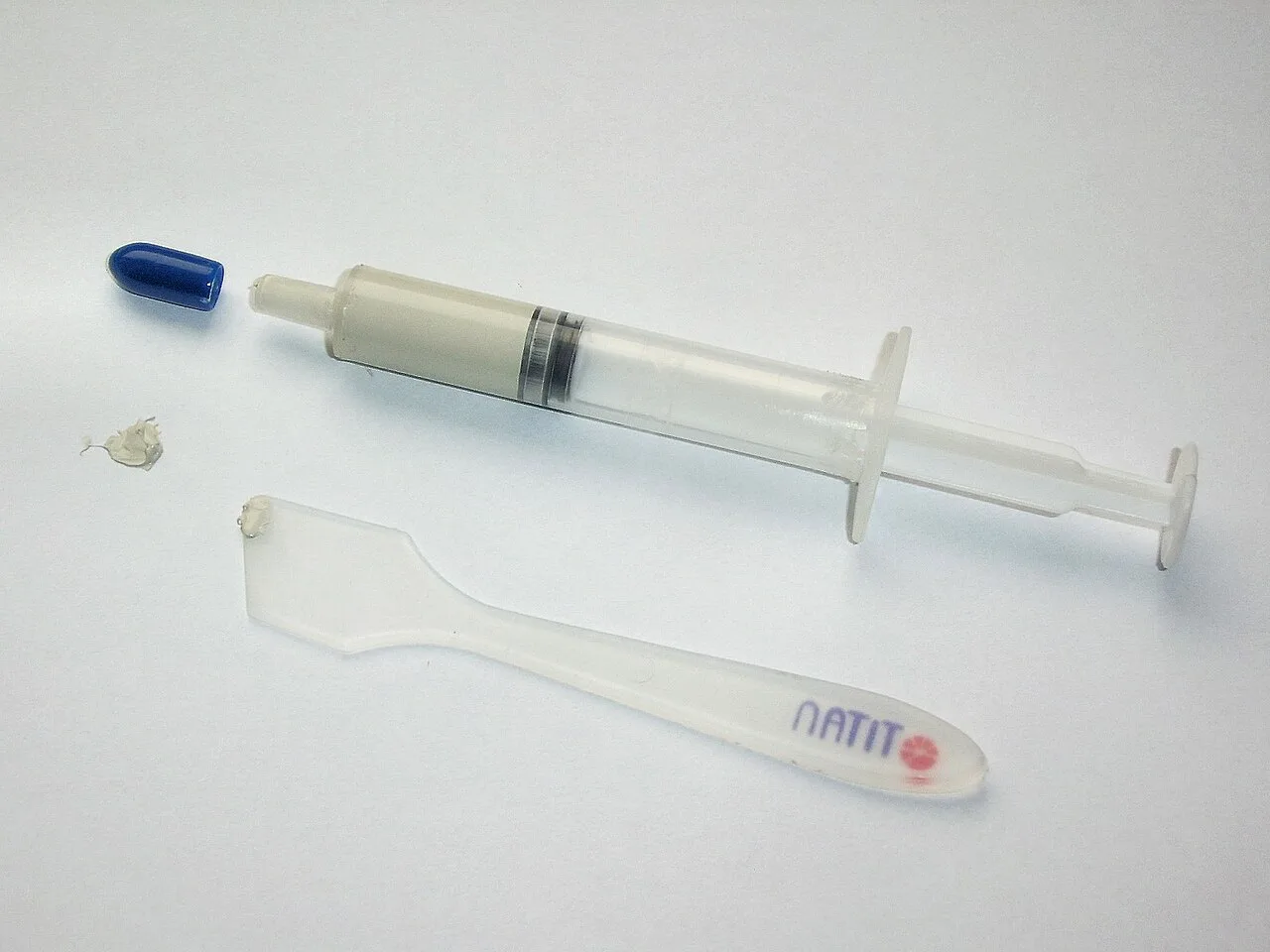
The choice of filler is what separates one type of thermal paste from another. It sets the thermal conductivity, whether the paste is electrically insulating or conductive, how long it lasts, and how much it costs. ZIITEK’s thermal grease line (TIG®780), for example, spans 1.0–5.2 W/mK across different filler formulations — a spread driven almost entirely by filler chemistry and loading.
Thermal conductivity explained: what W/mK means
Thermal conductivity is measured in watts per meter-kelvin (W/mK). It describes how much heat a material carries per unit thickness for a given temperature difference — higher is better. When a datasheet lists a paste at “5 W/mK,” it means the bulk material conducts heat five times better than a 1 W/mK compound of the same thickness.
For context:
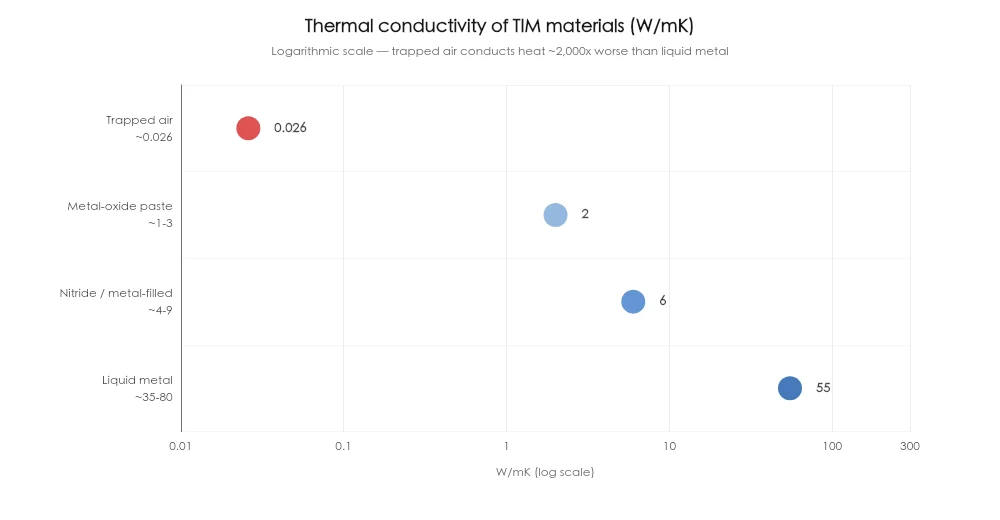
- Trapped air: ~0.026 W/mK
- A basic metal-oxide paste: ~1–3 W/mK
- A high-performance nitride or metal-filled paste: ~4–9 W/mK
- Liquid metal: ~35–80 W/mK
A word of caution that most consumer articles skip: a higher headline W/mK does not guarantee lower chip temperatures. Real-world performance depends on how thinly the paste bonds, how well it wets the surfaces, and the thermal resistance of the total joint. A well-applied 5 W/mK paste can beat a poorly applied 12 W/mK one. Datasheet W/mK values are also measured under standardized conditions — the industry reference is ASTM D5470, the standard test method for the thermal transmission properties of thermally conductive materials — so numbers are only comparable when they come from the same test. For a deeper treatment, see our explainer on understanding thermal conductivity (W/mK) in TIM.
Types of thermal paste
Pastes are classified by their filler — the ingredient that actually moves the heat. (The carrier is a separate axis: most pastes use a silicone oil base, but silicone-free versions of nearly every filler type exist. More on that below.) Each filler family trades off conductivity, electrical safety, longevity, and cost.
| Filler chemistry | Typical W/mK | Electrically conductive? | Relative cost | Best for |
|---|---|---|---|---|
| Metal-oxide ceramic (zinc oxide, aluminum oxide) | ~0.5–4 | No (dielectric) | Low | General-purpose, high-volume, the safe default |
| Nitride ceramic (aluminum nitride, boron nitride) | ~2–8 | No (dielectric) | Low–Medium | Mainstream CPU/GPU and electronics cooling |
| Metal particle (silver, aluminum) | ~3–9 | Slightly / capacitive | Medium | Higher performance without full liquid-metal risk |
| Carbon (graphite, carbon micro-particles) | ~4–12 | Mildly conductive | Medium–High | Thin bond lines, enthusiast cooling |
| Liquid metal (gallium alloys) | ~35–80 | Yes (short-circuit risk) | High | Extreme heat flux, expert application only |
About these numbers. They are typical ranges for commercially available pastes, not physical limits of the filler itself. Published figures move with filler loading, particle size, carrier chemistry, and — as noted above — the test method behind them, so treat them as a map of the landscape rather than spec-sheet values to design against. Always compare candidates on their own ASTM D5470 data. For reference, our own materials sit inside these ranges: the TIG®780 thermal grease line spans 1.0–5.2 W/mK and our liquid-metal TIM runs 35–58 W/mK.
A few practical notes behind the table:
- Ceramic-filled pastes are dielectric (non-conductive) whether the filler is a metal oxide or a nitride, so a stray smear won’t short a circuit. That safety margin is why they dominate high-volume manufacturing.
- Metal-oxide and nitride fillers are both “ceramics” in everyday usage, which is why many guides lump them into one row. Splitting them matters in practice: nitrides (especially AlN and BN) carry heat considerably better than zinc oxide at the same loading, and BN additionally brings a low dielectric constant.
- Liquid metal delivers by far the highest conductivity, but it is electrically conductive and corrodes aluminum. It belongs in expert hands and copper-based cooling, not a first-time build.
- Silicone-free options exist across the filler families for applications sensitive to silicone outgassing — optics, camera and sensor modules, and certain medical devices, where volatile siloxanes can condense on lenses and contacts.
Choosing among these is really a thermal-interface-material selection problem. Our guide to choosing a thermal interface material walks through the decision logic for a given design.
Thermal paste vs thermal grease vs thermal compound: are they the same?
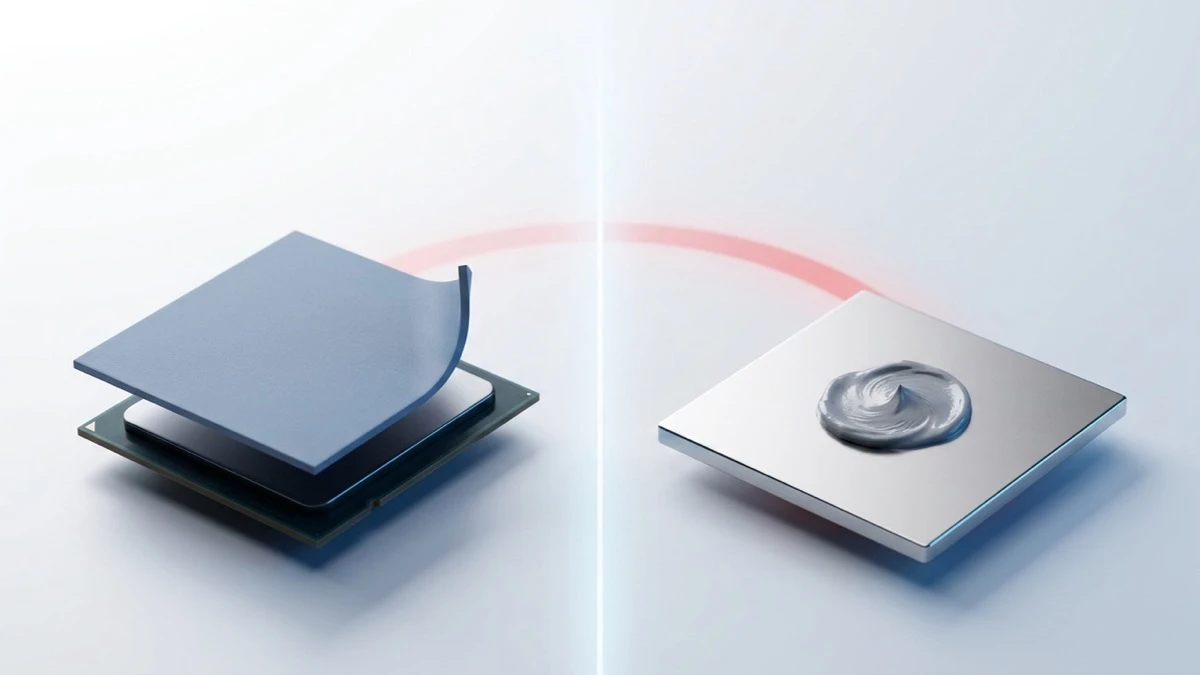
Yes. Thermal paste, thermal grease, thermal compound, thermal gel, and CPU grease are all names for the same class of material — a spreadable, non-curing (or slow-curing) TIM that fills the gap between a heat source and a heat sink. The naming is regional and marketing-driven, not technical.
The one distinction worth knowing is against materials that change form or cure:
- A thermal gel or gap filler is a thicker, dispensable paste used to bridge larger, uneven gaps.
- A phase-change material (PCM) is solid at room temperature and softens/flows only once it heats up.
Those are still part of the TIM family, just engineered for different gap sizes and reliability needs.
Where thermal paste fits in the TIM family
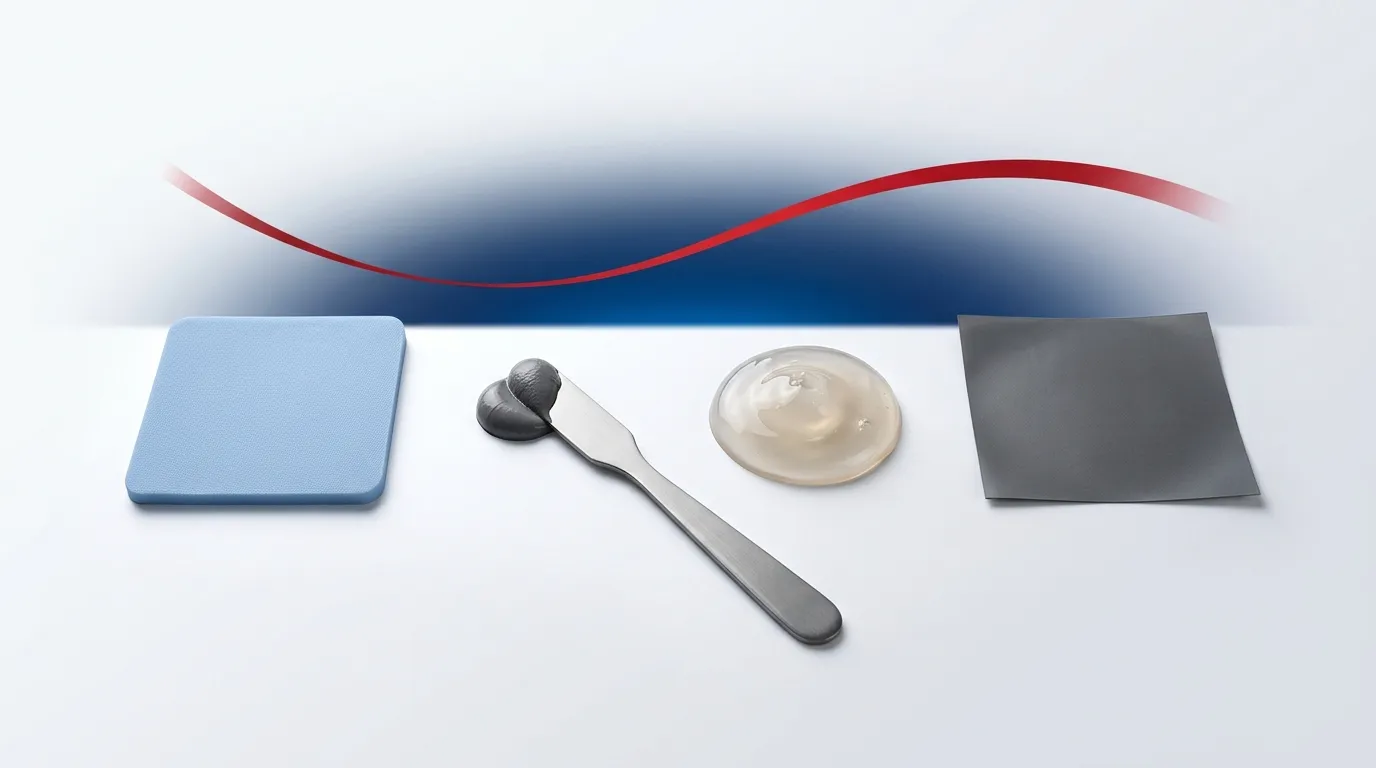
Thermal paste is one member of a broader family of thermal interface materials. Picking the right one is a design decision, and paste is not always the answer:
- Thermal paste — best for tight, flat, rigid-to-rigid interfaces (CPU/GPU dies, power modules).
- Thermal pads — pre-cut, easy-to-assemble sheets for larger gaps and high-volume production. See thermal pad vs thermal paste.
- Gap fillers and phase-change materials — for uneven or larger gaps and for reliability under thermal cycling. Compare them in gap filler vs gap pad vs phase change.
If you are weighing all of these against one another, start with our pillar overview: Thermal Interface Materials: The Complete Selection Guide.
Applying, dosing, and replacing thermal paste
The application basics are consistent across sources: clean both surfaces with isopropyl alcohol, apply a modest amount to the center of the chip, and let mounting pressure spread it. Which pattern you use matters far less than most forum arguments suggest — Club386 tested every common pattern (dot, line, X, five-dot, and full manual spread) and found they perform very similarly as long as they achieve full, bubble-free coverage. For the full method and the pros and cons of each pattern, see how to apply thermal paste correctly. Quantity follows the same rule as the bond line above: if you are going to miss, miss generous. Too little leaves part of the die uncovered, while excess mostly squeezes out under the cooler — so we cover dosing separately in how much thermal paste to use.
Thermal paste is not permanent. Over months and years it can dry out, and repeated heating and cooling can cause pump-out, where the paste is slowly squeezed out of the joint by thermal cycling. Both raise thermal resistance over time, which is why paste is periodically reapplied — typically every 3–5 years in consumer hardware, and per qualified maintenance intervals in industrial equipment. When it is time to redo the joint, follow how to remove and clean off thermal paste so the surfaces are clean for the next application.
Beyond the PC: thermal paste in industrial electronics
Most articles frame thermal paste as a gaming-PC topic, but the same physics governs far more demanding applications. In EV battery and inverter modules, 5G/telecom radios, high-power LED (COB) arrays, energy-storage systems, and server processors, TIMs must survive wide temperature ranges (often −45 °C to 200 °C), thousands of thermal cycles, and strict reliability qualification. In those settings, pump-out resistance, long-term stability, and electrical insulation matter as much as headline conductivity — and material selection is validated against standards like ASTM D5470 rather than a forum benchmark.
This is where manufacturer expertise earns its keep. ZIITEK develops thermal greases, gels, pads, phase-change materials, and liquid-metal TIMs for OEMs speccing these materials at volume, under IATF 16949 and ISO 9001 quality systems, with UL 94 V-0 flame ratings on the silicone pad and gel lines. If you are designing a thermal interface into a product, our engineering team can help you match a material to your gap, heat flux, and reliability targets — request a datasheet or samples for your design.
Frequently asked questions
Is thermal paste necessary? For any rigid chip-to-heat-sink interface, yes. Without paste, trapped air across the microscopically rough surfaces insulates the chip and causes overheating and throttling. The only interfaces that skip paste are ones designed to use a different TIM, such as a thermal pad or phase-change pre-applied material.
What can I use instead of thermal paste? Use a purpose-made TIM — a thermal pad, gap filler, or phase-change material — depending on the gap. Household substitutes like toothpaste dry out fast, offer poor conductivity, and can be mildly corrosive; they are not a real replacement.
Can I apply thermal paste with my fingers? Don’t touch it directly. Skin oils contaminate the paste and reduce performance, and some formulations (notably liquid metal) should never contact skin. Apply from the syringe and let cooler pressure spread it.
Is thermal paste toxic? Most silicone and ceramic pastes are low-hazard but should not be ingested and should be kept away from eyes; wash hands after handling. Liquid-metal (gallium-based) compounds require more care because they are electrically conductive and corrode aluminum. Always follow the product’s safety data sheet.
What does W/mK mean on a thermal paste? It is the material’s thermal conductivity in watts per meter-kelvin — how well the bulk paste carries heat. Higher is generally better, but real performance also depends on how thinly and evenly the paste is applied.