Bergquist Gap Pad TGF4500 Equivalent: TIF050AB
Compare Bergquist Gap Filler TGF 4500CVO with ZIITEK TIF050AB-11S: published specs, the numbers that do not convert, and what to qualify before a swap.
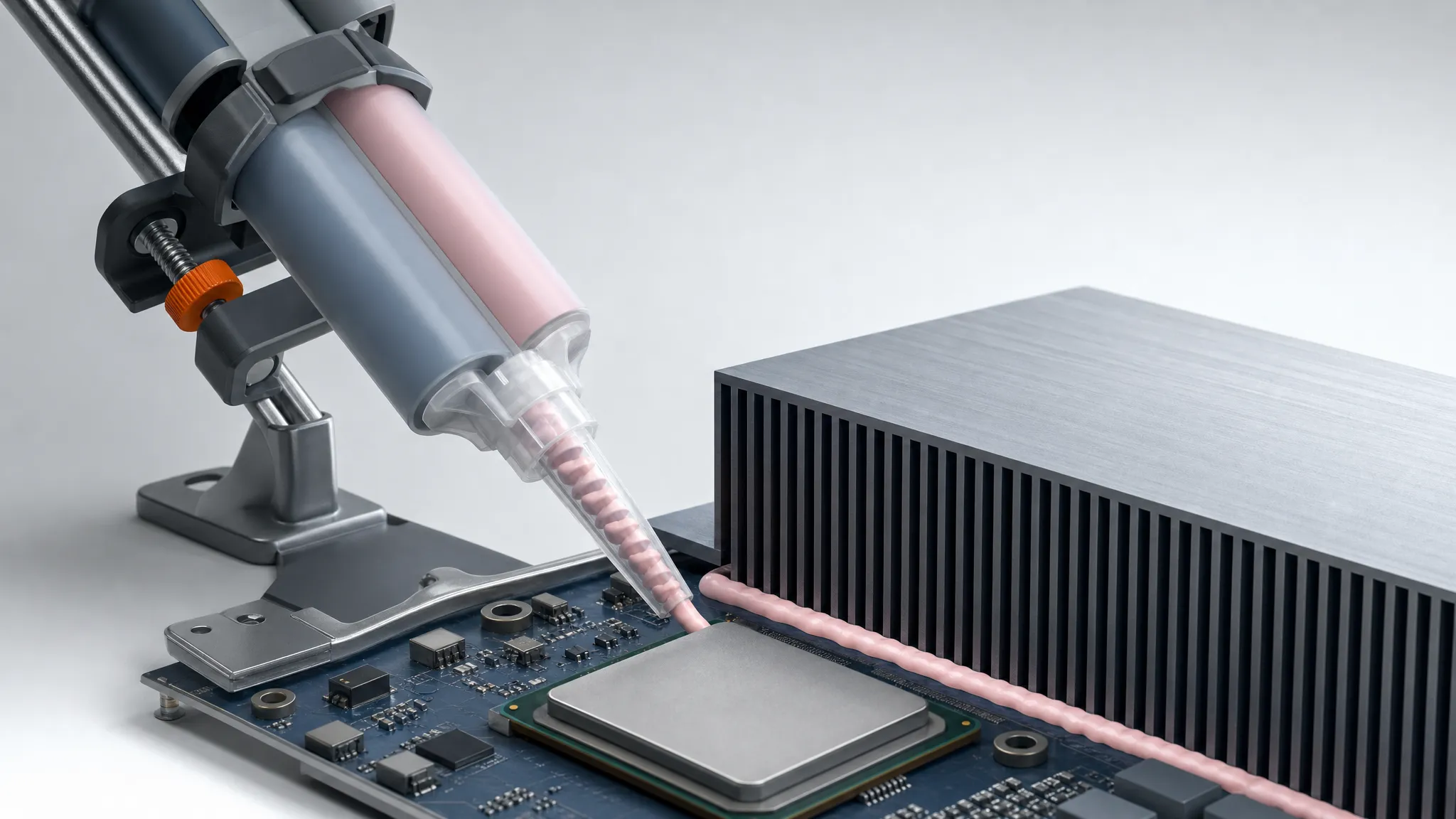
If you are searching for a Bergquist Gap Pad TGF4500 equivalent, the first thing worth fixing is the part name, because it changes what you are looking for. Henkel's published catalogue carries no "Gap Pad TGF4500"; that number belongs to BERGQUIST GAP FILLER TGF 4500CVO — a two-component, dispensable liquid gap filler that cures in place, not a pad cut from sheet stock. Bergquist, Gap Pad, Gap Filler and TGF 4500CVO are Henkel trademarks, used here only to name the product being cross-referenced. ZIITEK's own cross-reference table pairs that part with TIF050AB-11S, a two-part liquid gap filler rated 5.0 W/m·K against the incumbent's 4.5 W/m·K.
This page does what the search results for this query do not: it puts both published datasheets in one table with the test method attached to every number, separates the figures that can be compared from the ones that only look comparable, and then walks the qualification you would have to run before a swap is defensible.
A note on where this page comes from: ZIITEK manufactures TIF050AB-11S, so treat this as a supplier-authored comparison, not a neutral review. The incumbent's numbers are quoted from Henkel's own September 2023 technical data sheet throughout, including the places where Henkel's part is the stronger choice.
Why Engineers Search for a Bergquist Gap Pad TGF4500 Equivalent
Nobody searches for a Bergquist TGF 4500 equivalent while browsing. A part number plus "equivalent" is a procurement signal: the material is on a drawing, something about sourcing it has become inconvenient, and an engineer has been asked to find an alternative that does not force a redesign.
The triggers are usually one of four:
- Second-source policy. The program now requires a qualified backup for a single-sourced thermal material, whether or not the incumbent has ever missed a delivery.
- Allocation or lead time. Cartridge and pail formats of a filled silicone are not something you can substitute from a catalogue overnight.
- Cost pressure. A cost-down cycle reaches the BOM, and thermal materials are a visible line because they are consumed per unit.
- Rationalisation. Two platforms carry two similar gap fillers, and someone wants one qualified material instead of two.
None of these is a performance trigger, which is exactly why the evaluation has to be disciplined. You are not looking for a better material; you are looking for one that behaves the same way in a stack that is already validated. If you are still choosing the material class rather than the supplier, how to choose a thermal gap filler covers the selection criteria in full.
That is also why the "gap pad" wording matters. A liquid gap filler is dispensed into a variable gap and cures in place, so the assembled bond line is set by your dispense volume and your standoff. A pad is a die-cut solid of fixed thickness, held under compression by the assembly. The two are not interchangeable even at matching conductivity, because they load the board differently and they fail differently. If what you actually need is sheet stock, this is the wrong page — the differences between gap fillers, gap pads and phase-change materials is the place to start.
If you do need a filler, the exercise is a cross-reference: hold the incumbent's datasheet against the candidate's, compare like for like, and prove the swap on the real stack-up. The thermal material cross-reference library organises that brand by brand; this page is the worked instance for one pair.
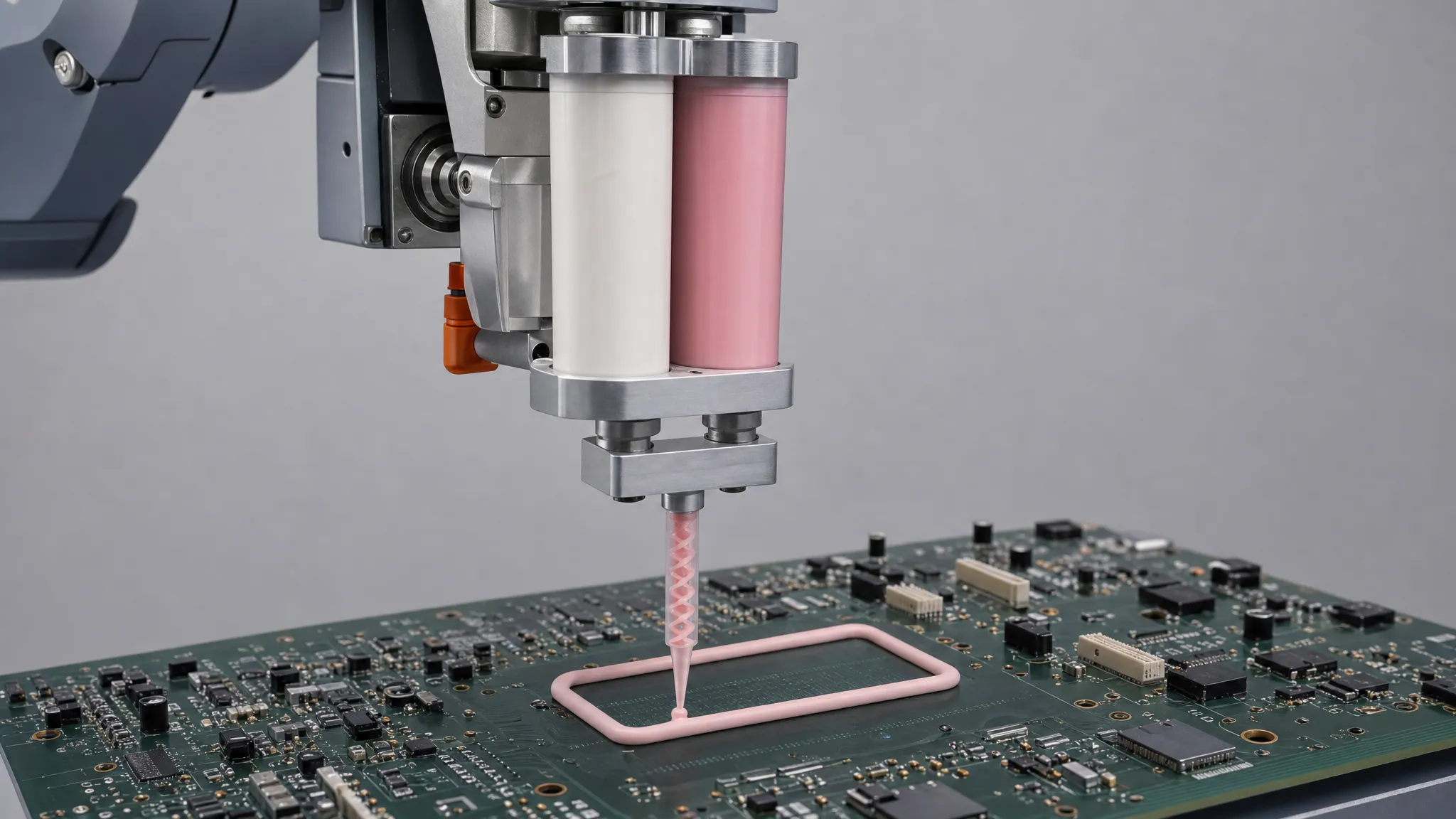
A two-part gap filler arrives as two reactive components: both are metered into one manifold and one static mixer, so what reaches the board is already a single mixed bead. The swap has to match the chemistry of the interface and the behaviour of the dispensing line.
The Incumbent, as Its Own Datasheet Describes It
BERGQUIST GAP FILLER TGF 4500CVO is a two-part silicone system, mixed 1:1 by weight and by volume, that cures at room temperature or faster with heat. Henkel describes it as a liquid gap filler with controlled volatile silicones, aimed at assemblies where outgassing matters and where the gap between a semiconductor package and its heat sink varies.
The properties below are transcribed from Henkel's technical data sheet for TGF 4500CVO, September 2023 revision. Where a test standard is printed on the sheet, it is carried into the table.
| Property | BERGQUIST GAP FILLER TGF 4500CVO | Method |
|---|---|---|
| Chemistry | Two-part silicone (filler chemistry not stated on the TDS) | — |
| Mix ratio | 1:1 by weight and by volume | — |
| Colour | Part A white, Part B pink, cured pink | Visual |
| Thermal conductivity | 4.5 W/m·K | ASTM D5470 |
| Density | 3.2 g/cc | ASTM D792 |
| Hardness | 70 Shore 00 | ASTM D2240 |
| Operating temperature | −60 to 200 °C | Declared on TDS |
| Work life | 21 h at 25 °C; 60 min at 50 °C; 3 min at 85 °C | ASTM D4473 |
| Cure schedule | 48 h at 25 °C; 4 h at 50 °C; 30 min at 85 °C | Declared on TDS |
| Thermal impedance | 0.45 / 0.38 / 0.32 °C·in²/W at 40 mil, 10 / 20 / 30 % deflection | ASTM D5470 |
| Dielectric strength | 10,000 V/mm | ASTM D149 |
| Volume resistivity | 1 × 10¹¹ Ω·m | ASTM D257 |
| Volatile siloxanes | < 300 ppm, ΣD4–D10 | ASTM F2466 |
| Flammability | V-0 | UL 94 |
Two details are worth pulling out of that table, because both affect a specification.
Henkel's own documents disagree on the low end of the temperature range. The September 2023 TDS states −60 to 200 °C. Henkel's sell sheet for the same part gives an application temperature of −50 to 200 °C. Both are Henkel documents, neither is marked superseded. If your qualification includes a cold-start or low-temperature operating claim near that boundary, resolve it with Henkel in writing rather than picking the friendlier number — and note that the same sell sheet is where the published dispense rate of 300 g/min (pattern dependent) comes from, so it is not a document you can simply discard.
The impedance figures are quoted at 40 mil at three deflections. That is a specific, useful way to publish interface resistance, and it is also the reason a single conductivity number will not tell you how the material performs in a 0.15 mm gap. More on that below.
ZIITEK TIF050AB-11S: The Candidate Grade
TIF050AB-11S sits in ZIITEK's two-part liquid gap filler family, which the product manual lists from 1.5 to 9.0 W/m·K with a family-level UL 94 V-0 rating. ZIITEK's cross-reference table maps this specific grade — two-part, 5 W/m·K — against both Henkel's TGF 4500CVO and Laird's Tflex CR550; this page works the first of those two pairings.
The values below are transcribed from ZIITEK's published product page and datasheet for TIF050AB-11S. The manual's family entry (5.0 W/m·K) agrees with the datasheet.
| Property | ZIITEK TIF050AB-11S | Method |
|---|---|---|
| Chemistry | Ceramic-filled silicone, two-part | — |
| Mix ratio | 1:1 | — |
| Colour | Part A white, Part B gray, cured gray | Visual |
| Thermal conductivity | 5.0 W/m·K | ASTM D5470 |
| Density | 3.2 g/cm³ | ASTM D792 |
| Hardness | 45 Shore 00 (printed as Shore OO on the datasheet) | ASTM D2240 |
| Operating temperature | −45 to 200 °C | Declared on datasheet |
| Pot life | 30 min at 25 °C | ZIITEK test method |
| Cure schedule | 60 min at 25 °C; 30 min at 70 °C | ZIITEK test method |
| Bond line thickness | 0.1 mm | Declared on datasheet |
| Thermal resistance | 0.08 °C·in²/W at 10 psi; 0.07 °C·in²/W at 50 psi | ASTM D5470 |
| Breakdown voltage | ≥ 5,500 V/mm | ASTM D149 |
| Viscosity | Part A 2,800,000 mPa·s; Part B 3,000,000 mPa·s | GB/T 10247 |
| Flow rate | 6 g/min (50 cc syringe, 1.5 mm orifice, 90 psi) | ZIITEK test method |
| Flammability | V-0 | UL 94 |
The properties ZIITEK does not publish for this grade are as important as the ones it does: volatile siloxane content (ΣD4–D10), volume resistivity, dielectric constant, packaging formats and colour tolerance are all absent from the published datasheet. Each of those is an open item for the swap, and the sections below say what to do about them rather than filling them in with an estimate.
TGF 4500CVO vs TIF050AB-11S, Property by Property
Read together, the two datasheets describe materials in the same functional class: two-part silicone, mixed 1:1, dispensed as a liquid, cured in place, rated V-0, and both rated to 200 °C at the top of their range.
| Property | Henkel TGF 4500CVO | ZIITEK TIF050AB-11S | Method |
|---|---|---|---|
| Thermal conductivity | 4.5 W/m·K | 5.0 W/m·K | ASTM D5470 (both) |
| Density | 3.2 g/cc | 3.2 g/cm³ | ASTM D792 (both) |
| Hardness | 70 Shore 00 | 45 Shore 00 | ASTM D2240 (both) |
| Operating temperature | −60 to 200 °C (TDS) | −45 to 200 °C | Declared |
| Mix ratio | 1:1 by weight and volume | 1:1 (basis not stated) | Declared |
| Working life / pot life | 21 h at 25 °C | 30 min at 25 °C | ASTM D4473 / ZIITEK |
| Cure at room temperature | 48 h | 60 min | Declared |
| Dielectric strength | 10,000 V/mm | ≥ 5,500 V/mm | ASTM D149 (both) |
| Thermal impedance | 0.45 °C·in²/W at 40 mil, 10 % deflection | 0.08 °C·in²/W at 10 psi, 0.1 mm BLT | ASTM D5470, different conditions |
| Shelf life | 180 days at 25 °C | 12 months | Declared |
| Packaging | 50 / 200 / 400 / 1,200 cc cartridges; 6 gal pail kits | Not published — confirm | Declared |
| Volatile siloxanes | < 300 ppm ΣD4–D10 | Not published | ASTM F2466 |
| Volume resistivity | 1 × 10¹¹ Ω·m | Not published | ASTM D257 |
Four rows are genuine like-for-like comparisons, because both suppliers used the same standard: conductivity (ASTM D5470), density (ASTM D792), hardness (ASTM D2240) and dielectric strength (ASTM D149). That is more than most cross-references can offer, and it is worth being precise about what the matches do and do not mean.
- Conductivity: 4.5 against 5.0 W/m·K, same method. This is the strongest single data point in favour of the candidate, because it is the one comparison where both sheets cite the same standard. It is still a nominal-value comparison: neither sheet publishes a tolerance band around its typical value, so treat the half-a-W/m·K difference as smaller than the uncertainty you are actually working with until both suppliers give you limits. Neither sheet publishes an interface resistance curve across the pressure range your assembly uses, either.
- Density: the same published value, 3.2 g/cc. Same filler loading order, which is a mild signal that the two are built on a similar formulation basis. It matters for dispense volume calculations: the shot size you need to fill a given gap does not change materially.
- Hardness: 45 Shore 00 against 70. The candidate cures softer. On a package with a thin die or a large lid, a softer cured material is generally the gentler of the two, since it transmits less load into the die and the solder joints. On a stack that relies on the filler to conduct heat across a thick gap, softer also means the material can be pushed aside more easily under clamp load. Which of those dominates is a property of your stack, not of the datasheet.
- Dielectric strength: 5,500 against 10,000 V/mm. The incumbent is roughly twice the candidate on this property, and both numbers were obtained to ASTM D149. If your design uses the gap filler as part of the insulation co-ordination — rather than purely as a thermal path — this is the row to look at first, and the one where the case for switching is weakest.
- Shelf life is the candidate's one outright win outside performance. Henkel publishes 180 days at 25 °C; ZIITEK publishes 12 months. On a consumable line it changes stock rotation, minimum order quantity and the risk of a pail going out of date in a slow-moving program. It is also the simplest thing on this page to verify — check the date code on the sample you receive.
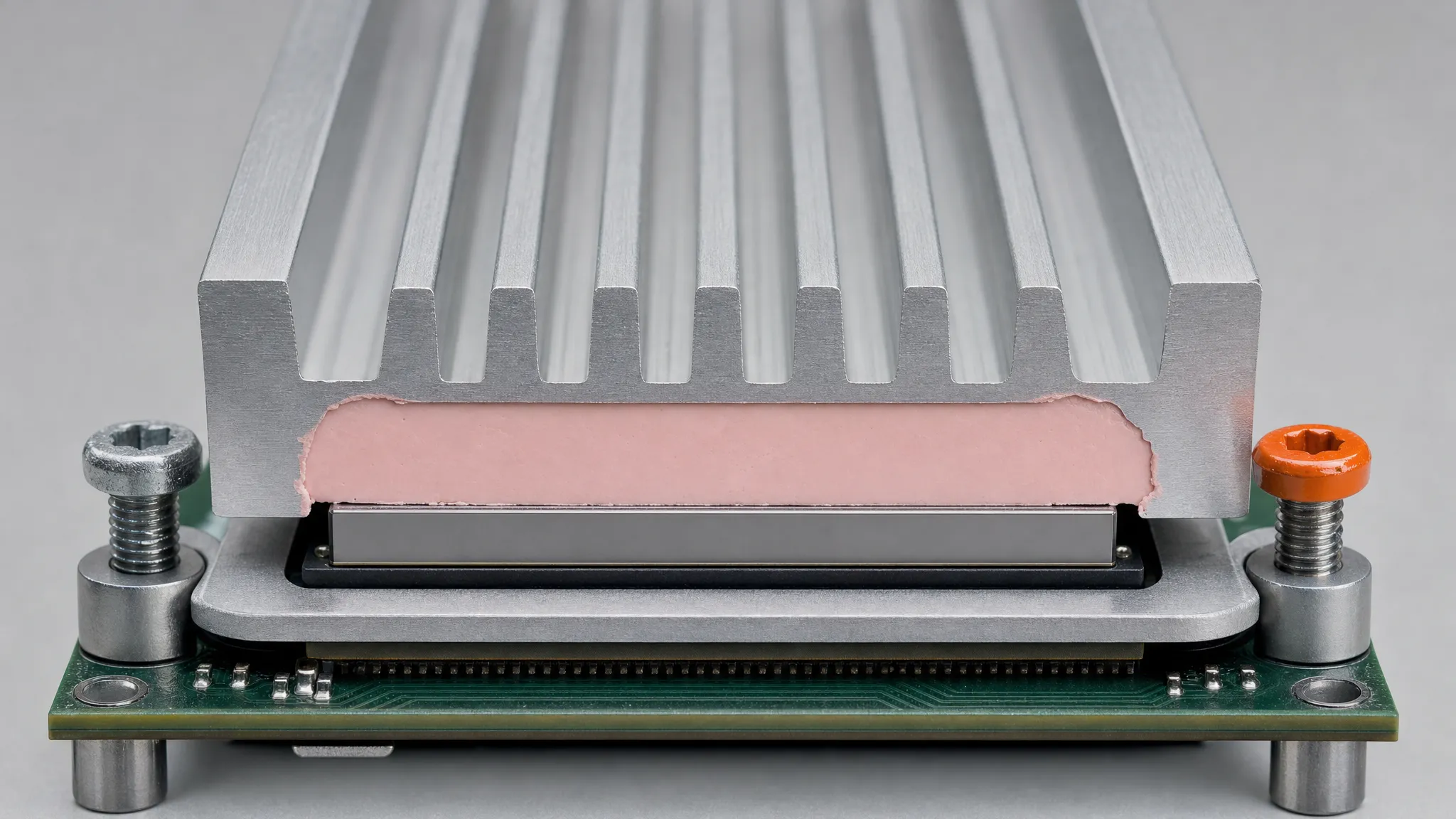
The table describes bulk properties; the assembly experiences the cured bond line — its thickness, its contact at both faces, and what happens to it after thermal cycling.
Three Numbers That Do Not Convert
Three figures across these two datasheets look comparable and are not. Each one is a place where a buyer can talk themselves into a swap that the data does not support.
Viscosity. Henkel publishes two shear rates for each component: 20,000 and 11,000 mPa·s at 1,500 s⁻¹ (ASTM D5099), and 522,000 and 361,000 mPa·s at 1.0 s⁻¹ (DIN 53019). ZIITEK publishes 2,800,000 and 3,000,000 mPa·s to GB/T 10247 without stating the shear rate. A filled silicone is strongly shear-thinning, so a viscosity figure without its shear rate is not a number you can compare with anything — it could be the low-shear plateau of a material that flows easily at dispense rate, or a genuinely stiff paste. Read the ZIITEK figure as "this is a high-viscosity, high-fill system" and nothing more until applications engineering supplies the curve.
Flow rate. 6 g/min through a 50 cc syringe with a 1.5 mm orifice at 90 psi is not comparable to 300 g/min "pattern dependent" from a production metering system. Different orifice, different pump, different pressure profile. The honest reading is that the incumbent is documented as a high-throughput dispense material and the candidate is documented at a lab-scale rig, and the only way to know the candidate's throughput on your line is to run it on your line.
Thermal impedance. Henkel quotes 0.45 °C·in²/W at 40 mil and 10 % deflection — a thick bond line, expressed against deflection. ZIITEK quotes 0.08 °C·in²/W at 10 psi with a 0.1 mm bond line — a bond line roughly a tenth as thick (40 mil is 1.016 mm), expressed against pressure. Resistance scales with thickness, so the two figures describe different physical situations and cannot be used to rank the materials. If the distinction between the two quantities is new to you, thermal resistance vs thermal impedance sets out why they are quoted differently. The correct request, to both suppliers, is impedance at your bond line and your clamp pressure, measured to ASTM D5470.
The Process Window Is Where This Swap Lives
Here is the row that decides most real evaluations, and it is not a thermal property at all. Henkel's work life is 21 hours at 25 °C; ZIITEK's pot life is 30 minutes at 25 °C. Cure at room temperature is 48 hours against 60 minutes. Note that these are not the same test: Henkel's work life is measured to ASTM D4473, ZIITEK's pot life to an in-house method with no published endpoint, so treat the gap as directional until ZIITEK states its criterion.
Those are not small differences, and they cut in both directions. A 30-minute pot life means the material begins to build viscosity while it is still in the static mixer, so purge frequency, mix-bead change-out and the time between dispense and assembly become line parameters rather than housekeeping. A 60-minute room-temperature cure means parts can be handled and tested far sooner, which shortens work-in-progress and can remove an oven from the flow entirely. Henkel's 21-hour work life is what makes the incumbent forgiving on a line with long queues between dispense and mate; it is also why the same line can absorb a schedule change without scrap.
This is the sense in which a two component gap filler is a process purchase as much as a material one: the datasheet row that decides the project is often the working life, not the conductivity.
The practical consequence is that the two materials imply different processes:
- Mixer and purge discipline. A short pot life requires a mix ratio that is verified often and a purge schedule that is short. Both datasheets state a 1:1 mix, but only Henkel's says so by weight and by volume; ZIITEK's says 1:1 without stating the basis. If applications engineering confirms the candidate's ratio holds by volume as well as by weight, your pump setting does not change and only the cadence does — if it holds by weight only, the recipe changes with it.
- Queue time between dispense and assembly. If your line holds dispensed units for hours before the heat sink goes on, a 30-minute pot life is a hard constraint, not a preference.
- Cure energy. If removing a 48-hour ambient cure or a 30-minute 85 °C cure from the flow is worth something to you, the candidate's 60-minute ambient cure is a genuine gain. If your oven is already there and loaded, it is not.
- Wear. Filled silicones are abrasive. A higher-viscosity, higher-fill material at a lower dispense rate changes pump wear and shot-size repeatability, and both of those show up as process capability data, not as thermal data.
This is the same shape of conclusion as the Laird Tputty 607 alternative worked through for a one-part gel, with the process question inverted: there the risk sat in dispense rheology and vertical stability, here it sits in pot life and cure schedule.
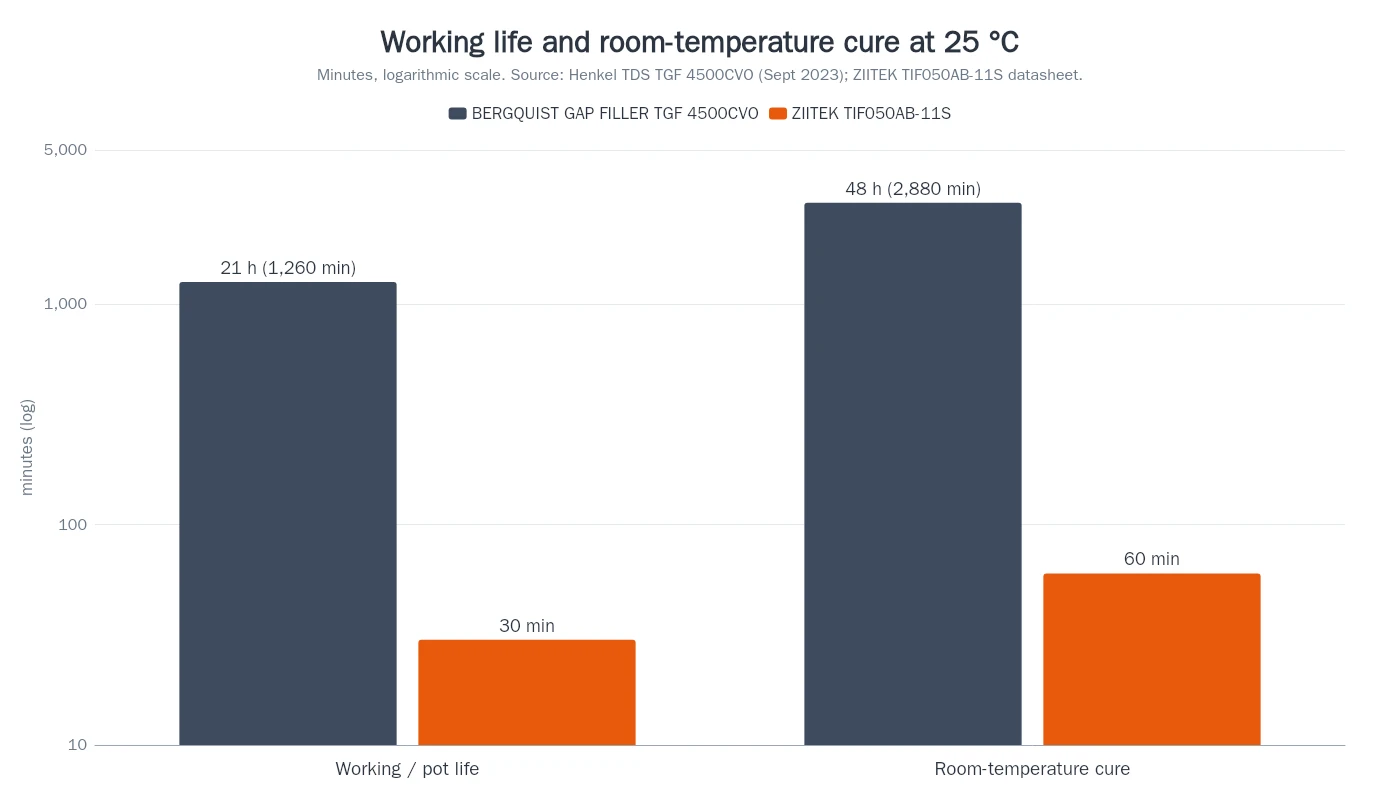
Working life and room-temperature cure, plotted from the two datasheets on a logarithmic time axis. The incumbent is built for a forgiving line; the candidate is built for a fast one.
Controlled Volatility: The Gate Most Comparisons Skip
The "CVO" in TGF 4500CVO stands for controlled volatile outgassing, and it is what that suffix pays for: the low-volatility formulation is the point of the part, not an add-on. Henkel specifies it as less than 300 ppm of ΣD4–D10 siloxanes to ASTM F2466, and markets it for optical components, sensitive environments and semiconductor packaging operations where a migrating siloxane can condense on a lens, a contact or a bond pad.
For a general-purpose power assembly, that number is a nice-to-have. For an optical module, an imaging assembly, a sensor window or a sealed enclosure with a contamination class, it is the first gate, and it is the one this comparison cannot close: ZIITEK does not publish a volatile siloxane figure for TIF050AB-11S. Nor does it publish outgassing to ASTM E595, which is the other common way buyers specify this.
That is not an accusation and it is not a disqualification — it is an open item with a specific action. Ask ZIITEK for ΣD4–D10 to ASTM F2466 and for TML/CVCM to ASTM E595 on the exact grade and cure schedule you would run, and compare them to the incumbent's published <300 ppm. If the answer comes back above your threshold, the evaluation ends there, and the correct decision is to stay on the Henkel part or move to a low-volatility grade built for that purpose.
The same logic applies to the two electrical properties ZIITEK does not publish. Volume resistivity and dielectric constant are not optional in a design that uses the interface as part of an insulation scheme, and "not published" is not the same as "adequate".
Substance compliance is the other gate that gets skipped in these comparisons. Neither datasheet above lists a full RoHS/REACH position, and no page on this SERP states one — yet for an EU-bound program it is a release condition, not a nice-to-have. ZIITEK documents third-party RoHS, REACH, SVHC, TSCA, POPs, PAHS, PFAS and California Prop 65 reports across its materials, and holds QC 080000 for hazardous-substance process management; the RoHS, REACH and PFAS compliance position for thermal materials sets out what is covered. Ask both suppliers for the declaration against your own restricted-substance list rather than accepting a logo on a page.
How to Qualify the Swap on Your Own Stack
Everything above is a shortlist. Qualification is the part that turns a candidate into a second source, and it has a natural order — cheap and fast first, expensive and slow last.
- Confirm both parts exactly. The incumbent's full part number including packaging suffix, and its revision (the September 2023 TDS is the current one referenced here). The candidate's grade and the datasheet revision your supplier quotes. A comparison against the wrong revision is worse than no comparison.
- Measure bond line thickness on real assemblies. Dispense both materials into your stack and measure the cured thickness at the corners and the centre, not just the nominal. The candidate publishes 0.1 mm; the incumbent's cured thickness in your assembly is set by standoff and shot volume, and that is what the thermal model runs on.
- Run compression set and load-deflection. Softer cured hardness (45 against 70 Shore 00) changes the load the material transmits at a given compression. Confirm the clamp load stays inside the package's allowance and that the filler still fills the gap after thermal cycling.
- Thermal cycle the assembly, then re-measure. Junction temperature and interface resistance before and after cycling tell you whether the material pumps out, voids or hardens. A first-article impedance measurement on a fresh sample is the least informative number in the whole exercise.
- Test outgassing if the assembly is sensitive. ASTM E595 TML/CVCM and ΣD4–D10 to ASTM F2466, on the grade and cure you will run. See the section above for why this is a gate rather than a detail.
- Verify the UL file covers the grade. Henkel points to UL file E59150 for its thermal management materials; ZIITEK's UL yellow card (E331100) is documented across a range of its products. Check that the specific grade and construction you are qualifying appears in the current file rather than assuming a family listing covers it.
Then document the result and get it signed. A second source that exists only in an email is not a second source.
Do your own qualification. Nothing on this page is a specification, a warranty or an approval. Both datasheets publish mostly typical values rather than guaranteed limits — the two-sided exceptions are the candidate's ≥ 5,500 V/mm floor and the incumbent's < 300 ppm ΣD4–D10 ceiling — and a typical value is not what your assembly will see. Qualify the candidate on your own stack, with your own process window, before you put it on a drawing — and treat any claim of equivalence, including this page's framing, as a hypothesis to be tested rather than a conclusion.
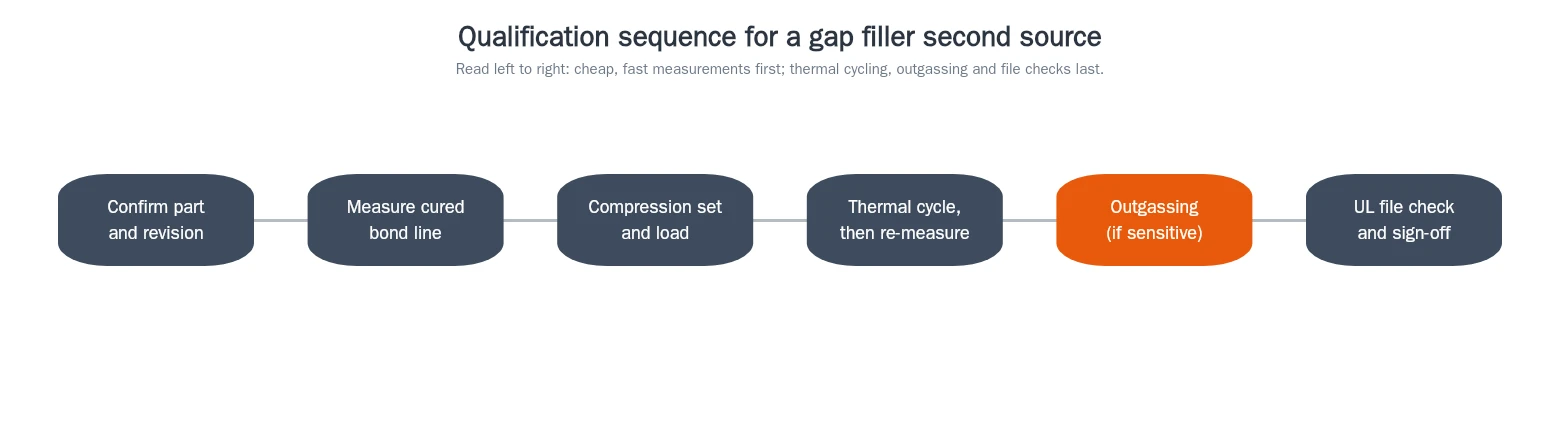
The order matters: cheap measurements first, thermal cycling and outgassing last, sign-off at the end.
When the Henkel Part Is Still the Right Choice
A comparison page that never recommends the incumbent is a sales page. There are four situations where the case for staying with TGF 4500CVO is straightforward.
Your line depends on a long work life. If dispensed units queue for hours, or if your mixer purge discipline is built around a 21-hour window, a 30-minute pot life is a line redesign. The engineering hours and the scrap risk usually cost more than the material delta.
You need high dispense throughput. Henkel documents 300 g/min on production metering equipment. The candidate is documented at 6 g/min on a lab-scale rig. Until the candidate is proven on your tooling, the incumbent is the only one of the two with a throughput number you can plan capacity against.
Volatile siloxanes are in your requirement set. With <300 ppm published against nothing published, the incumbent wins that gate by default. That is not a permanent verdict — it is what the available data supports today.
You need the higher dielectric strength, or you are already qualified. 10,000 V/mm against ≥5,500 V/mm is a real difference on a real standard, and a qualified line has value that does not appear on any datasheet.
Where the candidate earns its place is narrower and more specific: a 5.0 W/m·K two-part system at the same density, softer after cure, with a fast ambient cure, available as a second source from a supplier whose cross-reference table already names this exact pairing. That is a good reason to sample it. It is not a reason to skip step 4 above.
Request a Sample and a Stack Review
If the incumbent on your drawing is TGF 4500CVO and TIF050AB-11S looks like a candidate, the useful next step is a sample plus a stack review rather than a purchase order. Send the incumbent part number and revision, the board or module drawing, the nominal gap and its tolerance, the clamp load, your dispense and cure window, and the operating temperature profile including the cold end.
Talk to a ZIITEK engineer about a TIF050AB-11S sample, and bring the incumbent datasheet and the open items from this page — volatile siloxanes, volume resistivity, packaging and dispense curve — to the call. Applications engineering can confirm the closest grade and tell you which of the six qualification steps above your program will actually need.