Fujipoly Sarcon GR25A Alternative: TIF100-30-11U
SARCON GR25A against the published ZIITEK 3 W/m·K TIF100 grade, TIF100-3030-06: which numbers convert, which do not, and the qualification a swap needs.
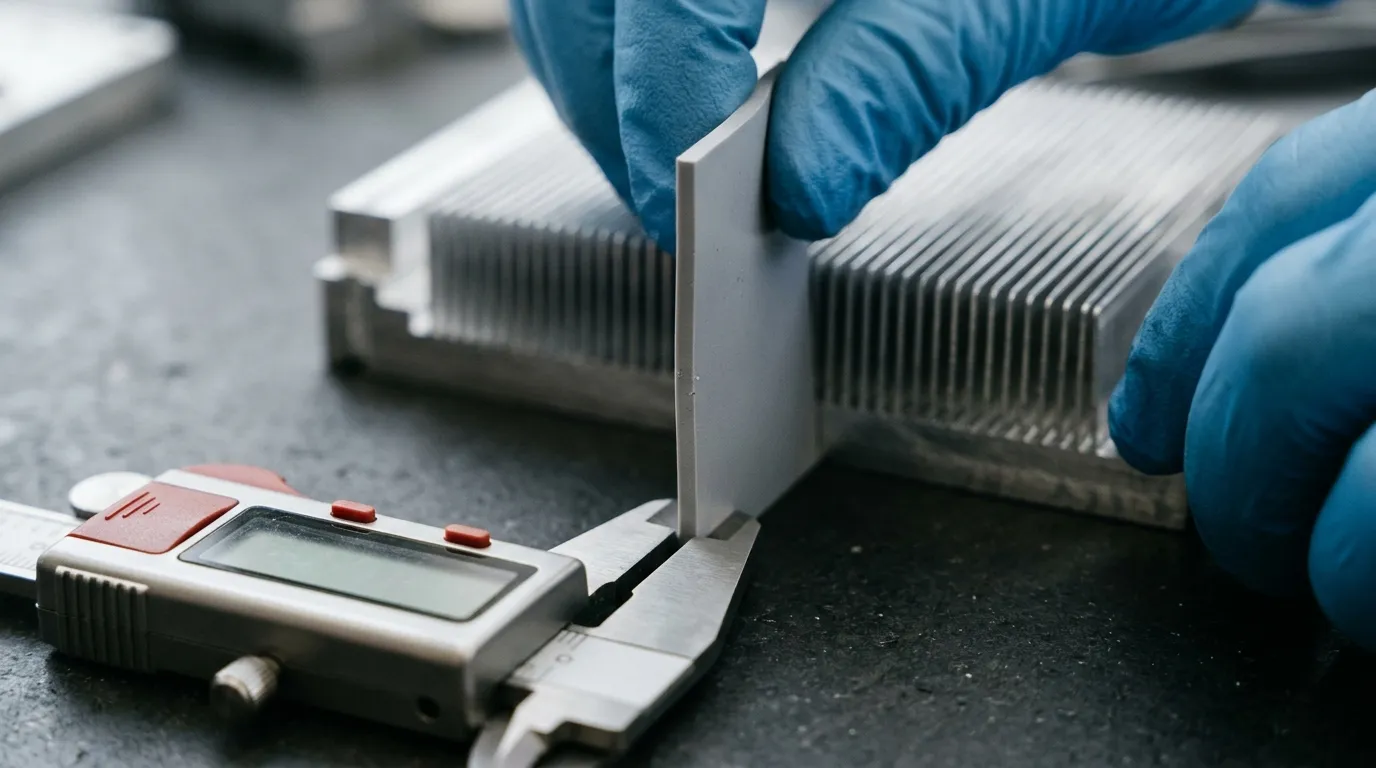
If you are searching for a Fujipoly Sarcon alternative, the first thing worth fixing is the name. SARCON® is Fujipoly's brand for a whole line of thermal interface materials, not a part number and not a material. Ten different product families sit under it on Fujipoly's own SARCON page, covering everything from 0.75 W/m·K grease to 13 W/m·K putty — a spread that includes 1.2 W/m·K thin-film pads and 8–13 W/m·K high-performance pads. "A Sarcon equivalent" therefore has no answer until you say which family and which grade, because replacing a grease with a pad is a different project, not a different supplier. SARCON is a registered Fujipoly trademark, used here only to name the product being cross-referenced.
At grade level the question becomes answerable. The pairing worked through on this page is SARCON GR25A, a 2.5 W/m·K silicone gap filler pad used where a compliant sheet has to bridge an uneven gap between a component and a chassis or heat sink, against ZIITEK TIF100-30-11U, the grade ZIITEK's own cross-reference table pairs with it at 3 W/m·K. One qualification up front: ZIITEK publishes a datasheet for its 3 W/m·K TIF100 grade but not for the −30−11U suffix itself, so the candidate figures below are that published grade's, and the candidate section says exactly what still has to be confirmed on the suffix you would actually buy.
This page puts both suppliers' published numbers in one table, with the test method attached to every row, separates the figures that can be compared from the ones that only look comparable, and then walks the qualification you would have to run before the swap survives an engineering review. It also does something the pages ranking for this query do not: it names the rows where the Fujipoly part is the stronger one.
A note on where this page comes from: ZIITEK manufactures TIF100-30-11U, so treat this as a supplier-authored comparison, not a neutral review. The incumbent's numbers are quoted from Fujipoly's own GR25A data sheet (ES_DS4090, version 1.1, 23 September 2014) throughout, including the rows where Fujipoly is ahead. The thermal material cross-reference library organises this brand by brand; this page is the worked instance for one pair.
What "Fujipoly Sarcon" Actually Names
Fujipoly's SARCON page lists the families and their conductivity bands explicitly: standard gap filler pad 1.4–4.5 W/m·K, non-silicone pad 1.3, non-silicone form-in-place 2.5, grease 0.75–4.2, high-performance pad 8.0–13.0, electromagnetic-wave-absorbing pad 0.8–3.0, two-part gap filler 2.3–3.0, putty 2.5–13.0, form-in-place 2.1–7.0 and thin film pad 1.2–3.0. That list is the reason a brand-level query cannot be answered: the same word covers a dispensed gel, a pre-cured sheet, a grease and an absorber.
Inside a family, the name resolves in layers, and every layer changes what a substitute has to match. The letter after the number is part of the grade rather than decoration. Fujipoly's US standard-performance catalogue lists GR25B at the same 2.5 W/m·K as the GR25A sheet quoted here, on a different mesh construction; GR25A itself does not appear in that list, and the sheet quoted is dated September 2014. I could not establish whether GR25A is current, discontinued or simply catalogued elsewhere, so grade currency is the first thing to settle with Fujipoly or your distributor — ahead of any comparison on this page.
| Layer | Example | What it fixes | What it leaves open |
|---|---|---|---|
| Brand | SARCON® | That it is a Fujipoly thermal interface material | Everything below |
| Family | GR — gap filler pad | Class: a pre-cured, compressible silicone sheet | Conductivity, hardness, thickness |
| Conductivity digits | GR25A | 2.5 W/m·K, and specifically the Hot Disk value | The 2.8 W/m·K Hot Wire figure on the same sheet |
| Variant letter | GR25A vs GR25B | Which variant of the 2.5 W/m·K grade you hold | Which variant datasheet to read — they are separate documents |
| Construction | −00 / −0H / −F0 / −FH | Tack, stiffening, handling | Die-cut behaviour, surface energy |
| Thickness code | −50 / −100 / −500 | 0.5 mm, 1.0 mm, 5.0 mm nominal | Tolerance stack in your assembly |
| Colour code | GY | Grey | Nothing that matters thermally |
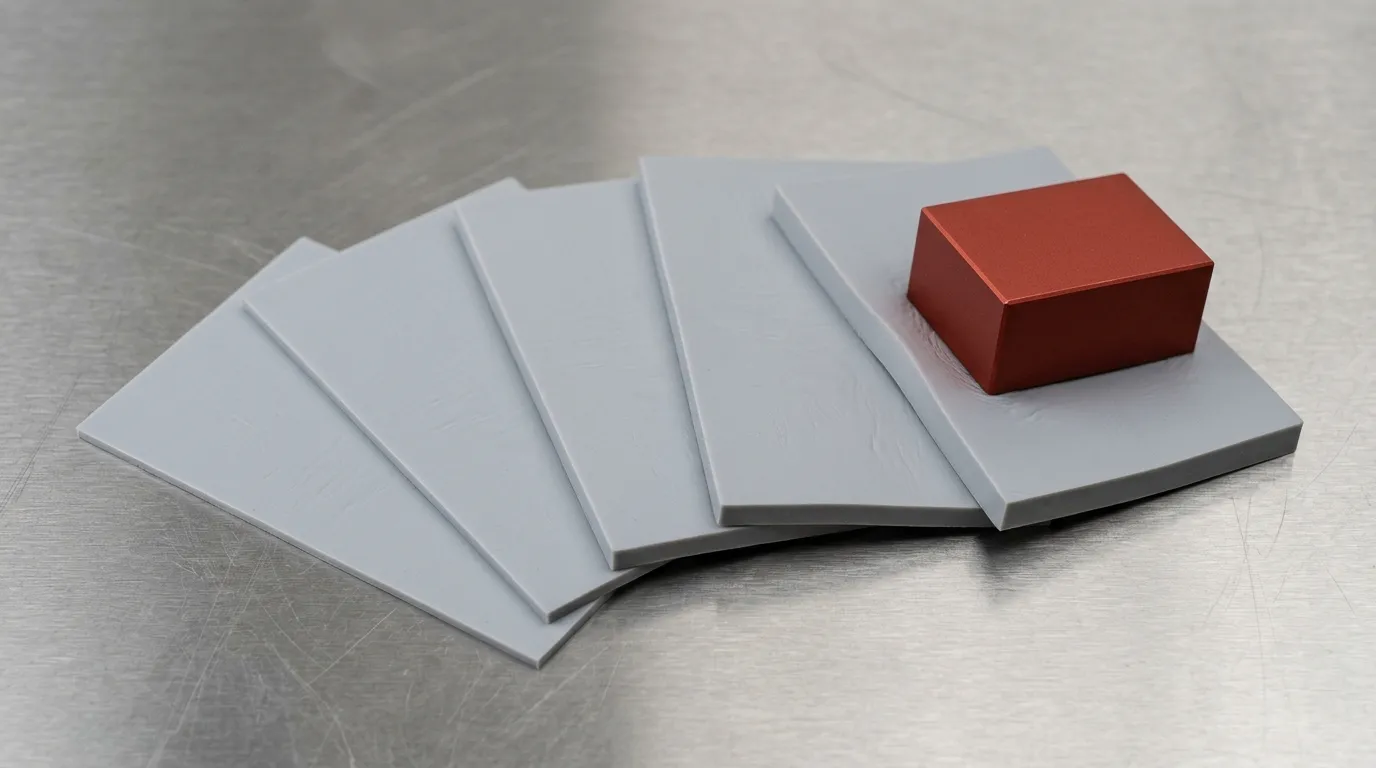
The practical consequence: a cross-reference that stops at "GR25A" has matched a conductivity number and nothing else. Two parts can both be GR25A and behave differently in your assembly, because the tail decides whether the sheet is tacky on both faces, stiffened on one, or carried on a nylon mesh. Reading a cross-reference chart is its own skill, and the version of it that matters here is the one that refuses to match at family level.
Why a Sarcon Part Ends Up on a Replacement List
Nobody looks up a Sarcon alternative while browsing. A grade plus "alternative" is a sourcing signal: the material is on a drawing, something about getting it has become inconvenient, and someone has been asked to find a substitute that does not force a redesign. The triggers are usually one of four:
- Second-source policy. The program now requires a qualified backup for a single-sourced thermal material, whether or not the incumbent has ever missed a delivery.
- Allocation or lead time. A die-cut pad is a converted part with a tooling step, not a catalogue item you can pull from a shelf overnight.
- Cost pressure. A cost-down cycle reaches the BOM, and thermal materials are visible because they are consumed per unit.
- Rationalisation. Two platforms carry two similar pads and someone wants one qualified material instead of two.
None of those is a performance trigger, which is why the evaluation has to be disciplined. You are not looking for a better material. You are looking for one that behaves the same way in a stack that is already validated — and for a gap pad, "behaves the same way" includes the mechanical job it does: carrying clamp load, absorbing tolerance, and not pumping out of the gap after cycling.
The Incumbent: SARCON GR25A as Its Own Datasheet Describes It
GR25A is a "Gap Filler Type" material: a silicone compound supplied fully cured and pliable, which conforms to surface irregularity under compression. In the −00 construction both faces are tacky, so it holds position during assembly without an adhesive. The values below are transcribed from Fujipoly's GR25A data sheet, with the printed test method carried into the table where the sheet states one.
| Property | SARCON GR25A-00 | Method |
|---|---|---|
| Construction | Silicone compound, fully cured, tacky both faces (plain) | — |
| Colour | Grey | Visual |
| Thermal conductivity | 2.8 W/m·K by Hot Wire; 2.5 W/m·K by Hot Disk | ASTM D2326; ISO/CD 22007-2 |
| Hardness | 50 Shore OO (ASKER C 18) | ASTM D2240; ISO 7619 |
| Specific gravity | 2.6 | ASTM D792 |
| Tensile strength / elongation | 0.1 MPa / 200 % | ASTM D412 |
| Tear strength | 0.8 N/mm | ASTM D624 |
| Volume resistivity | 1.0 × 10¹¹ Ω·m | ASTM D257 |
| Breakdown voltage | 15 kV/mm | ASTM D149 |
| Dielectric strength | 9 kV/mm | ASTM D149 |
| Dielectric constant | 6.05 at 1 kHz; 5.74 at 1 MHz | ASTM D150 |
| Dissipation factor | 0.0300 at 1 kHz | ASTM D150 |
| Useful temperature | −40 to +150 °C | Declared on sheet |
| Low-molecular siloxane | 0.0028 wt % ΣD4–D20 | Gas chromatography |
| Flame | UL 94 V-0 | UL 94 |
| Thickness, −00 construction | 0.5 to 5.0 mm in 0.5 mm steps | — |
| Sheet size | 300 × 200 mm (290 × 190 usable) | — |
| Recommended compression | Up to 30 % | Handling note |
Two things in that table are worth pulling out, because both affect how a specification gets written.
The first is that the sheet publishes two conductivities. 2.5 W/m·K by Hot Disk and 2.8 W/m·K by Hot Wire are the same material measured two ways, and the part number carries the Hot Disk number: the digits track that value across the family — GR14B at 1.4, GR25B at 2.5, GR45A at 4.5 by Hot Disk against 6.0 by Hot Wire — as Fujipoly's published standard-performance catalogue shows for each grade. If your internal comparison table quotes "2.8 W/m·K" for GR25A, you are already comparing a Hot Wire number with whatever method the candidate used.
The second is the ageing table, which most cross-reference pages ignore. Fujipoly publishes five 1,000-hour blocks: 70 °C, 150 °C, 60 °C/95 % RH, −40 °C, and a −40 to +125 °C cycling block. Thermal conductivity holds at 2.5 W/m·K in every one. Breakdown voltage holds at 15 kV/mm in the 70 °C, −40 °C and cycling blocks, slips to 14 after 1,000 h at 60 °C/95 % RH, and rises to 19 after the 150 °C soak. Hardness moves the most: ASKER C 18 falls to 14 at 70 °C, to 13 in humidity and to 17 in the cold, and rises to 27 after 1,000 h at 150 °C. A pad that ends up half again as hard after a high-temperature soak is a different mechanical part from the one you qualified, and that is the kind of drift a swap has to reproduce, not just a conductivity number.
The Candidate: ZIITEK TIF100-30-11U
ZIITEK's cross-reference table pairs GR25A with TIF100-30-11U, a silicone gap filler pad rated 3 W/m·K. TIF100 is ZIITEK's general-purpose silicone pad family, published as 1.0–10.0 W/m·K and 0.25–5.0 mm on the family page, with UL 94 V-0 grades.
One disclosure before the table, because it is exactly the discipline this page asks of everyone else: at the time of writing ZIITEK publishes grade datasheets for its TIF100 part numbers, but not for the −30−11U suffix specifically. The published 3 W/m·K TIF100 grade is TIF100-3030-06, and that is the datasheet transcribed below. It is the same family and the same nominal conductivity — and it is not the same suffix, so its hardness and thickness rows must be re-read on the −30−11U sheet before anything is put on a drawing. The ZIITEK sheet also carries no revision date; its footer identifier is TIF100 3030-06-1125, so ask which revision your quote is against.
| Property | ZIITEK TIF100-3030-06 (published 3 W/m·K TIF100 grade) | Method |
|---|---|---|
| Construction | Ceramic filled silicone elastomer; self-adhesive, no added adhesive | — |
| Colour | White | Visual |
| Thermal conductivity | 3.0 W/m·K | ASTM D5470 |
| Thermal conductivity, second method | 3.0 W/m·K | ISO 22007 (part not stated) |
| Hardness | 65 / 30 Shore OO — 65 over the 0.25–0.50 mm band, 30 over 0.75–5.00 mm in the PDF column layout | ASTM D2240 |
| Density | 3.0 g/cm³ | ASTM D792 |
| Thickness | 0.25–0.50 mm and 0.75–5.00 mm | ASTM D374 |
| Breakdown voltage | ≥ 5,500 V/mm | ASTM D149 |
| Dielectric constant | 5.8 at 1 MHz | ASTM D150 |
| Volume resistivity | 1.0 × 10¹² Ω·cm | ASTM D257 |
| Operating temperature | −40 to 200 °C | Declared on page |
| Flame | UL 94 V-0, cited to E331100 | UL 94 |
| Thermal impedance | Charted, ℃·in²/W against 10–100 psi, at 1.0 / 3.0 / 5.0 mm | — |
| Compression ratio | Charted, compression % against 10–100 psi, at 1.0 / 3.0 / 5.0 mm; no handling ceiling stated | — |
| Low-molecular siloxane | Not published for this grade | — |
| 1,000 h ageing data | Not published for this grade | — |
The published product page and datasheet for TIF100-3030-06 is where every ZIITEK figure above comes from, and it is worth opening before an internal review, because the impedance, siloxane and ageing rows are the ones that decide whether the swap is cheap or expensive. A missing row is not a disqualification. It is an item to request.
GR25A vs the Published 3 W/m·K TIF100 Grade, Property by Property
Both columns are what the suppliers publish. The ZIITEK column is the published 3 W/m·K grade, TIF100-3030-06, for the reason given in the previous section.
| Property | Fujipoly GR25A-00 | ZIITEK 3 W/m·K TIF100 grade | Comparable? |
|---|---|---|---|
| Thermal conductivity | 2.5 (Hot Disk) / 2.8 (Hot Wire) | 3.0 (D5470) / 3.0 (ISO 22007) | Partly — comparable if that is 22007-2, +20 % |
| Hardness | 50 Shore OO | 65 / 30 Shore OO (65 thin band, 30 thick band) | Partly — 65 only on the 0.25–0.50 mm band |
| Density | 2.6 g/cm³ (printed as specific gravity 2.6) | 3.0 g/cm³ | Yes — ASTM D792 both |
| Thickness range | 0.5–5.0 mm | 0.25–5.0 mm | Yes (portfolio) |
| Operating temperature | −40 to +150 °C | −40 to +200 °C | Declared values |
| Breakdown voltage | 15 kV/mm | ≥ 5.5 kV/mm | Yes — incumbent stronger |
| Volume resistivity | 1.0 × 10¹¹ Ω·m (10¹³ Ω·cm) | 1.0 × 10¹² Ω·cm | Yes, after conversion |
| Dielectric constant | 5.74 at 1 MHz | 5.8 at 1 MHz | Yes — same frequency |
| Flame rating | UL 94 V-0 | UL 94 V-0 | Yes |
| Thermal resistance | Tabulated at 100/300/500 kPa: 0.5–5.0 mm (−00), 0.3–5.0 mm (−0H series, the 0.3 mm part being −0H2); ASTM D5470-equivalent | Impedance charted at 10–100 psi | Partly — different reporting |
| Siloxane content | 0.0028 wt % ΣD4–D20 | Not published | No |
| 1,000 h ageing | Published, five 1,000-hour blocks | Not published | No |
Read the last column as tiers rather than a scoreboard. One row is a like-for-like pair if ZIITEK's ISO 22007 citation resolves to the hot-disk part, and it favours the candidate: 2.5 against 3.0. Three more are single-value comparisons on the same standard — density (ASTM D792 on both sides), dielectric constant (both at 1 MHz) and volume resistivity (ASTM D257 on both, after conversion) — and those are the rows that can be quoted in a review without a footnote. The rest are declared values, ratings rather than measurements at your thickness and construction, differently reported data, or figures the candidate does not publish at all. The dielectric-constant row is a small surprise: at the one frequency both suppliers publish, dielectric constant agrees almost exactly, 5.74 against 5.8. Quoting Fujipoly's 1 kHz figure of 6.05 against ZIITEK's 1 MHz figure would have manufactured a difference that does not exist.
Density is another clean row, and it cuts against the candidate. 3.0 g/cm³ against 2.6 means roughly 15 % more mass for the same die-cut outline. On a weight-sensitive stack, or in a program where the pad is also counted as a mass item, that is a real consequence of the swap and it does not appear in any thermal calculation.
Which Numbers Convert, and Which Do Not
Three figures need a method check before anyone ranks them. One survives it; two do not.
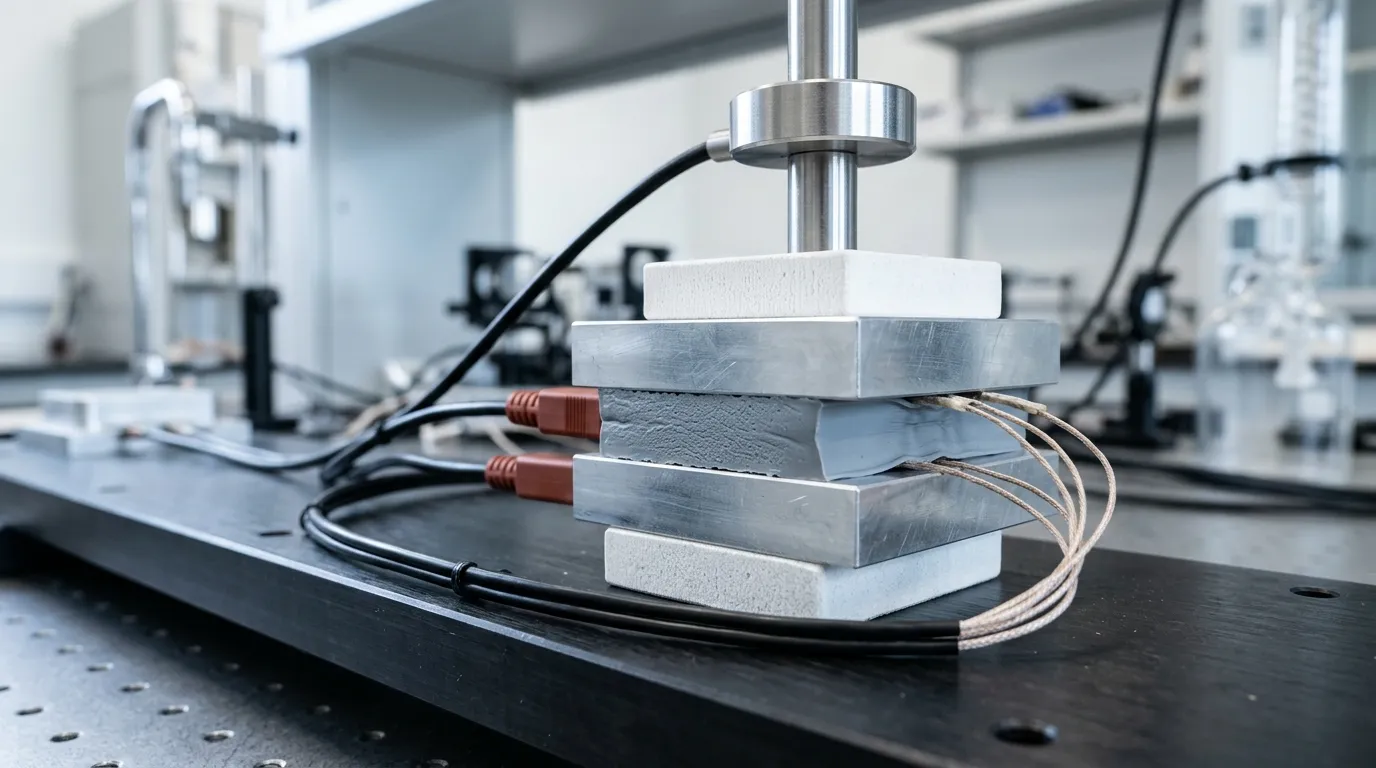
Thermal conductivity. Both suppliers publish two methods. Fujipoly's sheet gives 2.5 W/m·K by Hot Disk (ISO/CD 22007-2) and 2.8 W/m·K by Hot Wire (ASTM D2326). ZIITEK's published 3 W/m·K grade gives 3.0 W/m·K by ASTM D5470 and 3.0 W/m·K by ISO 22007. That second ZIITEK row is the one that changes the arithmetic. ZIITEK cites ISO 22007 without a part number; if that is ISO 22007-2 — the transient plane source part that Hot Disk instruments implement — then 2.5 against 3.0 is a comparison on the same method, and the candidate is 20 % ahead there. That is an inference from a standard's structure rather than a printed statement, so get it confirmed in writing before it goes into an internal review. The cross-method pairs do not convert — Fujipoly's 2.8 Hot Wire figure and ZIITEK's 3.0 D5470 figure are each measured on a different principle from the other supplier's matching row, so neither can be ranked against the other, and D5470 is a steady-state guarded measurement of a stack while Hot Disk and Hot Wire are transient measurements of a specimen. Fujipoly says as much itself, in the note closing its datasheet: Hot Disk and its TIM Tester are methods the company defined as its own standards. The request is therefore narrower than "give me W/m·K": ask each supplier for conductivity on the same method at the same thickness, and say plainly that the Hot Disk pair is the one row you consider comparable, subject to that confirmation.
Thermal resistance. Fujipoly tabulates resistance at 100, 300 and 500 kPa across 0.3 to 5.0 mm, in K·cm²/W with K·in²/W in brackets, by Fujipoly test method FTM-P3050 on a TIM Tester 1300 — which the sheet describes as ASTM D5470 equivalent. ZIITEK does not tabulate resistance for this grade, but the datasheet does publish an impedance curve: ℃·in²/W on the vertical axis against 10 to 100 psi on the horizontal, with separate curves at 1.0, 3.0 and 5.0 mm. Those pressure ranges overlap Fujipoly's 14.5, 43.5 and 72.5 psi, so the axis exists on both sides — it is simply reported two different ways, one tabulated and one charted. A chart cannot be read to the precision a qualification report needs, which is why the ask is tabulated impedance at your thickness and your clamp pressure from both suppliers. Two conversions matter when those numbers arrive: one square inch is 6.4516 cm², and ℃·in²/W and K·in²/W are the same magnitude, because a one-degree interval is a one-kelvin interval. If the distinction between resistance and impedance is new to you, thermal resistance vs thermal impedance sets out why suppliers quote them differently and why only one of them is a material property.
Hardness and compression. Both suppliers use Shore OO to ASTM D2240, which makes this look like the cleanest row in the table. It is not, for two reasons. Fujipoly prints a single value, 50. ZIITEK's published page flattens its grade to "65 / 30" with no mapping, though the PDF behind it sets the two values over the two thickness bands — 65 for 0.25–0.50 mm, 30 for 0.75–5.00 mm — and its product identifier prints hardness 30. That is recoverable, but it has to be confirmed for the suffix you actually order, because the band you need is what decides the load. And hardness is not the property the assembly feels: at a given deflection, a harder pad transmits more load into the package and the solder joints, which is why Fujipoly's own handling note caps compression at 30 % and warns that exceeding it causes excessive silicone oil exudation. How much compression a gap pad needs, and what happens above it, is set out in the compression guide; the number to bring to this evaluation is the load at your target deflection, not the durometer alone.
The Part-Number Tail Decides More Than the Number Before It
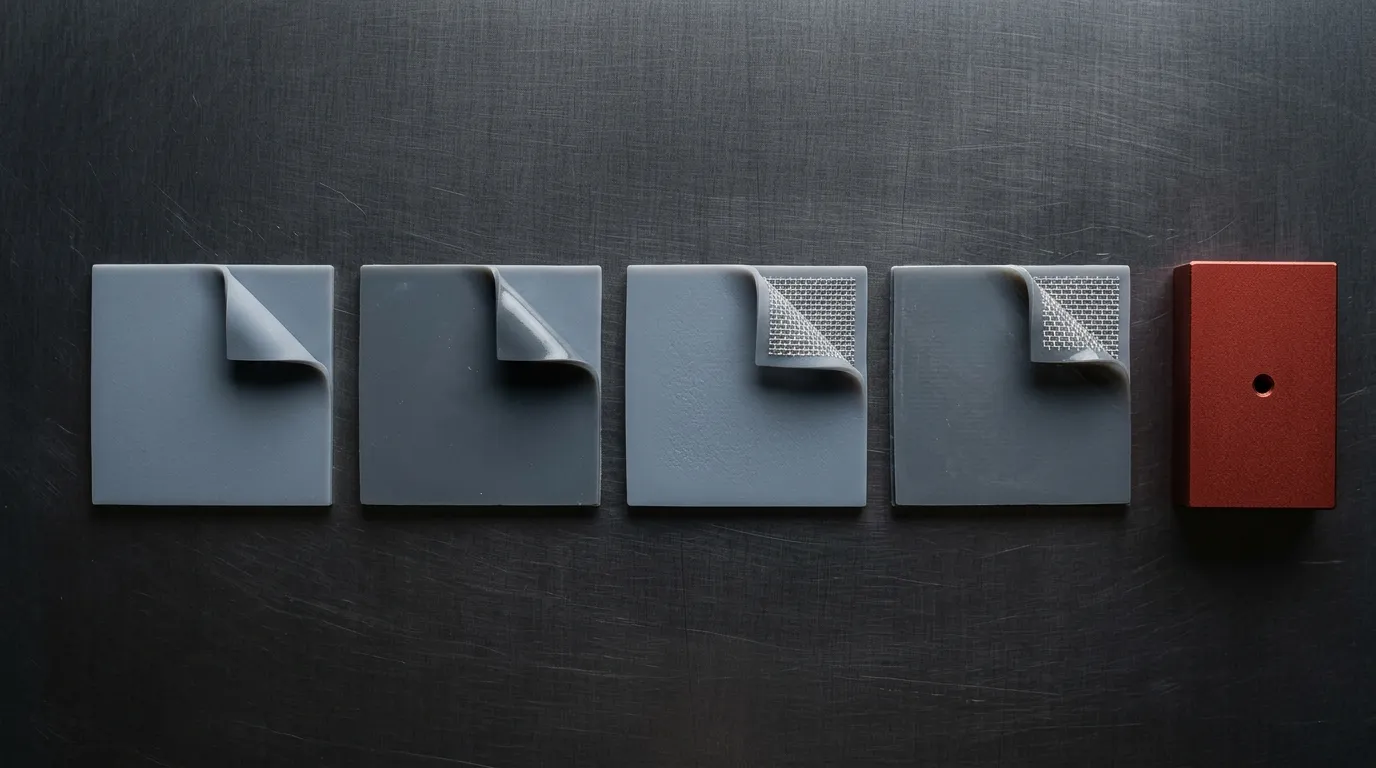
GR25A is not one part. The construction suffix changes how it behaves in assembly, at identical conductivity:
| Suffix | Construction | What changes for you |
|---|---|---|
| −00 | Plain, tacky both faces | Holds position on the component but is not self-supporting; best conformity |
| −0H | Hardened one surface | Easier handling and installation in complex assemblies; available from 0.5 mm |
| −0H2 | Hardened both faces | The only construction in this data sheet that reaches 0.3 mm; stiffer on both faces in handling |
| −F0 | Nylon mesh reinforcement | Resists stretching during die-cutting and placement |
| −FH | Nylon mesh plus hardened surface | Both of the above |
Note what the flame rating does and does not say. UL 94 V-0 appears once on the sheet, in the typical-properties table, against the −00 construction; the construction list itself carries no flame annotation at all. The rating is therefore stated for the material, not per construction. If a flame rating is a release condition in your program, confirm it against the construction your drawing actually specifies rather than against the family.
The thickness tail matters just as much. −50 is 0.5 mm nominal, quoted at ±0.05 mm on the plain and hardened-surface constructions and at ±0.15 mm on the two mesh constructions. The thickness portfolio differs by construction too: −500 is a 5.0 mm part at ±0.30 mm, but it exists only in the −00 and −0H constructions — the two mesh constructions stop at 2.0 mm. Fujipoly's −00 construction starts at 0.5 mm while −0H2 (hardened on both faces) reaches down to 0.3 mm — that is the part number GR25A‑0H2‑30GY, not −0H — so on a 0.3 mm gap the construction you specified decides whether a pad exists at all. ZIITEK's published 3 W/m·K grade covers a 0.25–0.50 mm band as well as 0.75–5.00 mm, which makes this one place where the candidate's portfolio is the wider of the two — worth knowing before the conversation turns into a stack redesign.
ZIITEK's tails are no more transparent. TIF100-15-11U is 1.5 W/m·K, TIF100-40-10S is 4.0, TIF100-65-11U is 6.5, and one of the 3 W/m·K grades is TIF100-3030-06 — different digits, same nominal conductivity. The leading digits track conductivity in tenths often enough to be tempting and not reliably enough to trust. Read the tail off the datasheet, never off the pattern, which is the same rule that makes "drop-in replacement" a claim rather than a specification.
Voltage and Volume Resistivity: Where the Incumbent Is Stronger
Two rows in the comparison favour Fujipoly by a margin large enough that no method caveat explains it away.
Breakdown voltage is 15 kV/mm for GR25A against ≥ 5.5 kV/mm for the published ZIITEK grade — a factor of roughly 2.7. The same Fujipoly sheet also prints a dielectric strength of 9 kV/mm on the same standard, and against that row the gap narrows to about 1.6 times, so quote whichever figure your insulation requirement actually names. Both are ASTM D149, though electrode geometry and specimen thickness affect the result, so treat the ratio as directional and the absolute values as needing confirmation at your thickness. If the pad is purely a thermal path and the design has separate insulation, this row is a note. If the pad is part of the insulation co-ordination — a live tab, a floating heat sink, a creepage budget — it is the row that ends the evaluation.
Volume resistivity is the row where units decide the conclusion. Fujipoly publishes 1.0 × 10¹¹ Ω·m; ZIITEK publishes > 1.0 × 10¹² Ω·cm. Written that way, the candidate looks one decade better. Converted to a common unit, Fujipoly's figure is 1.0 × 10¹³ Ω·cm, which is ten times the candidate's published floor. The incumbent is ahead here, not behind, and only the unit conversion reveals it.
Volatile Siloxanes: The Gate This Comparison Cannot Close
GR25A publishes low-molecular siloxane content as 0.0028 wt % ΣD4–D20, by gas chromatography. That is 28 ppm, and it is the kind of number that exists because some customers cannot tolerate more: a migrating siloxane can condense on a lens, a contact or a bond pad in a sealed assembly.
ZIITEK publishes no siloxane figure and no ASTM E595 result for this grade. ZIITEK's product manual lists a low-volatility TIF100L family rated 1.5–6.0 W/m·K for optics, cameras and laser equipment — the family has no model page on the English site yet, so ask for its datasheet — and the company documents how to read E595 TML and CVCM data in its guide to low-outgassing thermal pads — but neither is the same as a number for TIF100-30-11U.
That is not an accusation and not a disqualification; it is an open item with a specific action. If your program has an outgassing or contamination class, ask ZIITEK for ΣD4–D20 by gas chromatography and TML/CVCM to ASTM E595 on the exact grade and thickness you would run, and put them beside the 28 ppm. If the answer comes back above your threshold, the evaluation ends there, and the right decision is to stay on the Fujipoly part or move to a grade built for low volatility.
How to Qualify the Swap on Your Own Stack
Everything above is a shortlist. Qualification turns a candidate into a second source, and it has a natural order — cheap and fast first, expensive and slow last.
- Confirm both parts exactly. The incumbent's full code including construction and thickness suffix, and the revision of the data sheet your supplier quotes. The candidate's grade as ZIITEK's cross-reference names it, plus the grade datasheet for that exact suffix. A comparison against the wrong revision is worse than no comparison.
- Measure the bond line on real assemblies. Assemble the candidate at your nominal and worst-case gaps and measure the compressed thickness at corners and centre, not just the nominal. Fujipoly caps compression at 30 % of the pad's thickness and warns that exceeding it causes oil exudation. ZIITEK publishes a compression-ratio curve instead of a ceiling — compression percentage against pressure at 1.0, 3.0 and 5.0 mm — and on a 1.0 mm bond line that curve passes 30 % at roughly 10 psi, which puts many clamp designs above the incumbent's envelope. Read your own compression off the curve at your clamp load, and ask ZIITEK what it says happens above 30 %.
- Run load-deflection and compression set. On a 1–2 mm bond line the candidate's published value is 30 Shore OO against Fujipoly's 50, so the pad you would actually order is the softer of the two, not the harder one. Softer means less load into the package at a fixed gap — good for a thin die — but also less spring-back against the heat sink, more compression at a fixed clamp load (and therefore a thinner bond line than the thermal model assumed), and a higher risk of pump-out after cycling. Confirm the clamp load, the compressed thickness and the post-cycling contact, not just the durometer.
- Thermal cycle, then re-measure. Junction temperature and interface resistance before and after cycling tell you whether the material pumps out, voids or hardens. A first-article reading on a fresh sample is the least informative number in the exercise.
- Test outgassing if the assembly is sensitive. E595 TML/CVCM and ΣD4–D20 on the grade and thickness you will run, as described above.
- Verify the UL file covers the grade. ZIITEK's grade page cites UL 94 V-0 under yellow card E331100; confirm that the specific grade and construction you are qualifying appears in the current file rather than assuming a family listing covers it.
Then document the result and get it signed. A second source that exists only in an email is not a second source.
Do your own qualification. Nothing on this page is a specification, a warranty or an approval. Both suppliers publish mostly typical values rather than guaranteed limits, and a typical value is not what your assembly will see. Qualify the candidate on your own stack, with your own process window, before it goes on a drawing — and treat any claim of equivalence, including this page's framing, as a hypothesis to be tested.
When the Fujipoly Part Is Still the Right Choice
A comparison page that never recommends the incumbent is a sales page. There are four situations where staying with GR25A is straightforward.
Your design leans on the pad for insulation. 15 kV/mm against ≥ 5.5 kV/mm, and 10¹³ Ω·cm against > 10¹² Ω·cm, is a real gap on real standards. If the pad is in the insulation scheme, this is the row that decides, and the candidate does not win it.
Volatile siloxanes are in your requirement set. With 28 ppm published against nothing published, the incumbent wins that gate by default. That is not a permanent verdict — it is what the available data supports today.
You need ageing data before you can sign. Fujipoly publishes five 1,000-hour blocks, including 70 °C, 150 °C, 60 °C/95 % RH, −40 °C and a −40 to +125 °C cycling block. ZIITEK publishes none for this grade. If your qualification plan requires a documented end-of-life state, you are waiting on data, not on a sample.
You are already qualified and the part ships. A qualified line has value that does not appear on any datasheet. Changing it needs a reason, and "the conductivity number is 0.5 W/m·K higher on the matched method" is not one.
Where the candidate earns its place is specific. On the matched-method conductivity pair — hot disk at 2.5 against 3.0 — it is 20 % ahead, subject to the ISO 22007 part-number confirmation above. It also covers a 0.25–0.50 mm thickness band that the incumbent's −00 construction does not reach. What it does not win is the electrical and volatility rows, and UL 94 V-0 is a match rather than a differentiator. Add a cross-reference table that already names this exact pairing, so the application engineering conversation starts from a known grade instead of a blank page. That is a good reason to sample it. It is not a reason to skip a single step above. The same discipline applies to every other grade in the family: the Laird Tputty 607 alternative works the same exercise for a one-part gel, with the process risk in a different place.
Request a Sample and a Stack Review
If the part on your drawing is GR25A and TIF100-30-11U looks like a candidate, the useful next step is a sample plus a stack review rather than a purchase order. Send the incumbent's full part code and revision, the board or module drawing, the nominal gap and its tolerance, the clamp load or target compression, your operating profile including the cold end, and any outgassing or UL requirement the program carries.
Talk to a ZIITEK engineer about a TIF100-30-11U sample — ZIITEK manufactures under IATF 16949, and bring the open items from this page — the construction suffix match, the hardness band at your thickness, thermal resistance at your bond line, and the siloxane question — to the call.