Thermal Pad Cross Reference: How to Read the Chart
A thermal pad cross reference pairs one brand's grade with another's. How to read each column, decide equivalence, and verify a swap before you qualify it.
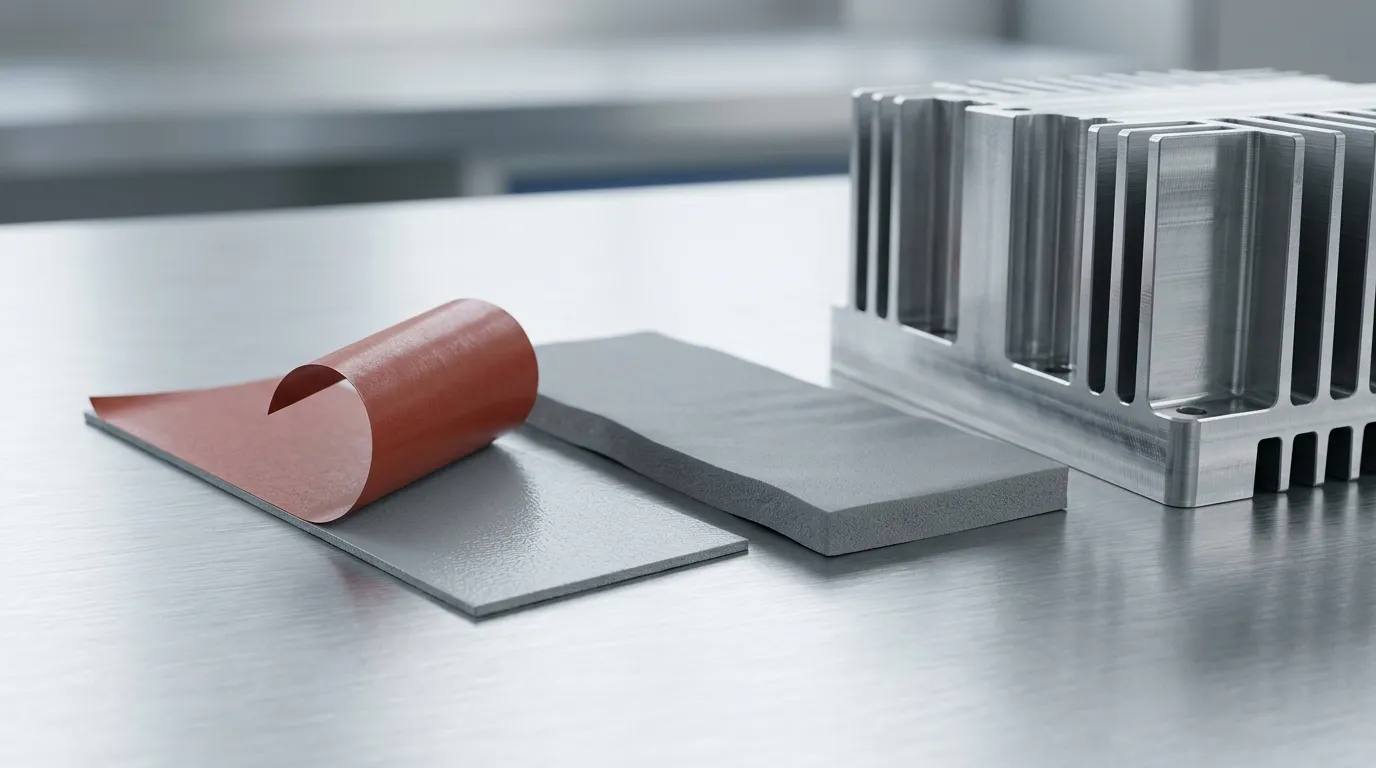
A thermal pad cross reference is a table that pairs a grade from one manufacturer with the closest grade in another manufacturer's portfolio, matched on nominal conductivity, thickness range, hardness and format. It is a shortlist tool: it tells you which parts are worth comparing in a sample request, and it says nothing about whether they behave the same in your stack-up.
That distinction is the whole point of this page, because cross-reference tables are routinely read as certificates of equivalence. They are not. A row is an engineering claim built from two datasheets, and the distance between "the numbers look close" and "this part is qualified in my design" is where the money is spent — in samples, test coupons and thermal cycling.
This is from ZIITEK. We make thermal interface materials, and we maintain a cross-reference list that maps Laird, Bergquist, Parker, Fujipoly, Honeywell, Boyd, DENKA and T-Global grades to our own. It is a working reference we apply in engineering review rather than a chart we publish on this site — you get the relevant rows back when you send us an incumbent grade. We are therefore a party to the comparison, so this page spends more room on how to read such a chart and where it breaks than on the specific mappings. Every mapping quoted here comes from our own engineering cross-reference list and every competitor number is attributed to the document it came from.
One scope note before the detail: on the web, "thermal pad" pulls heavily towards graphics-card repair, and most pages ranking for pad charts are GPU pad-thickness lookups. That is a different job. This page is for the engineer or buyer replacing a named supplier grade in a production design, where the deliverable is a sample request and a qualification plan.
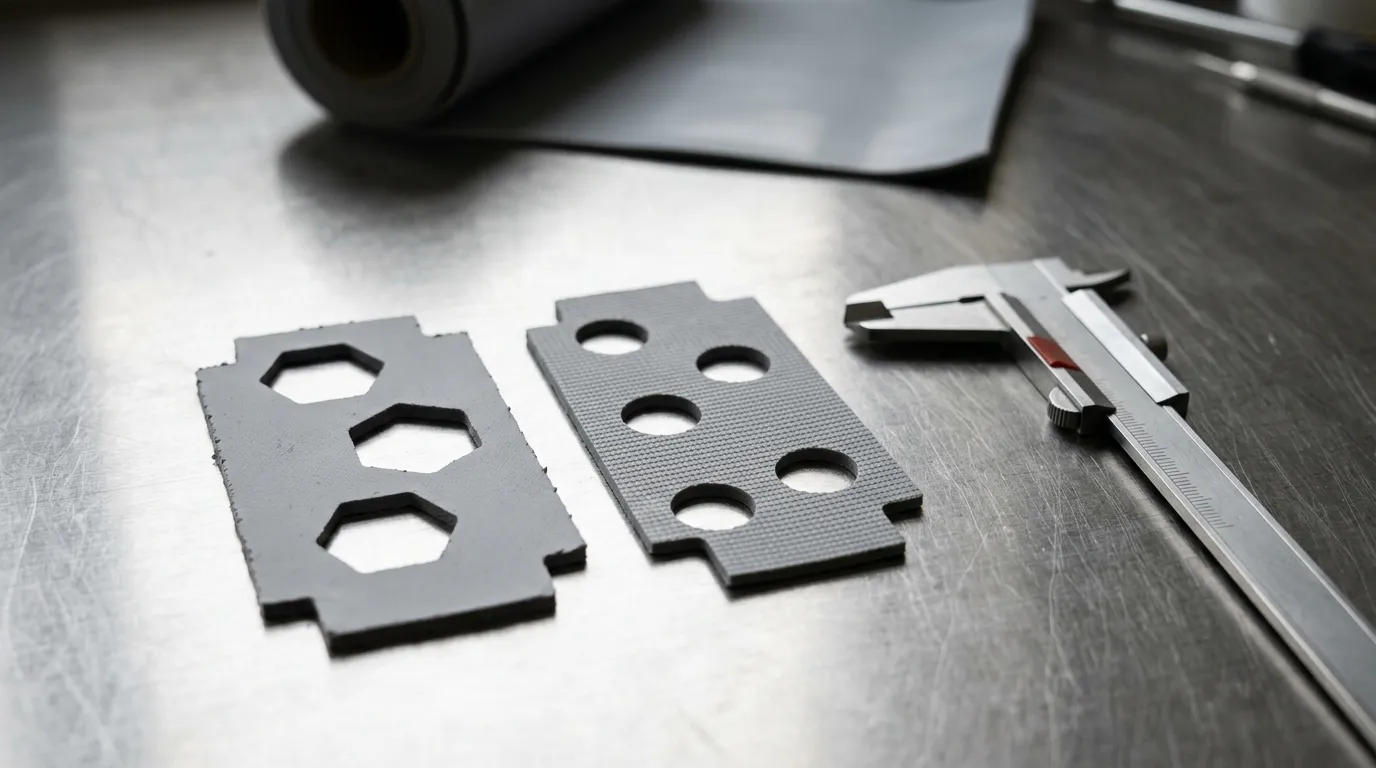
Two parts from two suppliers, one bench: a cross-reference chart exists to get you from the left pad to a candidate for the right one.
What a Thermal Pad Cross Reference Chart Actually Claims
A thermal pad cross reference chart is not a datasheet and not a certificate. Look at one honestly and it makes exactly three claims per row.
The two grades belong to the same format family. A pad maps to a pad, a dispensable gel maps to a dispensable gel, a phase-change sheet maps to a phase-change sheet. The format decides how the material fills the gap and how much force it needs, so a table that steps across formats is not cross-referencing anything — it is proposing a redesign. A pad, for reference, is a soft pre-formed sheet that fills a defined gap between a component and a heat sink; if that is the object you are replacing, what a thermal pad actually is covers the construction and the format families in one pass.
The nominal specs land in the same class. Conductivity in W/mK, thickness range, hardness and operating temperature are the usual columns. "The same class" is doing real work in that sentence: the mapping is built from published nominal values, not from measured data at your bond line.
The mechanical envelope is plausible. A candidate in the same thickness range with a similar modulus can usually be made to fit the same cavity. Plausible is not proven — your clamp load and your tolerance stack decide the compressed thickness, and the compressed thickness decides the thermal result.
What the row does not claim is just as important. It does not claim equal thermal impedance under your assembly pressure. It does not claim the same low-molecular-weight siloxane behaviour in a sealed optical cavity. It does not claim the incumbent's carrier, tack, or shelf life. And it does not claim the grade you are holding is the grade the mapping was written against — supplier portfolios are revised, and a cross-reference built in one year can be reading a datasheet that no longer exists in the next. Every one of those gaps is a qualification step, not a footnote.
Reading the Columns That Carry the Weight
Four columns carry almost all the risk in a thermal pad cross reference chart. Reading them correctly is a matter of knowing what each number was measured under.
Thermal conductivity (W/mK). The number is meaningless without its test method. ASTM D5470 measures thermal transmission properties through a sample under a defined load and thickness (ASTM D5470), and it is the method that makes two datasheets roughly comparable; a conductivity figure produced by a different technique is not comparable with it, a problem the thermal interface material literature has been pointing at for two decades (Electronics Cooling, thermal interface materials). The practical reading habit is simple: find the method column first. A vendor row that states the method, the operating range, the flammability class and the compliance status in one place is what a complete data row looks like — Parker Chomerics publishes exactly that for its THERM-A-GAP GEL 45, at 4.5 W/m·K by ASTM D5470, −55 to 200 °C, UL 94 V-0 under UL file E140244, RoHS compliant, with outgassing at 0.23 % TML / 0.06 % CVCM by ASTM E595 (Parker Chomerics THERM-A-GAP GEL 45 datasheet). A cross-reference cell that carries a W/mK number and nothing else is not a comparison; it is an advertisement.
Thermal impedance. Most cross-reference tables do not have this column at all, and its absence is the biggest single weakness of the format. Impedance at a stated pressure and bond line is the number that predicts your junction temperature; conductivity is the property that gets printed. If you want the arithmetic behind that claim, what a W/mK figure actually measures takes it apart, and thermal resistance versus thermal impedance covers why the two are not interchangeable.

Strip the liner and the grades still look identical. What separates them is the condition each published number was measured under.
Thickness. The chart lists nominal thickness availability. Your assembly has a gap, and the pad you install compresses into it, so the number that matters is the compressed thickness after clamp load, not the ordered number. Nominal thickness gets you a shortlist; measuring the gap and compression ratio gets you a decision.
Hardness and modulus. On soft silicone pads the industry quotes Shore 00 hardness; on gels and ultra-soft pads vendors quote Young's modulus or a compression-deflection figure instead, and the two are not convertible by arithmetic. What the column really tells you is how much force the material needs to conform. A grade that needs real pressure under a bolted heat sink is a problem under a spring-loaded cage, and a chart that lists hardness without saying which measurement it is should be treated as incomplete.
Read down a single row and ask one question: could a competent engineer outside both companies reproduce this claim from the two datasheets cited? If the answer is no, the row is a lead, not evidence.
How Equivalence Is Decided: Three Levels
"Equivalent" gets used loosely in this market. Sorting cross-reference claims into three levels makes the word usable, and it makes clear where each level stops.
Level 1 — format and family alignment. Same material class, same gap-filling mechanism, same assembly process. This level is a gate rather than a judgement: if the incumbent is a dispensable one-component gel and the candidate is a pre-formed pad, nothing downstream is a cross-reference. ZIITEK's own mapping list is organised on that same principle — pad grades are listed against pads, one-component gels against one-component gels, and two-component cured gels against their own counterparts. Sorting the claims in a thermal pad cross reference this way is what turns a pile of model numbers into a decision order.
Level 2 — nominal spec alignment. Here the two ends of a row rarely match digit for digit, and reading that as a defect is a common mistake. Take a real pair out of our mapping list: the ZIITEK TIF070-11 one-component gel is listed against a Laird Tputty™ 607, whose published conductivity our list records as 6.4 W/mK against the gel's 7 W/mK. Now take the pad row: the ZIITEK TIF100-30-11U is listed at 3.0 W/mK against the BERGQUIST® GAP PAD® TGP 3500ULM, which Henkel publishes at 3.5 W/mK (Henkel BERGQUIST GAP PAD TGP 3500ULM). Both pairs are ordinary mappings, and neither pair is a pair of identical numbers. A ±10 % band on the headline figure is a workable shortlist filter, and that is all it is — a filter. Two figures measured by different labs, in different years, under different applied loads cannot settle a design question on their own.
Working definition used on this site: a cross-reference is a nominal mapping built from published datasheets; an equivalent is a cross-reference that has survived a form-fit-function check in the actual assembly. The first is free and takes an afternoon. The second takes a sample, a coupon and a test.
Level 3 — verified form-fit-function. Assemble the candidate into the real stack-up, at the production clamp load, and measure junction temperature or interface impedance against the incumbent. Thermal-cycle it if the application cycles, and check the failure modes your product cares about — pump-out, compression set, outgassing, contact loss. The spec-by-spec execution of that work — which numbers to pull from the incumbent's datasheet, in what order, and what tolerance to allow — is the subject of the drop-in replacement workflow, matched spec by spec; this page stays on how the chart itself should be read.
Read the three levels as a pipeline rather than three opinions about a material. Level 1 eliminates candidates that would change your process. Level 2 builds the shortlist. Level 3 converts a shortlist entry into a second source you can put on a drawing.

Candidates for one gap: a chart narrows three pads to one, and the sample test decides whether the one you picked stays in contact.
Reading the Brand Side of the Table
Most cross-reference tables are organised by brand, and the brand column is where readers lose the thread. Two structural facts explain why.
Brand owners change, and the chart does not. Laird Performance Materials has been part of DuPont since 2021, when DuPont completed the acquisition (DuPont completes acquisition of Laird Performance Materials); that business has since been separated again: DuPont spun its electronics unit off as Qnity Electronics in November 2025, and the thermal materials are now published through Qnity's thermal management hub, which lists Laird™ as a brand alongside its EMI and inductive lines (Qnity Electronics thermal management materials). Fujipoly operates its own US thermal materials catalogue (Fujipoly thermal interface materials). Practical consequence: when a chart says "Laird grade X", the datasheet you must verify against may live at a different domain than the one the chart's author used, and it may have been revised in between.
Brands are portfolios, not grades. The same brand sells many grades with overlapping nominal conductivity and different modulus or carrier. That is why a row that names a brand without a grade is not actionable — you cannot sample "a Laird", and "a Bergquist" spans very different products. Our own list is grade-level for exactly this reason: TIF100-30-11U against Laird T-flex™ HD300/600, Bergquist TGP 3500ULM, Fujipoly GR25A, Boyd BCTIM-217-1060, DENKA FSL-B, Honeywell TGP3500PT and T-Global TG-AD3200L; TIF050AB-11S against Laird Tflex™ CR550 and Bergquist TGF 4500CVO; TIF035AB-05S against Laird Tflex CR350 and Bergquist TGF 3600. Each cell names a part, not a brand, because a part is what you can quote, sample and test.
The table below shows how the brand families distribute across material formats. That layout matters when you read someone else's chart: a brand appearing heavily in one format area and thinly in another is a statement about that brand's portfolio, not about the quality of its products.
| Format | ZIITEK series | Brand families mapped in this area |
|---|---|---|
| Silicone gap pad | TIF® pads, 1–16 W/mK, 0.25–5.0 mm, 15–45 Shore 00 | Laird T-flex / TGP · Bergquist GAP PAD · Fujipoly GR · Boyd BCTIM · DENKA FSL-B · Honeywell TGP3500PT · T-Global TG-AD3200L |
| One-component gel | TIF® one-part gel, 1.5–9.0 W/mK | Laird Tputty (e.g. 607) |
| Two-component cured gel | TIF® two-part gel, 1.5–5.0 W/mK | Laird Tflex CR · Bergquist TGF |
Mappings from ZIITEK's own cross-reference list; brand-grade values as published in each vendor's datasheet as of September 2026. The ZIITEK series ranges are series-level windows from our own product data — the pad row matches the specification window published on our thermal pad product page. Verify current datasheets before you act.

Four format areas, four different equivalence questions. The pad block is the largest by far — most second-source projects start there.
Coverage of other brands' grades
An incumbent's own selector tool covers its portfolio deeply and other manufacturers not at all. That is not a criticism — it is the tool doing its stated job. Our list inverts the direction: it is built to answer a question the incumbent's tool never asks, which is "what else fits this gap".
Direction of the mapping
Cross-reference charts are directional. Ours maps incumbent grades onto ZIITEK grades; it works in reverse as a starting point, but the candidate set on the reverse side is the grades we actually make, not the whole market. Read the direction before you trust a cell.
Data provenance
Every value on both sides of our list is a published datasheet value, attributed in the table. A downstream tool that shows spec values without saying where they came from is telling you less than a plain table that cites its sources.
Applications and tooling support
A manufacturer's own applications team knows its grades in depth, including behaviour that never reaches a datasheet. Our answer to that is a grade recommendation plus a die-cut sample against your drawing; it is a different kind of help from a decade of field data on one incumbent grade.
Commercial terms
Trade-offs differ in ways a chart cannot show: allocation, minimum order, tooling for a custom shape, lead time, and whether the supplier will hold a second source open for you. None of this is visible in a spec column, and for a second-sourcing decision it often outweighs a tenth of a W/mK.
How to Verify a Cross-Reference Before You Qualify It
The chart's job ends at a candidate. Seven checks stand between that candidate and an approved part, and the order matters because each one can end the exercise cheaply.
- Pull the incumbent's current datasheet, from the brand owner's own site, not from your archive copy. Confirm the grade still exists.
- Record the test method and conditions behind every number you intend to compare — method, pressure, bond line, sample thickness. Numbers measured under different conditions are not a comparison.
- Recompute what the joint actually needs. Start from the temperature rise you can afford across the interface and the watts crossing it; a joint that needs 4 W/mK instead of 8 changes the shortlist.
- Check hardness against your hardware. Match the compression the clamp will apply to the deflection the grade can take.
- Check environmental behaviour for your cavity. In a sealed optical or imaging assembly, outgassing matters more than conductivity — ASTM E595 measures total mass loss and collected volatile condensable materials in vacuum (ASTM E595), and it is the test to ask for.
- Check flammability and compliance for the thickness you are actually using. Solid-material ratings and thin-film ratings are different classes, and V-0 versus VTM-0 on a thin film covers why the distinction bites; UL publishes the combustion tests behind both classes (UL combustion tests for plastics).
- Sample-test the real assembly, at production clamp load, and thermal-cycle it if the product cycles. If the part must fit a recessed pocket or an unusual outline, confirm the conversion step at the same time — die-cutting the replacement to the same drawing is part of equivalence, not an afterthought.
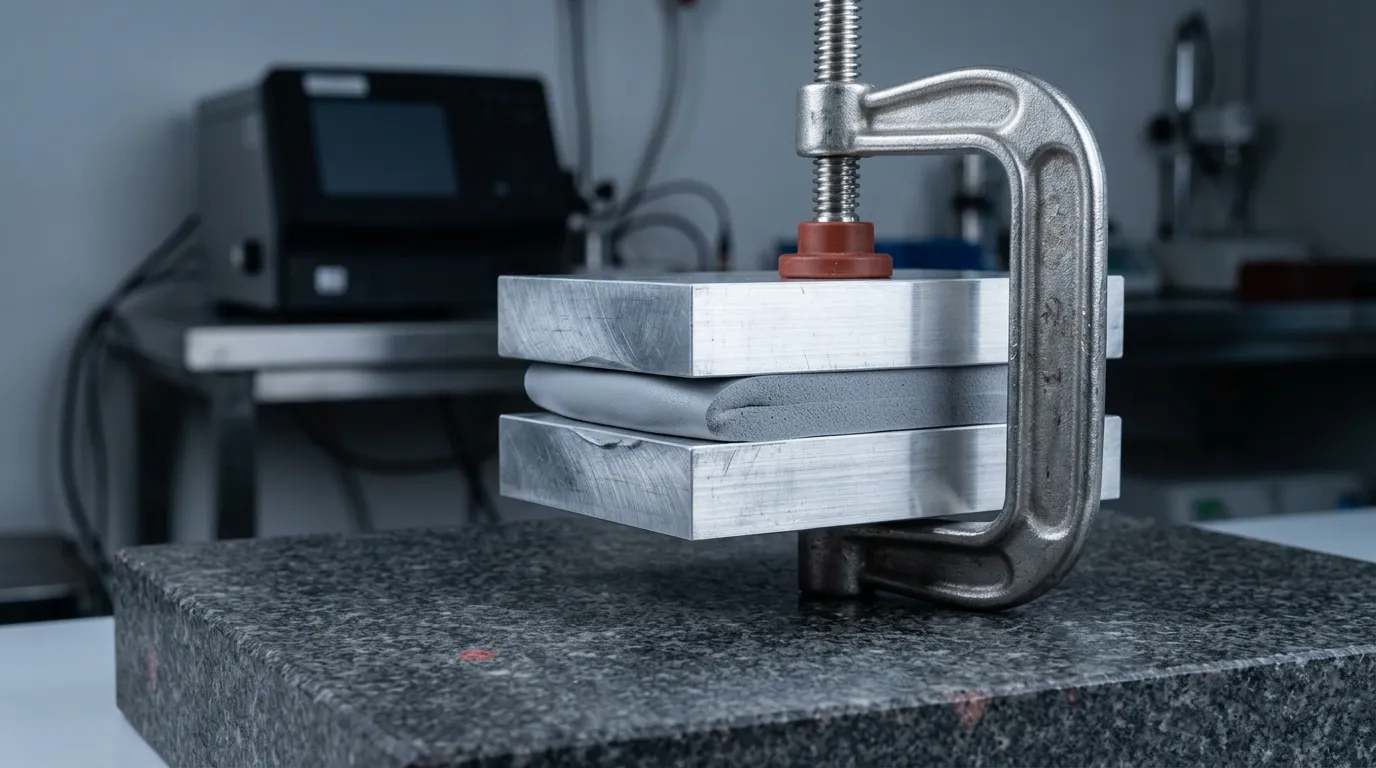
Step seven is the one that cannot be shortened: the same pad, in the real stack-up, under the real clamp load.
None of these checks can be done by a thermal pad cross reference chart, and any chart that implies otherwise is overselling. What a good chart does is cut a field of hundreds of grades down to two or three candidates so that the expensive work happens on the right parts.
When a Competitor's Grade Is the Better Answer
A cross-reference page written by a supplier will tell you the supplier's part fits. Here is the honest list of cases where it does not, or where changing supplier costs more than it saves.
- Your controlling document names the incumbent grade. If a customer drawing, a qualified parts list or a regulatory submission names the incumbent part, substitution is a change-control exercise with its own cost. For low-volume or late-stage programmes it is frequently correct to leave the incumbent in place.
- You need the incumbent's own measured data or simulation support. Some vendors will run the stack-up for you or release measured impedance curves at your bond line. A cross-reference cannot substitute for that, and if your thermal margin is thin you want the measurement, not the mapping.
- Your volume does not carry a new supply chain. Tooling, first-article inspection, a new supplier audit and dual inventory all have a floor cost. Below a certain annual volume the correct answer is to pay the incumbent.
- Your requirement sits outside the mapped portfolio. Our list covers pad, gel, cured gel, phase-change, insulator, graphite and non-silicone families across the conductivity range we publish — but if your design needs a specific carrier, a proprietary thin-film construction or a grade above the top of the range we publish, the honest answer is that we do not have that grade. The chart cannot conjure one.
- You need a different kind of support. An incumbent with a decade of field data on your exact application, or an applications team in your region and time zone, may beat a cheaper equivalent on total cost of ownership.
- Compliance re-qualification outweighs the saving. If the product ships under a safety standard such as IEC 62368-1 for audio/video and ICT equipment (IEC 62368-1) or falls inside the EU RoHS regime (EU RoHS Directive), the replacement part needs its own documentation. Sometimes that is an afternoon; sometimes it is a project.
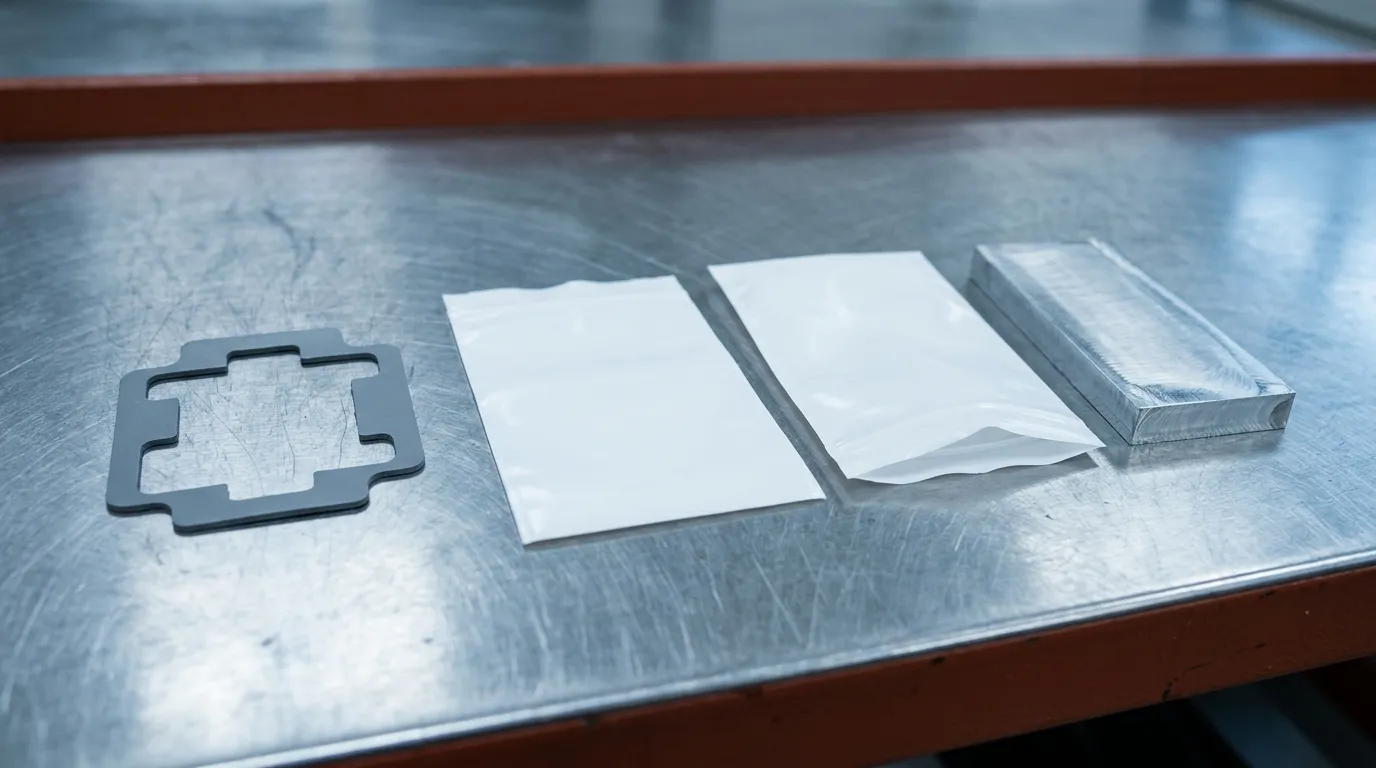
Cross-referenced is not chosen. Candidate parts become a second source only after the qualification step that decides between them.
Where our own cross-reference list falls short. It covers grades we manufacture and no others. Its competitor-side values are datasheet nominals captured as of September 2026, and datasheets change. It does not carry measured impedance at your bond line or your pressure. It does not certify equivalence. Its granularity stops at grade level, so it says nothing about lot-to-lot variation between two production runs. And it is not published as a chart: the mapping comes back with the sample request. There is no public pricing for any of the grades on either side, ours or theirs.
Using the Chart on Your Next Swap
Work it in four moves. Write the incumbent's grade, format and gap; read the matching format block in a cross-reference table; pull two candidates and compare them against the incumbent's datasheet with the seven checks above; then ask for samples of the surviving candidate against your drawing, and test.
If it helps to start from our side of the table, send the incumbent grade and the gap, pressure and temperature limits for the joint, and ZIITEK's application engineers will return the closest grade from our mapping list with a die-cut sample for your stack-up — the thermal pad range lists the series, and the thermal material cross-reference hub is the landing page for the cross-reference and drop-in guides in this cluster.
FAQ
What is a thermal pad cross reference?
A thermal pad cross reference is a mapping table that pairs a grade from one manufacturer with the closest grade in another's portfolio, matched on nominal conductivity, thickness range, hardness and format. It is a shortlist tool built from published datasheets; it is not a certificate that the two parts behave identically in your assembly.
What can I use as a substitute for a thermal pad?
The substitute has to match the job, not the photograph. For a fixed gap under a bolted heat sink, another silicone pad in the same thickness and hardness class is the direct substitute. For uneven stacks and larger gaps, a dispensable gap filler holds a controlled bond line at low pressure. For sealed optical cavities the substitute must also meet the outgassing limit, which usually means a low-volatile or non-silicone grade rather than an ordinary pad.
Are thermal pads as good as thermal paste?
They solve different problems. Paste forms a bond line measured in microns on flat, well-clamped surfaces, and pads fill a defined gap and absorb height differences between components. Swapping one for the other is a change to the thermal path, so it is a redesign rather than a cross-reference.
How do I know two pads are actually equivalent?
You do not know from the table. The table gives you a candidate; the decision comes from comparing both datasheets under the same test conditions and then measuring the candidate in the real assembly at production clamp load. Until that test is done, the correct description of the pair is "cross-referenced", not "equivalent".
Cross-reference values quoted in this article come from ZIITEK's own engineering cross-reference list. Competitor figures are attributed to the vendor page or datasheet cited next to them and reflect what those documents published as of September 2026. Always verify against the current datasheet of both parts before you commit to a substitution; a thermal pad cross reference is a starting point for a form-fit-function check, not a swap you can approve on the table alone.