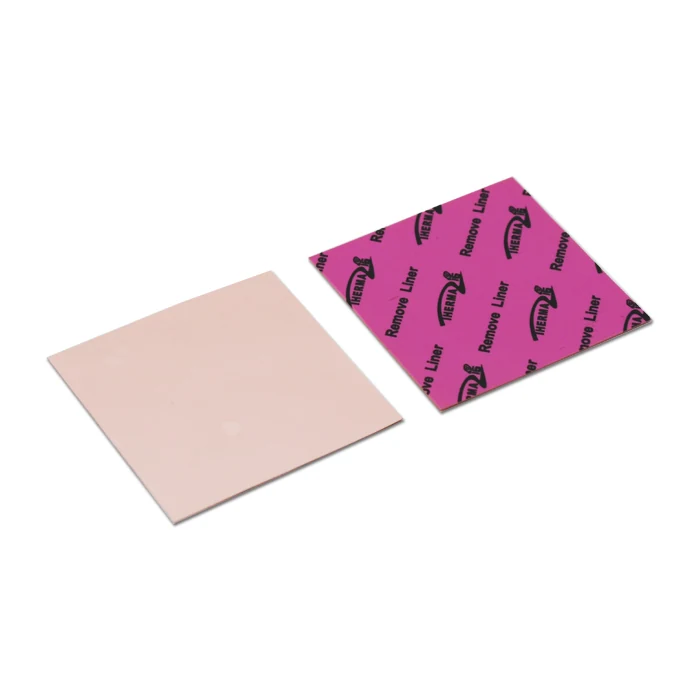
TIC800P Phase Change Material
- Thickness
- 0.126/0.203/0.254 mm
- Density (g/cm³)
- 2.2
- Thickness Tolerance
- ±0.019/0.019/0.030mm
- Thermal Conductivity (W/m·K)
- 0.95
TIC800P — Product overview
TIC800P Series is low melting point thermal interface material. At 50'C, TIC800P series begins to soften and flow, filling the microscopic irregularities of both the thermal solution and the integrated circuit package surface, thereby reducing thermal resistance. TIC800P series is a flexible solid at room temperature and freestanding without reinforcing components that reduce thermal performance. TIC8ooP Series shows no thermal performance degradation after 1,000 hours@130'C,or after 500 cycles, from -25'C to 125'C.The material softens and does not fully change state resulting in minimal migration (pump out)at operating temperatures.
TIC800P — Features
Highly compliant surface combined with high thermal conductivity
High thermal conductivity together with high dielectric strength
Low thermal resistance with high voltage isolation
Resistant to tears and punctures (Kapton reinforced)
Phase change at 50°C softens material to fill bondline irregularities
Suitable for general high-pressure interface applications
Where this grade is used
Typical application targets for this grade include Power conversion equipment, Power semiconductors: TO packages, MOSFETs and IGBTs, Audio and video components, Automotive control units, Motor controllers, General high-pressure interface applications.
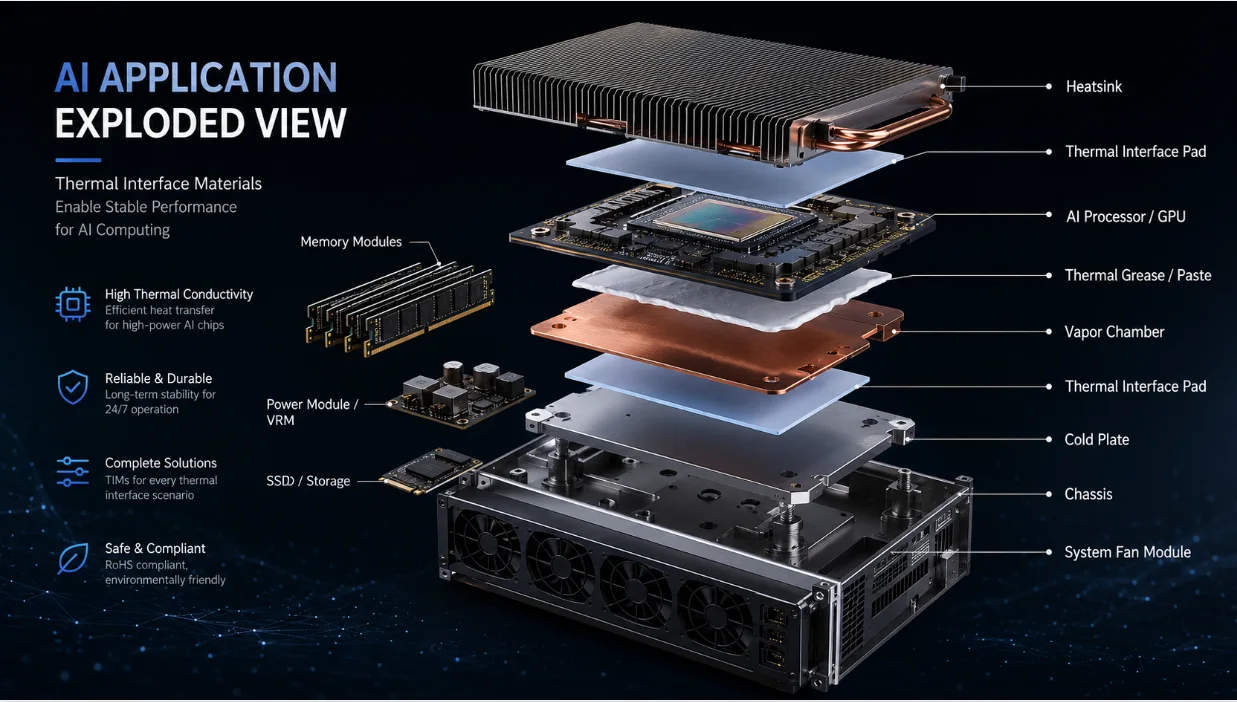
GPU, ASIC, liquid cooling
Data Center & AI Servers
GPU chipset liquid metal · Vertical power delivery pads · DIMM module cooling · Liquid-cooled GPU solutions
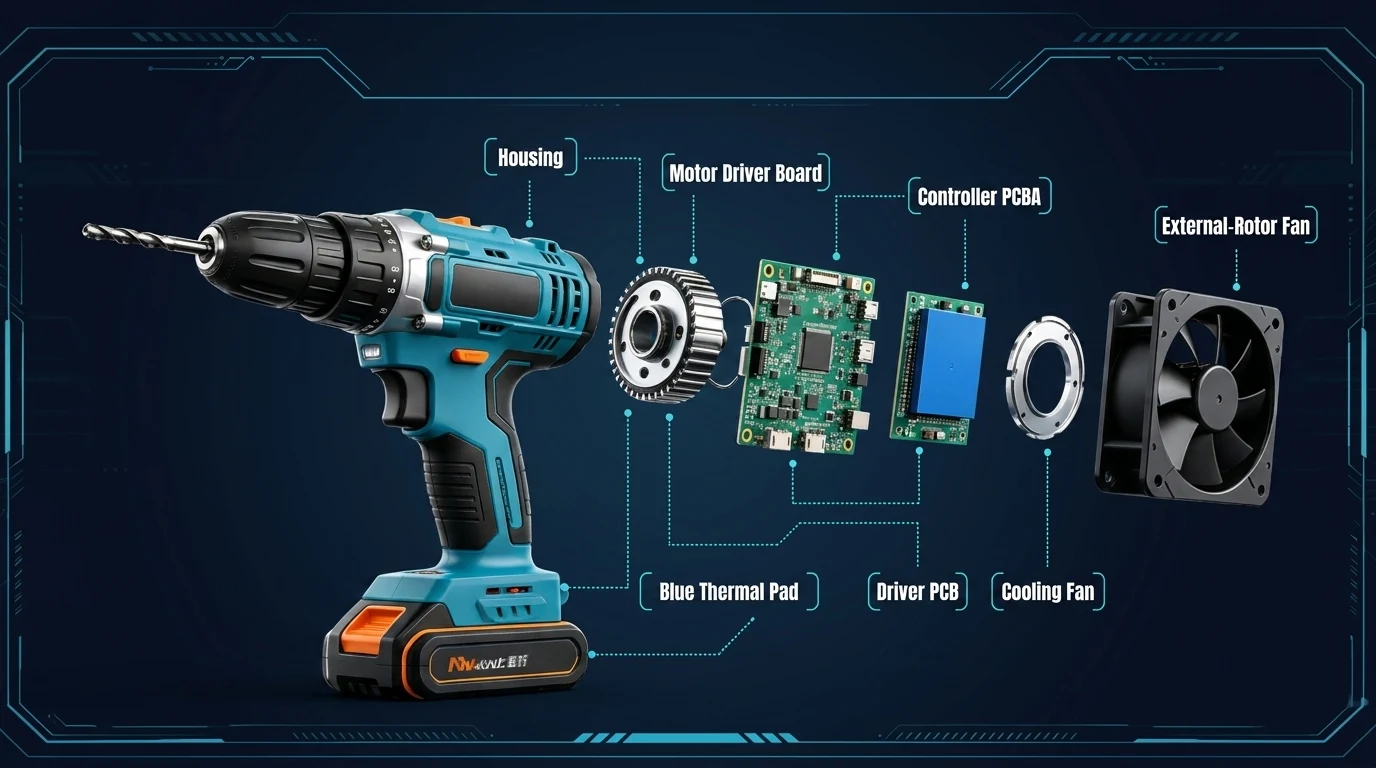
Brushless tool PCBAs, MOSFETs
Power Tools & Control Systems
PCBA-to-heatsink gap fill · MOSFET interfaces · Vibration-ready pads · RoHS / REACH support
TIC800P — datasheet specifications
Values below are transcribed from the official datasheet (PDF: TIC800P-K1-TDS_EN_REV01.3.pdf). Use the linked PDF for sign-off and lot-specific CoA.
Request application engineering support| Parameter | Value (typical / as stated) | Method / note |
|---|---|---|
| Typical Properties | ||
| Product Name | TIC™805P / TIC™808P / TIC™810P | — |
| Color | Pink | Visual |
| Thickness | 0.005" (0.126 mm) / 0.008" (0.203 mm) / 0.010" (0.254 mm) | - |
| Thickness Tolerance | ±0.0008" (±0.019 mm)/±0.0008" (±0.019 mm)/±0.0012" (±0.030 mm) | - |
| Density (g/cc) | 2.2 | Helium Pycnometer |
| Temperature range | -25℃~125℃ | - |
| Electrical | ||
| Phase Change Softening Temperature | 50℃~60℃ | - |
| Thermal Conductivity (W/m·K) | 0.95 | ASTM D5470 |
| Thermal Impedance @50 psi (345KPa) | 0.024℃-in²/W (0.15℃-cm²/W) / 0.053℃-in²/W (0.34℃-cm²/W) / 0.080℃-in²/W (0.52℃-cm²/W) | ASTM D5470 |
* Match values to the PDF revision cited on your purchase order.
Related phase change materials models
TIC800P — common questions
Replacing another vendor's TIM or need a stack review? Send drawings — applications responds quickly.
Talk to an engineerWhat is the nominal thermal conductivity of TIC800P?
The customer workbook lists nominal through-plane conductivity as 0.95W/m·K. What you measure depends on pressure, gap, and fixture — use the technical documentation as the reference.
Can Ziitek supply TIC800P die-cut or in custom thickness?
Yes — send DXF/DWG outlines and stack height. Phase change materials parts are routinely converted at Ziitek; tolerances depend on thickness and geometry.
Where is the documentation for TIC800P?
Download the technical documentation from this page when available. If your revision differs, name the file from your RFQ so applications engineering matches it.
Is TIC800P RoHS-aligned?
Ziitek targets RoHS-oriented formulations across TIM lines. Cite the compliance block for audits and tell us if you need additional regional substance lists.

Your next thermal solution starts here.
From rapid prototyping to full-scale production — our engineers are ready to design a custom thermal solution for your application. Trusted by 7,000+ clients across EV, 5G, and consumer electronics.